


 For all latest news, follow the Daily Sun's Google News channel.


Meeting with prime minister
REHAB places 6-point housing agenda
Daily Sun Report, Dhaka
Published: 23 Jul 2026, 12:00 AM
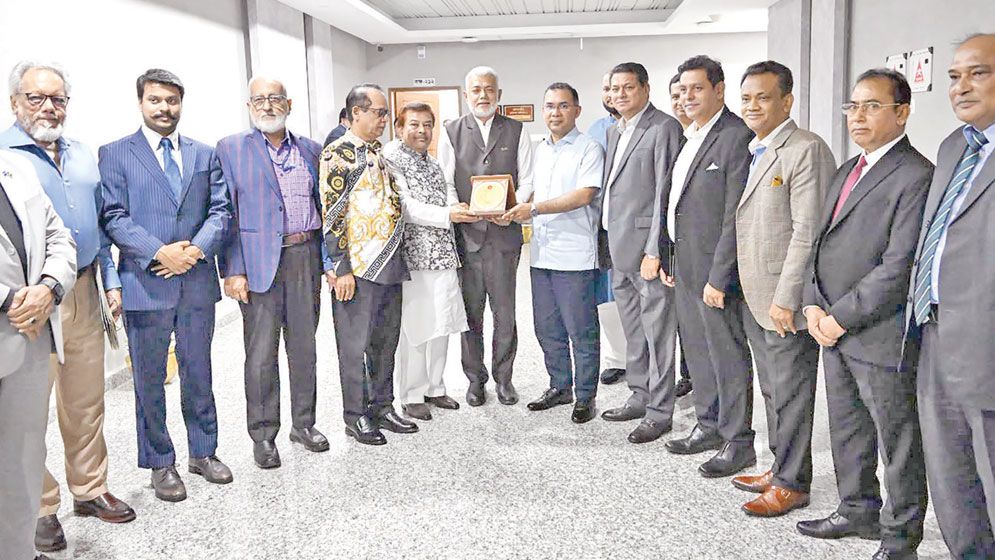
Real Estate and Housing Association of Bangladesh (REHAB) leaders call on Prime Minister Tarique Rahman at his Cabinet Division office in Secretariat on Wednesday. -PMO Photo
Leaders of the Real Estate and Housing Association of Bangladesh (REHAB) called on Prime Minister Tarique Rahman on Wednesday, laying out a six-point proposal designed to lift the country’s housing sector, encourage planned urbanisation and widen access to affordable homes.
REHAB President Dr Ali Afzal led the delegation, which included several senior figures from the real estate industry, to the Prime Minister’s Office at the Cabinet Division of the Bangladesh Secretariat.
Housing and Public Works Minister Zakaria Taher Sumon and MP Mustafizur Rahman Bhuiyan Dipu were also present, along with other senior leaders.
Discussions ranged widely over the state of the housing sector, the difficulties of planned urbanisation, practical snags thrown up by the Detailed Area Plan (DAP), and where the real estate industry ought to be headed in the longer term.
Among the delegation’s requests: that registration fees on land, plots and apartments be brought down to more reasonable levels, and that housing-related government services be fully digitalised. REHAB also pressed for a modest increase in the Floor Area Ratio (FAR), arguing that vertical urbanisation makes far better use of Dhaka’s limited land.
Dr Afzal told the prime minister that REHAB had spent more than 35 years working as a development partner in support of planned urbanisation and sustainable housing.
The sector, he said, employs close to five million people and accounts for roughly 15% of Bangladesh’s GDP, while more than 300 linked industries – cement, steel, bricks, ceramics, tiles, glass, paint, electrical goods, sanitaryware, furniture and transport among them – depend on it.
The six proposals
REHAB’s proposals covered: a national land zoning policy; a PPP-based affordable housing programme for low- and lower-middle-income groups; long-term, single-digit-interest housing loans for the middle class; rationalisation of registration costs, VAT and the tax structure; withdrawal of the 15% capital gains tax on landowners; and full digitalisation of the planning approval process.
A national land zoning policy
REHAB urged the government to draw up a comprehensive National Land Zoning Policy to guide a more planned Bangladesh. With population growth, urbanisation and housing demand projected out to 2100, the association wants land scientifically classified — agricultural, forest, waterbody, residential, commercial, industrial and protected — with distinct rules governing each category.
Such a policy, it argued, would curb unplanned land use, safeguard agricultural land, support balanced industrialisation and housing development, and leave a more sustainable, liveable Bangladesh for future generations. REHAB also called for the existing DAP and building regulations to be reviewed and updated so they better support planned vertical development.
Affordable housing and middle-class loans
The association proposed a PPP-based housing programme to deliver affordable apartments for low- and lower-middle-income citizens, pairing government land and policy support with private-sector investment and expertise to widen access to safe, decent housing for poorer families.
For middle-income households, REHAB asked for a dedicated long-term housing loan scheme carrying single-digit interest rates. Affordable mortgage financing of the kind available in many developed countries, the association said, would let millions of families own their homes while giving the sector itself a boost.
Registration costs, VAT and tax
REHAB pointed out that property registration costs in Bangladesh rank among the highest in Asia, and proposed bringing them down to around 5% -- in line with Malaysia, China, Thailand and Hong Kong.
A more realistic tax structure, it argued, would encourage buyers to register transactions at their true value, cut down on undisclosed income, and ultimately raise government revenue.
Taxation is essential to national development, the association said, but the system needs to be practical, investment-friendly, fair, hassle-free and fully digital.
REHAB also asked that the recently imposed 15% capital gains tax on landowners involved in apartment development projects be withdrawn, saying it burdens landowners financially before they have received any actual benefit – pushing up project costs and, in turn, apartment prices for buyers.
Digitalising planning approval
REHAB called for building plan approvals, land registration and apartment registration to be fully digitalised, cutting out unnecessary delays, bureaucratic tangles and unwanted interference.
A fully digital system, the association said, would make public services faster, more transparent, more accountable and less of a hassle – accelerating growth across the sector.
Dr Afzal told the Prime Minister that REHAB had always worked as a responsible partner in the government’s development agenda and remained committed to that role, adding that he hoped the proposed reforms would strengthen the housing sector further and bring home ownership within easier reach of middle-income families.
Government pledges a corruption-free environment
The Prime Minister, for his part, described the housing industry as one of the key drivers of the national economy, one whose continued growth matters a great deal to Bangladesh’s overall development.
The government, he said, is working to build a transparent, accountable and investment-friendly environment in which the housing sector can grow in a planned, sustainable and corruption-free way.
He noted that several reform initiatives were already under way to prevent irregularities in the sector, with further measures being prepared to strengthen governance and transparency still more.
Urban development, he stressed, should not be concentrated in Dhaka alone – other regions of the country need balanced, well-planned development too – while at the same time, agricultural land must be protected as development proceeds.
He also made clear that he did not believe RAJUK, or the government itself, should be directly engaged in real estate development, suggesting instead that PPP-based housing programmes were better placed to deliver affordable housing for ordinary citizens.
Delegation
The REHAB delegation also included Vice President-2 Abu Khalid Md. Barkatullah; Managing Director of Eastern Housing Limited Md Aminul Karim Siddique; Additional Managing Director of United Group Nizamuddin Hasan Rashid; United Group Manager Mushfiqul Alam Khandakar; Chairman of Rupayan Group Liaquat Ali Khan Mukul; Co-Chairman of Rupayan Group Mahir Ali Khan Ratul; Executive Director of Amin Mohammad Group Abul Kalam Md Rezaul Karim; Chairman of Century Group Maj Gen (retd) Nasir Mazumdar; Director of US-Bangla Assets Limited Brig Gen (retd) Md. Jalal Ghani Khan; and Managing Director of Swadesh Properties Limited Dr MA Quayum.