


 For all latest news, follow the Daily Sun's Google News channel.


Union Travels had purchased air tickets worth Tk25 lakh from Flight Expert, one of the oldest online travel agencies in the country, on behalf of its clients before it absconded with the money last year. Since then, Union Travels has been facing a severe liquidity crisis and has been forced into bank debt.
"I am the second generation in this business and am struggling for the first time to keep my operation running due to the liquidity crisis caused by Flight Expert's absconding. Our company is in bank debt for the first time," Mohammed Bin Mostafa, director of Union Travels Ltd, told the Daily Sun.
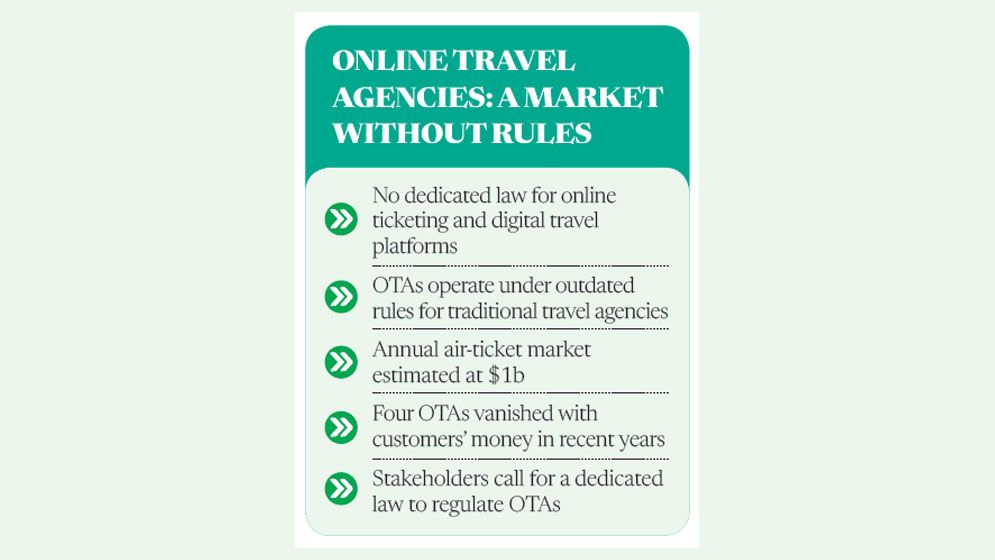
Over the past few years, four online travel agencies, including Flight Expert, have disappeared with customers' money due to the lack of a regulatory framework, triggering a severe financial crisis across the sector and forcing many offline travel agencies to shut down after losing substantial sums.
An online travel agency (OTA) is a digital platform that sells travel services such as airline tickets and hotel bookings. In the business-to-business (B2B) model, OTAs supply tickets to smaller travel agencies, while in the business-to-customer (B2C) model, they sell directly to individual customers through websites or mobile apps.
Flight Expert launched operations in 2017. The company disappeared in August 2025, about seven years after entering the market.
Two other OTAs – Fly Far International, which began operations in 2017, and Travel Business Portal, which launched operations in 2014 – also shut down and allegedly fled with customers' money later that same year.
Industry stakeholders said the three online travel agencies disappeared after collecting more than Tk100 crore from over 300 travel agencies, in addition to an unknown number of individual passengers. Several individuals and offline travel agencies have filed multiple cases against these OTAs.
Earlier, in 2021, 24tkt.com allegedly swindled around Tk50 crore from customers and small travel agencies. The company's office was later found closed, while several of its directors were arrested by the CID.
A tale of greed and unsustainable business model
The Criminal Investigation Department (CID) said that its investigation found that Flight Expert attracted customers and sub-agents by offering unusually high discounts and collected large advance payments for air tickets. However, in many cases, it failed to provide the promised tickets. The company's managing director, Salman Bin Rashid Shah Sayem, reportedly left Bangladesh on 1 August 2025.
After the investigation, CID filed a money laundering case involving nearly Tk35 crore against Flight Expert with Motijheel Police Station in Dhaka on 11 July this year.
Stakeholders said that online travel agencies actually scammed people by offering unusually large discounts and thereby destabilised the market.
"Airlines offer a fixed 7% commission on ticket sales. Sometimes they provide additional incentives, but those are limited. We sell tickets based on that commission. However, some online travel agencies offer huge discounts which we cannot match, so our customers move to them. To retain our customers, we are forced to buy tickets from those OTAs at discounted prices,” said Mohammed Bin Mostafa.
“The OTAs incur losses due to the exorbitant discounts they offer to capture the market and later disappear with customers' money. That is why the government should introduce regulations for OTAs and clearly define how they can operate their business," he added.
No regulation for OTAs
Online travel agency (OTA) business began emerging in Bangladesh around 2013, but the country still lacks a dedicated regulatory framework for this business. OTAs have been operating under the Bangladesh Travel Agencies (Registration and Control) Act, 2013, and the Travel Agency (Registration and Control) Rules, 2022, the same legal framework that governs traditional or offline travel agencies.
However, those laws do not specifically define or regulate OTAs. They contain no separate provisions governing online ticketing platforms, digital payment handling, customer fund protection, or B2B wholesale ticket sales. As a result, OTAs operate under rules originally designed for conventional brick-and-mortar travel agencies, creating regulatory gaps as the online travel market expanded.
The Association of Travel Agents of Bangladesh (ATAB), which represents around 4,000 travel agencies in Bangladesh, estimates the monthly air-ticket market at Tk1,200-1,300 crore, with annual sales exceeding $1 billion.
As industry insiders, including offline travel agencies and ATAB, have repeatedly demanded the introduction of a regulatory framework for online travel agencies, the previous interim government introduced the Travel Agency (Registration and Control) Ordinance, 2026.
The proposed law sought to improve consumer protection by introducing stricter licensing requirements, requiring OTAs to maintain a Tk1 crore bank guarantee, mandating disclosure of the ultimate beneficial owners (UBOs), and imposing tougher penalties for violations. However, it also contained a controversial provision that would have prohibited OTAs from engaging in B2B airline ticket sales.
The ordinance was not enacted by the BNP-led government after it assumed office. As a result, the OTA sector continues to operate under the existing legal framework, which is inadequate to regulate online travel agencies.
Afsia Jannat Saleh, secretary general of the ATAB, said the draft ordinance included several provisions that were not business-friendly, particularly the proposed ban on B2B operations, which is a globally accepted model.
She said the ordinance had been prepared without adequate consultation with industry stakeholders, but a separate legal framework for OTAs is still essential.
She also warned that unless the government introduces a dedicated law to regulate OTAs, similar incidents could recur in the future.