


 For all latest news, follow the Daily Sun's Google News channel.


Diarrhoea cases rise in flood-hit Ctg, 1 dies
Daily Sun Report, Chattogram
Published: 18 Jul 2026, 12:00 AM
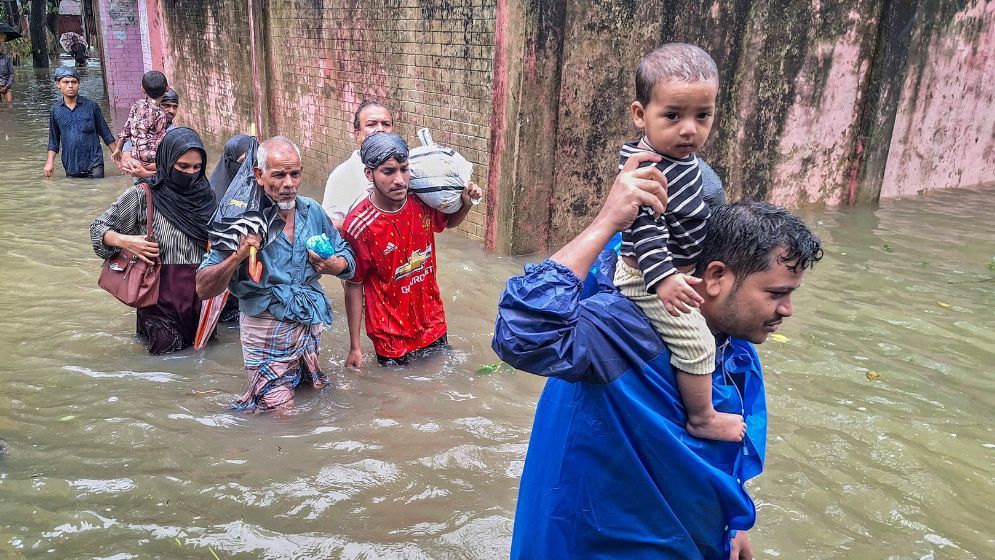
Residents wade through floodwaters after heavy monsoon rains in Chattogram on 12 July 2026. Photo: AFP
Waterborne diseases are spreading in flood-affected areas of Chattogram as floodwaters recede, raising fears of a post-flood health crisis. At least one person has died from diarrhoea, while more than 500 others have been admitted to different hospitals.
The deceased was identified as Abdul Matin, 75, a resident of the Bayezid Bostami area in Chattogram city. He was taken to Marine City Medical College and Hospital on Friday afternoon, where doctors declared him dead.
Dr Ratul Haldar of Marine City Medical College Hospital said the elderly man had already passed away before reaching the hospital.
“We have also admitted seven to eight diarrhoea patients from the same area. Contaminated water could be the reason behind the outbreak,” he said.
Local resident Abdullah Al Harun alleged that the water supplied to a residential colony in the area comes from an unhygienic tank.
“The water source is dirty, and many residents have fallen ill. More than 40 people have been admitted to different hospitals so far,” he said.
Health officials say the number of patients suffering from diarrhoea, dysentery and snakebites is increasing in flood-affected upazilas.
According to Satkania Upazila Health Complex, more than 300 patients visited its outpatient department in the last 48 hours, most of them suffering from diarrhoea.
Banshkhali Upazila Health Complex reported that over 30% of its current patients are experiencing illnesses related to diarrhoea.
Large parts of Chattogram, Cox’s Bazar and the three hill districts remained underwater for nearly 12 days after heavy rainfall and upstream hill runoff began on 4 July. The floods claimed 51 lives, most of them due to drowning.
Public health experts have warned that the shortage of safe drinking water could trigger a second disaster if urgent measures are not taken.
Dr Amit Dey, health officer of Satkania Upazila Health Complex, said that, “The risk of cholera and skin diseases may increase further as the clean water crisis deepens.”
Bandarban Civil Surgeon Dr Md Shaheen Hossain Chowdhury said hospitals across the district have seen a growing number of patients with diarrhoea and skin diseases since the floods.
According to the Department of Public Health Engineering (DPHE), 15 community clinics across the division were damaged during the floods, while around 20,000 shallow tube wells were contaminated. The department has distributed about 4 lakh water purification tablets in affected areas.
Dr Fazle Rabbi, director of health for Chattogram Division, said more than 50,000 additional water purification tablets have been distributed and that hospitals have sufficient stocks of oral saline and medicines.
Meanwhile, snakebite cases have emerged as another major concern in flood-hit districts. Health authorities have so far reported 126 snakebite incidents across five districts, including 112 in Chattogram and 14 in Cox’s Bazar.
District health officials said antivenom supplies have been stocked at upazila hospitals and emergency treatment preparations have been strengthened.
Agriculture and livestock officials noted that floods often force snakes such as cobras, monocled cobras, kraits, rat snakes and several species of water snakes into human settlements. However, not all of these species are venomous.
Civil Surgeon Dr Jahangir Alam said special instructions have been issued to upazila health complexes to deal with post-flood diseases, including snakebites.
“More than 1,100 vials of antivenom are currently available at health facilities across the affected upazilas,” he added.