


 For all latest news, follow the Daily Sun's Google News channel.


‘Climate change robs Bangladeshis of up to 84 hours of sleep yearly’
Daily Sun Report, Dhaka
Published: 17 Jul 2026, 12:00 AM
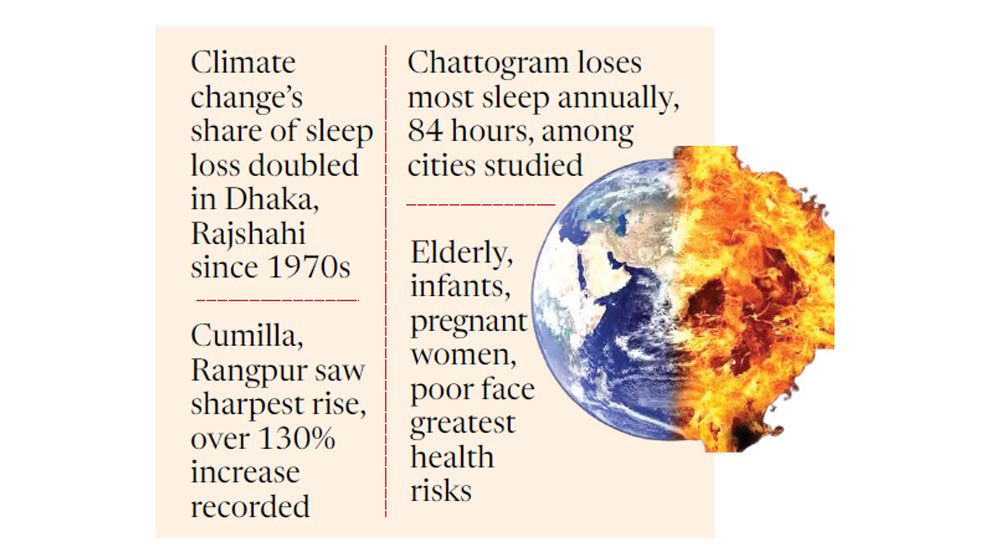
Rising night-time temperatures driven by climate change are robbing Bangladeshis of up to 84 hours of sleep a year, with the problem having worsened dramatically in every major city since the early 1970s, a new global analysis has found.
The study, Climate Change is Costing People Sleep, published by Climate Central, shows that climate change’s contribution to temperature-related sleep loss has at least doubled in every Bangladeshi city examined over the past five decades, deepening concerns about its toll on health, productivity and wellbeing.
Residents of Bangladesh’s major cities now lose between 72 and 84 hours of sleep annually because of hot nights, the analysis found.
In Dhaka and Rajshahi, climate change’s share of yearly sleep loss climbed from 3% in 1970-1975 to 6% in 2020-2025 – a 100% rise.
The increase was steeper still in Cumilla and Rangpur, where the figure rose from 3% to 7%, an increase of more than 130%.
Chattogram recorded the heaviest toll, with residents losing 84 hours of sleep a year during 2020-2025, followed by Khulna on 79 hours.
Dhaka and Rajshahi each lost 76 hours, Gazipur and Cumilla 74 hours, and Rangpur 72 hours.
Within the capital, Mirpur and Pallabi residents lost roughly 77 hours annually, while those in Mohammadpur lost about 73 hours.
The pattern mirrors a wider global trend. Across 1,338 major cities worldwide, annual temperature-related sleep loss rose by 9.5%, from 45.6 hours per person in 1970-1975 to 49.9 hours in 2020-2025.
Sleep loss directly attributable to climate change tripled over the same period, from 1.7 to 5.1 hours per person, pushing its share of global sleep loss from 4.1% to 11.2%.
Billed as the first global study to quantify climate-driven sleep loss, the report found the phenomenon had at least doubled in 1,335 of the 1,338 cities studied.
It warns that hotter nights stop the body recovering from daytime heat, raising the risk of cardiovascular disease, stroke, mental health disorders and lost productivity.
Bangladesh is especially exposed, the report says, owing to rapid urbanisation, the urban heat island effect and limited access to cooling, leaving millions vulnerable to increasingly warm nights.
Older adults, infants, pregnant women and low-income communities face the greatest risk, as poor access to cooling leaves them more susceptible to disrupted sleep and its consequences.
“Adults need seven to nine hours of sleep each night for optimal health. As climate change drives more frequent and intense hot nights, sleep disruption should be recognised as a growing public health concern,” said Dr Courtney Howard, an emergency physician, chair of the Global Climate and Health Alliance, and president-elect of the Canadian Medical Association.
“These findings reinforce the need for adaptation measures that address inequities, alongside urgent reductions in greenhouse gas emissions to protect both health and prosperity,” she added.
The report urges Bangladesh to factor night-time heat risks into public health and climate planning, expand cooling access for vulnerable groups, redesign cities to cut urban heat, strengthen heat-health action plans, and speed up the shift away from fossil fuels – steps it says are vital to safeguarding not just health but productivity and economic resilience.