



 For all latest news, follow the Daily Sun's Google News channel.


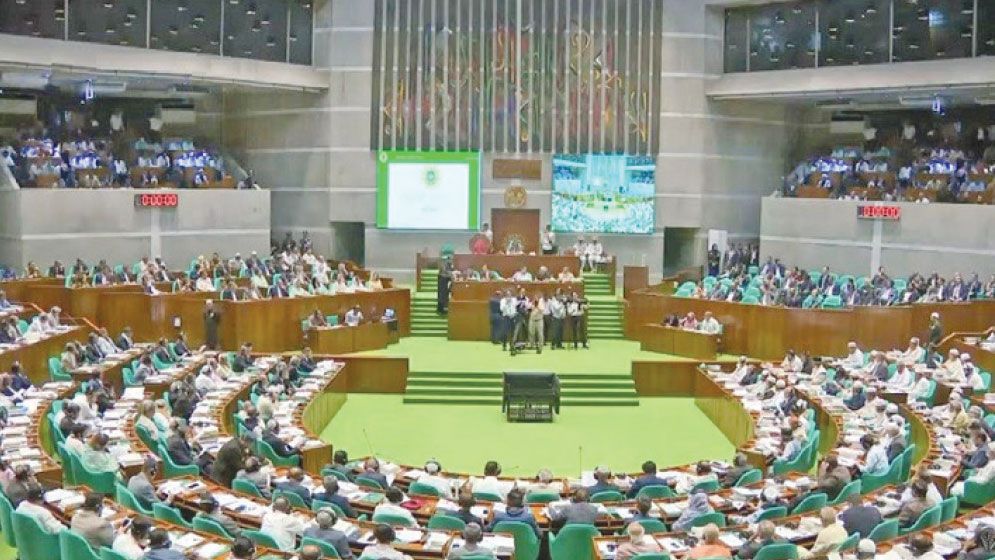
File Photo: Collected
Bangladesh's parliament passed the Finance Bill 2026 on 29 June with several amendments and gave the budget final approval by voice vote on Tuesday, June 30. The Tk 9.38 lakh crore (about $76.3 billion) budget, the country's largest ever, placed before parliament on 11 June for the fiscal year starting 1 July, is the first budget of an elected BNP government in two decades.
The biggest amendment raises the tax-free income ceiling from Tk 3.75 lakh to Tk 4 lakh for FY2026-27 and FY2027-28, rising to Tk 4.5 lakh and then Tk 5 lakh in later years, part of a five-year plan Finance Minister Amir Khosru Mahmud Chowdhury announced for low-income taxpayers. The government also kept its much-debated decision to legalise undisclosed money in real estate without question and dropped the proposed Tax Identification Number (TIN) requirement for opening bank accounts.
Other changes favour consumers and certain businesses: capital gains tax on gold sales falls from 15% to 5%; tax on apartments and other developer benefits to landowners stays but is now payable over three years; and individual dividend income gets a flat 15% tax, replacing rates up to 30%, easing, experts say, the tax burden and boosting share investment.
A separate plan to scrap the 20% tax on dividends earned by companies, which would have pushed the rate as high as 27.5%, was withdrawn, restoring the 20% rate.
Companies can now meet the public-company tax-rate condition via a Repeat Public Offering (RPO), alongside IPOs and direct listings, helping those that earlier could not offload the required 10% of shares. A 2.5-point discount for paying entirely by bank transfer, once limited to select listed firms, now extends to others, excluding banks, insurers and financial institutions; a Business Identification Number (BIN) is now mandatory for transactions from industrial loans to vehicle registration.
The rest of the budget is unchanged: revenue is targeted at Tk 6,95,000 crore, 23% above this year's original goal, with the National Board of Revenue collecting Tk 6,04,000 crore of it; the deficit is Tk 2,43,000 crore, 3.6% of GDP, with bank borrowing capped at Tk 1,12,000 crore, said to protect private lending space; and growth assumptions stand at 6.5% GDP, 7.5% inflation and 9.4% private credit. Reaching the full revenue target needs 42% growth over this year's revised collection – a level never achieved before; the 2011 record was just over 27%.
Centre for Policy Dialogue (CPD) data underline that gap: revenue collected between July and April was only about Tk 3,270 crore against an annual target of Tk 5,880 crore; private credit growth, assumed at 9.4%, stood at just 4.75% through April; and moving-average inflation for July-May was 8.63%, above the 7.5% target.
One notable feature of this budget cycle is a franker look at the banking sector: Bangladesh Bank data show defaulted loans at Tk 557,217 crore (30.60% of all loans) by end-2025, rising to Tk 588,704 crore (32.26%) by this March. The budget sets aside Tk 36,706 crore for bank restructuring, on top of nearly Tk 40,000 crore already spent this year recapitalising weak institutions.
The finance minister also announced the removal of the controversial Section 18(A) of the Bank Resolution Act, a clause inserted just before the BNP government turned the interim administration's Bank Resolution Ordinance into law on April 10, opening a path for former owners to return to the five merged banks. Opposition parties had argued it was designed to hand bank control back to controversial businessmen, including the S Alam Group.
The minister said yesterday that scrapping the clause followed stakeholder feedback and that the government's message was clear: those who looted public wealth will not be spared, while depositors' money is protected. Individual depositors of Sommilito Islami Bank — formed from the five merged banks — can withdraw up to Tk 2 lakh each from current and savings accounts, with the rest returned in phases.
Health spending has topped 1% of GDP for the first time, and education spending has risen from 1.41% to 1.79% — both gains, though still below international benchmarks. The Family Card programme, paying about 41 lakh low-income families Tk 2,500 monthly, anchors a social safety net budget now at 2.11% of GDP; tax on agriculture and essentials has eased, with new incentives for domestic edible oil and baby food production.
Reaction has been mixed. The Metropolitan Chamber of Commerce and Industry welcomed the reforms but warned total investment has slipped to 27.93% of GDP, a ten-year low; CPD found Annual Development Programme implementation between July and January at just 20.3%, the lowest in fifteen years; Jamaat-e-Islami branded the budget "anti-people" and "a budget of looting", staging protest rallies; and the NCP called it "ambitious but fiscally unrealistic".
Before passage, the government made real concessions to public and business pressure – on the tax-free threshold, the TIN rule and other measures. Yet its core assumptions on revenue growth, credit expansion and inflation still diverge from figures its own statistics agency and independent economists cited just months before the budget. Whether that gap between announcement and implementation narrows should become clear in the months ahead.
The writer is a student at the Department of Mass Communication and Journalism, University of Dhaka