


 For all latest news, follow the Daily Sun's Google News channel.


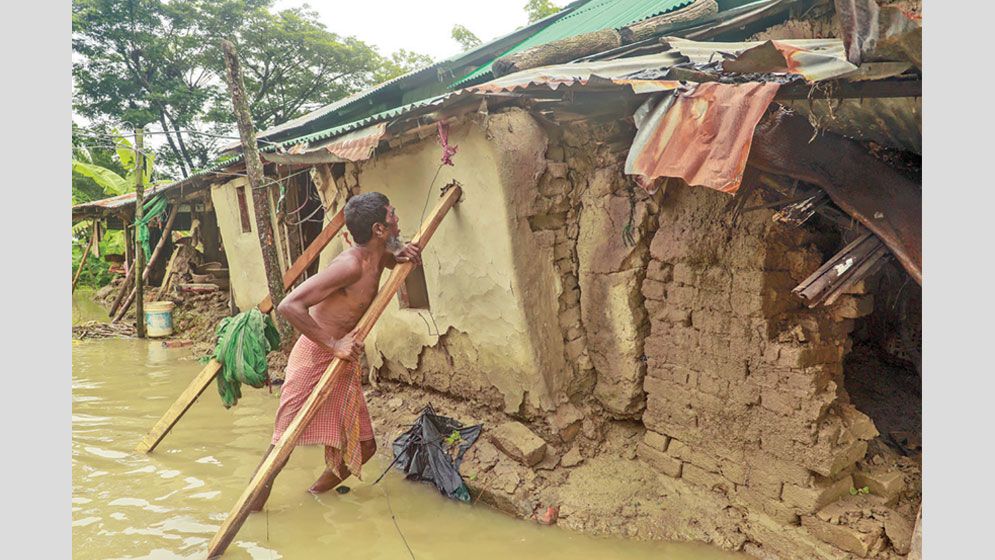
Photo: Rabin Chowdhury
The catastrophic flood situation across southeastern districts shows tentative signs of improvement as river levels begin to recede after days of relentless downpour. However, authorities have issued a stark warning that the current respite may be short-lived.
Meteorological forecasts predict heavy to very heavy rainfall over the next two days, which could trigger fresh, dangerous flooding across the northeast and northern regions of the country.
The human cost of this natural disaster continues to climb at an alarming rate.
In the Chattogram region alone, the death toll has risen to 43 following the tragic drowning of two more people, including a child, in 24 hours until 9pm on Saturday.
Thousands of families remain marooned in their homes, facing acute shortages of food, safe drinking water, and mounting health risks as their localities remain submerged under rising currents.
Across the affected districts, the suffering is palpable and widespread.
In Chattogram, residents in submerged upazilas like Satkania, Lohagara, and Banshkhali are grappling with the total loss of their homes and essential infrastructure. 
Meanwhile, in the northeast, despite water levels beginning to dip slightly in parts of Moulvivazar and Habiganj, more than 50,000 people remain stranded.
Many of these families have alleged that official relief efforts have struggled to penetrate the most isolated communities, leaving them to fend for themselves in treacherous conditions.
The forecast: A narrow window of improvement
The Flood Forecasting and Warning Centre (FFWC) reports that while the Sangu and Matamuhuri rivers are finally falling – offering a sliver of relief to the residents of Bandarban, Chattogram, and Cox's Bazar – the national situation remains volatile.
As of Saturday, six monitoring stations across four rivers in six districts were still recording water levels above the danger mark.
These include the Sangu River at Bandarban and Dohazari, the Khowai River at Ballah, the Manu River at Moulvivazar, and the Kushiyara River at the Markuli and Fenchuganj points.
The FFWC has warned that the window for recovery is closing.
Their latest models forecast heavy to very heavy rainfall across the Chattogram Division and the adjoining Indian state of Tripura over the next 24 hours.
This is expected to be followed by similar conditions in the Sylhet, Rangpur, and Mymensingh divisions, as well as the neighbouring Indian states of Meghalaya, Assam, and West Bengal, during the subsequent 24 to 48 hours.
The agency noted that while a low-pressure area over northern central Uttar Pradesh has weakened and is likely to dissipate, the structural impact on river systems remains severe.
The Muhuri, Feni, Selonia, and Halda rivers are expected to rise above danger levels at several points over the next two days.
This poses a renewed threat of short-duration flooding in low-lying areas of Feni, Chattogram, and Khagrachhari, with potential inundation spreading to parts of Lakshmipur and Noakhali.
In the northern belt, the outlook is equally concerning.
The Teesta, Dharla, and Dudhkumar rivers are expected to rise again, potentially crossing danger levels in Nilphamari, Lalmonirhat, Rangpur, Kurigram, and Gaibandha.
Widespread destruction in Chattogram region
In the Chattogram region, the trail of destruction from what many residents describe as an “unprecedented” flood event is only now becoming clear.
Road communication, including the critical Rangamati-Bandarban route, remains severed due to submerged highways and the collapse of key infrastructure, such as the Shilok Bridge in Rangunia upazila, which buckled under the force of strong currents on Saturday morning.
The economic impact is devastating for local communities.
The district fisheries department estimates that a total of 9,933 waterbodies and 320 enclosures have been affected across 15 upazilas, causing damages estimated at Tk109 crore.
Simultaneously, officials at the Directorate of Agricultural Extension (DAE) in Chattogram report that over 20,047 hectares of cropland – including Aush paddy, Aman seedbeds, summer vegetables, and betel leaf plantations – have been damaged or completely submerged across Chattogram and Cox’s Bazar since 6 July.
Despite the intensity of the crisis, the administration is struggling to reach every affected family.
Chattogram District Relief and Rehabilitation Officer (DRRO) Masudur Rahman confirmed that floods have impacted over 754,000 people from more than 188,000 families across 176 unions and wards.
When asked about local complaints regarding the scarcity of aid, Rahman noted that distribution is often hindered by disrupted communication lines and the difficulty of sourcing dry food in local markets during a disaster.
“We have already distributed 300 tonnes of rice and Tk43 lakh along with dry and cooked foods,” he stated, emphasizing that efforts to reach the most remote areas are ongoing.
Relief efforts and humanitarian challenges
In the wake of the disaster, various political and volunteer organisations have stepped in to support government efforts.
The Jatiyatabadi Chhatra Dal (JCD), led by its General Secretary Nasir Uddin Nasir, has been active in Chattogram's Banshkhali upazila.
On Saturday, they distributed relief packages containing rice, lentils, potatoes, and drinking water to 500 families.
During his visit, Nasir also met with the family of two-year-old Ismail Hossain, who tragically drowned in the floods, providing financial assistance to the bereaved parents.
However, the reality on the ground remains harsh.
At a shelter in Purba Ilsha Government Primary School, survivors like Sakhina Begum, 40, spoke of the desperation facing those who have lost everything.
“None heard from us. We are in crisis of drinking water. We have to go to several kilometres just to buy water,” she lamented.
Government officials, including State Minister for Disaster Management and Relief Engineer M Iqbal Hossain, have urged the public to move to designated shelters.
Visiting flood-hit areas in Fatikchhari and Chattogram, the State Minister insisted that the government is operating with “utmost sincerity.”
He announced that 500 metric tonnes of rice have been allocated to the Chattogram district alone, with further allocations promised if conditions worsen.
Addressing the long-term issues contributing to the disaster, State Minister for Energy and Mineral Resources Aninda Islam Amit held a view-exchange meeting in the Chattogram Circuit House.
He did not mince words regarding the cause of the severe waterlogging, attributing it to "long-term mismanagement, encroachment of canals and drains, and obstruction of water flow."
He added, "In the past, influential people committed irregularities without paying attention to the law. The current government will work to permanently resolve these problems."
Emergency healthcare directives
Recognizing the secondary health crisis that often follows floods, the Directorate General of Health Services (DGHS) has issued emergency instructions.
In a virtual meeting chaired by Director General Prof Dr Pravath Chandra Biswas, the DGHS ordered local health authorities to form immediate medical teams and maintain robust stocks of emergency medicines, oral rehydration salts (ORS), saline, water purification tablets, and anti-snake venom.
A key priority is the protection of the most vulnerable populations, specifically pregnant women and children.
The DGHS has instructed local health officials to coordinate with the Family Planning Department to ensure that expectant mothers are transferred to safer, hospital-based environments whenever necessary.
Furthermore, authorities have been ordered to ensure the presence of doctors, nurses, and midwives in all affected areas, with the cancellation of all staff leave where necessary.
Academic disruption, future exams
The flooding has also forced significant changes to the academic calendar.
Education and Primary and Mass Education Minister Dr ANM Ehsanul Hoque Milon announced on Saturday that Higher Secondary Certificate (HSC) and equivalent examinations postponed due to the natural disasters will be held at a later date using alternative sets of question papers.
"Natural disasters or acts of God are beyond anyone's control. Wherever students have been affected by floods, we have suspended the examinations in consultation with the local administration,"
Milon told reporters at an event marking Gono University Day.
He reassured students and parents alike that the alternative sets of question papers were ready. "Once the regular examinations are completed nationwide, we will conduct the postponed exams for students in the flood-affected areas using separate question sets. Therefore, there is no scope for any complication regarding the question papers or the examinations."
Locally, the Bangladesh Inter-Education Board Coordination Committee confirmed that all HSC and equivalent examinations under the Chattogram Education Board scheduled for 13, 15, and 16 July have been postponed.
The revised schedule for these candidates will be announced in due course, while examinations elsewhere in the country will proceed as planned.
Beyond the southeast: The wider picture
While Chattogram remains the epicenter of the tragedy, other parts of the country are not spared. In Khulna, 184mm of rainfall over 51 hours has caused widespread waterlogging, prompting residents to openly question the efficacy of a Tk823-crore drainage improvement project that has failed to prevent the city from becoming submerged.
Similarly, at the Benapole Land Port, the country’s largest land port, continuous rainfall flooded five storage sheds, partially submerging imported goods and creating significant logistical concerns for traders.
In the northeast, despite a 2cm drop in the Surma River over the past 24 hours, the Sunamganj municipality has cancelled all staff leave and activated a control room to monitor the situation. In Habiganj, water from the Khowai River has inundated at least 30 villages in Sadar, Baniachang, and Bahubal upazilas.
As the nation waits for the next phase of the monsoon, the directive from Prime Minister Tarique Rahman remains clear: implement a comprehensive 10-point package to strengthen rescue and rehabilitation efforts.
With the military – specifically members of the Bangladesh Army – operating under the “In Aid To Civil Power” initiative, the focus is now firmly on providing immediate life-saving support to those still marooned.