


 For all latest news, follow the Daily Sun's Google News channel.


15TH AMENDMENT TO CONSTITUTION
Caretaker govt, referendum provisions restored as AD upholds HC ruling
Daily Sun Report, Dhaka
Published: 10 Jul 2026, 12:00 AM
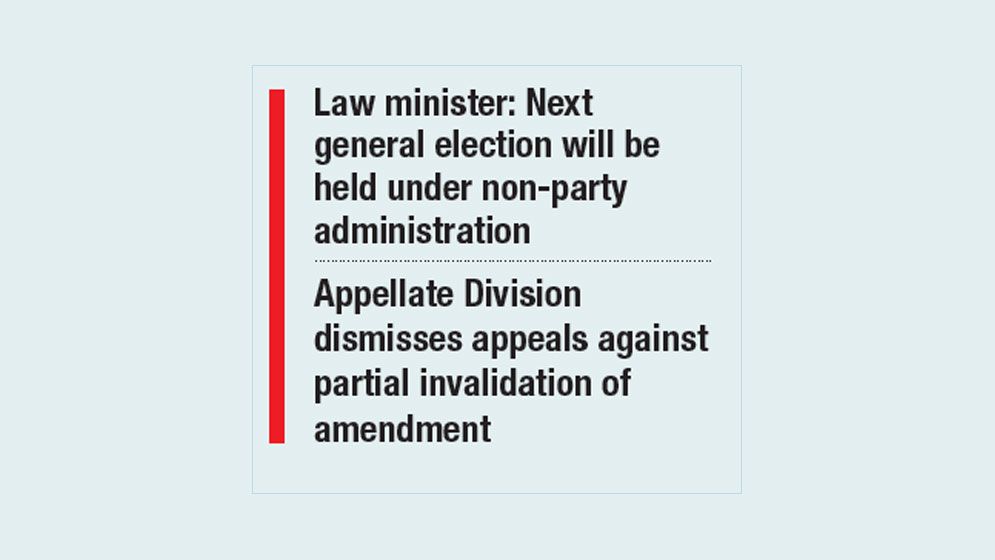
In a landmark constitutional ruling with far-reaching political implications, the Appellate Division (AD) of the Supreme Court on Thursday upheld the High Court’s verdict declaring key provisions of the 15th Amendment to the Constitution illegal, thereby restoring the constitutional basis for a non-party caretaker government to oversee national elections and paving the way for the next parliamentary polls to be held under such a system.
The judgment effectively ends a years-long legal and political dispute over the abolition of the caretaker government system, while reaffirming the principle that parliament cannot use its numerical strength to alter the Constitution’s fundamental structure and core democratic values.
The four-member Appellate Division bench, headed by Chief Justice Zubayer Rahman Chowdhury, dismissed the leave-to-appeal petitions challenging the High Court’s December 2024 judgment, thereby allowing the lower court’s decision to stand.
With the dismissal of the appeals, the High Court’s ruling remains intact, partially invalidating the 15th Amendment and reviving the constitutional provisions relating to an election-time non-party caretaker government and referendums.
The ruling is widely being viewed as bringing to a close the prolonged constitutional and political dispute over the abolition of the caretaker government system introduced through the 15th Amendment in 2011.
The appeals had been filed by Bangladesh Jamaat-e-Islami, several civil society members and other individuals seeking broader relief following the High Court verdict.
Advocate Mohammad Shishir Manir represented Jamaat-e-Islami, while Dr Sharif Bhuiyan appeared for the civil society petitioners.
Barrister Imran A Siddiq represented the Human Rights Support Society and Advocate ASM Shahriar Kabir appeared for another appellant.
Attorney General Barrister Md Ruhul Quddus Kazal, Additional Attorney General Mohammad Arshadur Rouf and Barrister Aneek R Haque represented the state, while Barrister Sara Hossain and Advocate Hamidul Misbah participated as independent interveners.
The judgment drew immediate reactions from leading constitutional experts and lawyers, many describing it as a defining moment for Bangladesh’s constitutional jurisprudence and democratic process.
Law Minister Md Asaduzzaman welcomed the verdict, saying the next parliamentary election would be held under a non-party caretaker government.
“It is also our political commitment,” he told journalists at his ministry office.
He said the detailed procedure for forming the caretaker government and determining its composition would become clearer after the full judgment is examined.
Attorney General Ruhul Quddus Kazal said the 15th Amendment had significantly weakened the constitutional checks and balances essential for a functioning democracy.
“The dismissal of the appeals by the Appellate Division legally validates the necessity of a neutral election mechanism. We are happy with the verdict. It is a victory for people’s voting rights,” he said.
The petitioners also welcomed the ruling.
Advocate Shishir Manir said the High Court had made observations on four major constitutional issues: restoration of the caretaker government system, revival of the constitutional provision for referendums, invalidation of Articles 7A and 7B that sought to shield the Constitution’s basic structure from amendment, and restoration of the High Court’s writ jurisdiction.
“Following the apex court’s decision, the High Court verdict stands, meaning that the caretaker government system has been restored and the other three issues have also been settled,” he said.
He noted that constitutional questions left unresolved by the High Court would now be matters for Parliament to address.
The High Court, however, did not strike down provisions recognising Sheikh Mujibur Rahman as the Father of the Nation, incorporating his 7 March speech into the Constitution through the Fifth Schedule, and several other provisions of the amendment.
The appellants had sought complete annulment of the 15th Amendment. Legal experts, however, observed that wholesale repeal of the amendment could have created significant constitutional complications. They believe the Appellate Division’s decision to preserve the High Court’s balanced approach was both prudent and historically significant.
Dr Sharif Bhuiyan said the petitioners had argued that the apex court should preserve provisions whose removal could create legal uncertainty.
“This verdict will be a milestone for democracy. It ensured that no amendment can undermine the democratic rights of the citizens,” he said.
Dr Badiul Alam Majumder, secretary of Shushashoner Jonno Nagorik (SHUJAN) and one of the petitioners, expressed satisfaction with the ruling while noting that some issues remained unresolved.
“We are happy with this verdict. However, we would have been even happier if the apex court had decided on some other issues of the 15th Amendment instead of rejecting our appeal. We believe that the current vibrant Parliament will settle the remaining demands,” he said.
He added that the petitioners would later decide whether to seek a review of the judgment.
Another petitioner, Md Zubairul Haque Bhuiyan, said the verdict would strengthen the Constitution’s foundational values and contribute to the country’s long-term political stability and democratic development.
Advocate Shishir Manir said responsibility now rested with Parliament and policymakers to establish a comprehensive constitutional framework that would prevent similar controversies in future.
The 15th Amendment was passed by Parliament on 30 June 2011 following a Supreme Court judgment that declared the 13th Amendment unconstitutional. The amendment abolished the non-party caretaker government system, which had previously supervised parliamentary elections.
The caretaker arrangement had evolved from the interim administration that oversaw the 1991 general election before being formally incorporated into the Constitution through the 13th Amendment in 1996.
The abolition of the caretaker system was followed by the parliamentary elections of 2014, 2018 and 2024, all of which generated intense political controversy.
Besides removing the caretaker government provisions, the 15th Amendment amended 54 constitutional provisions, introducing sweeping changes to Bangladesh’s constitutional framework.
It retained Islam as the state religion, included “Bismillahir Rahmanir Rahim” with its translation in the Constitution, increased reserved parliamentary seats for women from 45 to 50, and made changes relating to secularism and nationalism.
Following the 2024 mass uprising, BNP, Jamaat-e-Islami, freedom fighter Md Mofazzal Hossain of Naogaon and five eminent citizens, including Dr Badiul Alam Majumder, former caretaker government adviser the late M Hafizuddin Khan and local government expert the late Dr Tofail Ahmed, filed separate writ petitions in August 2024 challenging the legality of the 15th Amendment.
The High Court delivered its judgment on 17 December 2024, while the full text was released on 8 July 2025.
All petitioners except the BNP later sought leave to appeal, requesting complete annulment of the amendment. The Appellate Division granted leave on 13 November 2025.
A six-member Appellate Division bench led by the then Chief Justice Dr Syed Refaat Ahmed initially heard the appeals before proceedings were adjourned on 11 December 2025.
Hearings resumed on 6 July this year after a gap of about seven months, culminating in Thursday’s landmark judgment.