



 For all latest news, follow the Daily Sun's Google News channel.


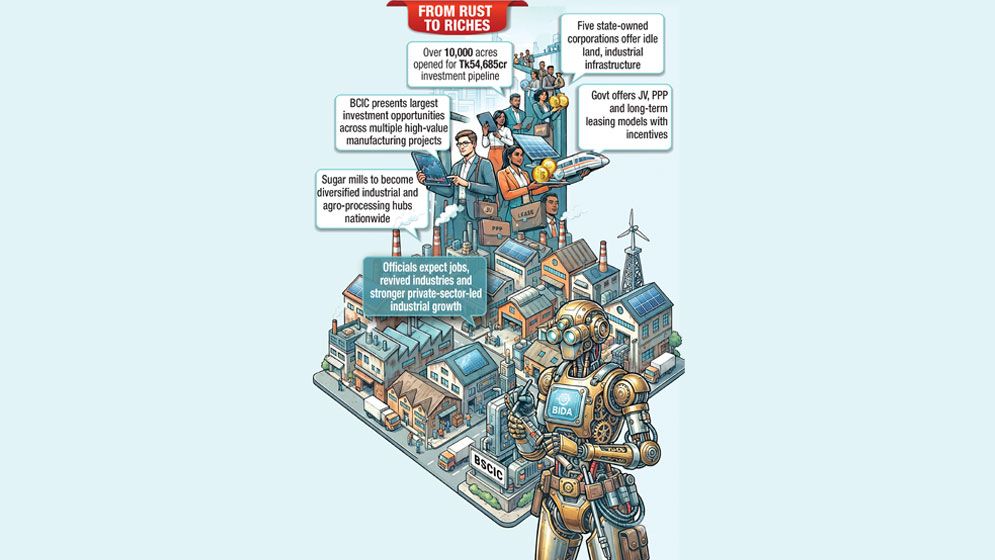
The government has unveiled an ambitious plan to unlock around Tk54,685 crore in investment by opening up more than 10,000 acres of idle land and dormant industrial facilities owned by state-run enterprises, in a move aimed at reviving loss-making factories, creating jobs and accelerating industrialisation.
The initiative, spearheaded by the Bangladesh Investment Development Authority (BIDA), seeks to attract both local and foreign investors by repurposing unused land, factories and existing infrastructure belonging to five state-owned corporations under the Ministry of Industries.
Officials believe the programme will breathe new life into long-shuttered industrial units, generate employment and make better use of public assets that have remained underutilised for years because of persistent losses, poor management and outdated operations.
BCIC offers the biggest investment prospects
The largest investment opportunities have been identified under the Bangladesh Chemical Industries Corporation (BCIC).
The corporation has earmarked 47.275 acres at the Khulna Newsprint and Hardboard Mills Complex, 91.19 acres at the Chittagong Chemical Complex, 18 acres at Dhaka Leather Company in Savar, 197 acres at Ashuganj Fertilizer and Chemical Company and more than 1,700 acres at Karnaphuli Paper Mills, alongside sizeable industrial land elsewhere in the country.
The proposed projects include a new TSP fertiliser plant, chlor-alkali and PVC plants, lithium battery manufacturing, an Active Pharmaceutical Ingredients (API) and starch complex, modern leather industries, and float and solar glass manufacturing facilities.
According to BIDA's investment portfolio, several projects are expected to generate returns of between 12% and 18%.
Sugar mills to become industrial hubs
The Bangladesh Sugar and Food Industries Corporation (BSFIC) holds the largest concentration of unused industrial land, with more than 8,500 acres spread across 13 closed and partially operational sugar mills.
High-tech manufacturing and tourism projects
The Bangladesh Steel and Engineering Corporation (BSEC) has proposed several advanced manufacturing projects, including electric vehicle (EV) and CKD assembly at Progati Industries Limited, power transformer production at General Electric Manufacturing Company Ltd (GEMCO), and electric two-wheelers and battery assembly at Atlas Bangladesh Limited.
The Ministry of Industries has also proposed establishing northern Bangladesh's first large-scale environmentally friendly steel mill in Bogura, with an annual production capacity of 300,000 tonnes and an estimated investment of Tk1,940 crore.
Meanwhile, the Bangladesh Textile Mills Corporation (BTMC) plans to diversify the use of several closed mills. A 22.39-acre site at Khulna Textile Mills has been proposed for an international-standard theme park, water park, resort and commercial complex.
Of BTMC's 25 mills, 16 have received policy approval for development under Public-Private Partnership (PPP) arrangements, while several have already been handed over to private operators.
The Bangladesh Jute Mills Corporation (BJMC) is also restructuring its operations. Of its 25 mills, 20 have been selected for long-term leasing, while 14 have already been transferred to private operators, including two managed by foreign investors.
Investment models and remaining hurdles
The government is offering three investment models – joint ventures (JV), Public-Private Partnerships (PPP) and long-term leasing.
Under these arrangements, state-owned corporations will contribute land and existing infrastructure as equity, while private partners will provide capital, technology and management expertise.
PPP projects will include renewable 30-year concession agreements, VAT incentives and grace periods of up to 36 months.
However, officials acknowledge that challenges remain, including legal disputes over land and assets and investors' concerns about reliable gas and electricity supplies.
BIDA Executive Member Nahian Rahman told the Daily Sun that the government owns idle land in more than 100 industrial establishments and has already published information on the first 44 investment-ready projects for local and foreign investors.
He said proposals had already been received for agro-based industries in northern Bangladesh, with several investment agreements expected to be finalised within the next three to six months.
BIDA Executive Chairman Ashik Chowdhury said the government was working to improve gas and electricity supplies while coordinating with relevant agencies to remove investment bottlenecks.
Speaking at a recent event at the Bangladesh Economic Zones Authority (BEZA), he said, "The time has come to put idle state assets into productive use."
He added that existing infrastructure, skilled manpower and strategic locations could help revive state-owned industrial enterprises through private investment and modern technology.
"The government's role is not to run businesses but to create an enabling environment in which the private sector can efficiently manage industrial operations," he said.
Economist Dr Mahfuz Kabir, research director at the Bangladesh Institute of International and Strategic Studies (BIISS), said the initiative could make state-owned enterprises financially sustainable, reduce the burden on taxpayers and improve transparency and accountability.
He noted that China and several other countries had recently expressed interest in investing in Bangladesh, adding that these dormant industrial assets could emerge as major investment destinations in the years ahead.