


 For all latest news, follow the Daily Sun's Google News channel.


DHAKA-SYLHET HIGHWAY
Only 21% completed after 89% of project timeline elapses
Land acquisition delays, flawed planning stall Bangladesh's biggest regional connectivity project

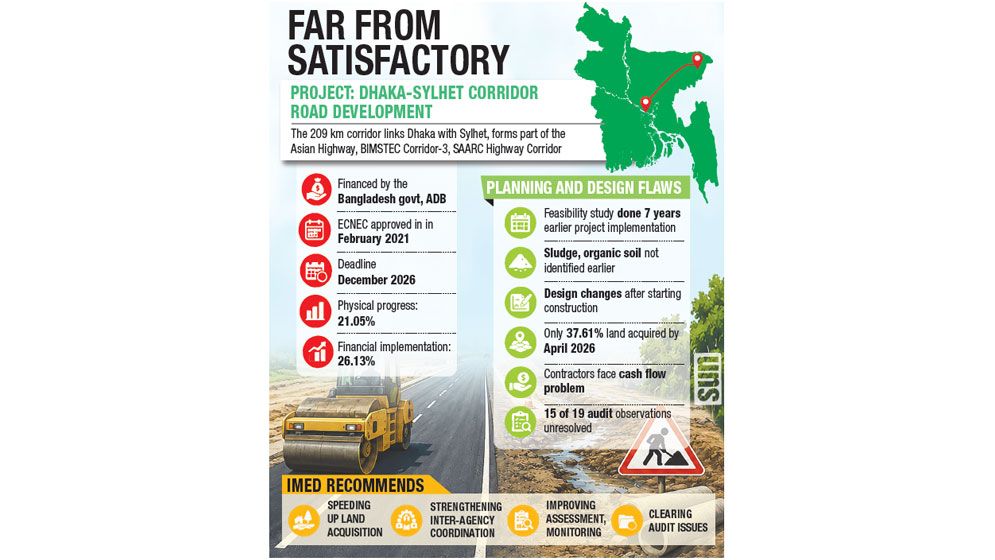
One of Bangladesh’s most strategically significant transport infrastructure projects has completed barely one-fifth of its physical work despite exhausting nearly nine-tenths of its scheduled implementation period, exposing deep-rooted weaknesses in project preparation, inter-agency coordination and execution, according to an intensive monitoring report by the Implementation Monitoring and Evaluation Division (IMED).
The Tk16,918.58 crore Dhaka-Sylhet Corridor Road Development Project was approved by the Executive Committee of the National Economic Council (ECNEC) in February 2021 to transform the country’s busiest eastern highway into a modern four-lane corridor with separate service lanes, bridges, flyovers and pedestrian facilities by December 2026.
Yet IMED’s latest assessment shows that by April 2026, physical progress had reached only 21.05%, while financial implementation stood at 26.13%, even though almost 89% of the project's implementation period had already elapsed. The report describes the pace of implementation as “far from satisfactory” and warns that completing the project within schedule will be difficult unless longstanding bottlenecks are addressed urgently.
A project too important to fail
The slow progress carries significance far beyond a single highway scheme.
Stretching over 209.3 km, the corridor links Dhaka with Sylhet and forms part of the Asian Highway (AH-1 and AH-2), BIMSTEC Corridor-3 and the SAARC Highway Corridor. Jointly financed by the Government of Bangladesh and the Asian Development Bank (ADB), it is expected to cut travel time by around two hours, improve road safety, reduce transport costs and strengthen both domestic and regional trade.
However, the report suggests that despite its strategic importance, implementation has struggled on almost every major front.
Although culvert construction has reached 58.79% and bridge works 31.14% under the project, its core highway infrastructure remains far behind schedule, with the main carriageway only 11.5% complete and service lanes 16.33%.
Delays rooted in planning failures
IMED attributes much of the slowdown to problems that began well before construction started.
The report says the feasibility study had been carried out nearly seven years before implementation, leaving it unable to reflect actual site conditions. During construction, engineers encountered extensive sludge and organic soil that had not been identified during the original investigations, forcing redesigns after work had already begun and adding both time and complexity to implementation.
Those technical setbacks were compounded by slow land acquisition and utility relocation.
By April, only 37.61% of the required land – around 319 acres – had been handed over for construction. At the same time, relocation of electricity lines reached just 46.2%, while relocation of Titas Gas and Jalalabad Gas pipelines stood at only 0.78% and 15.68%, respectively.
Without uninterrupted access to construction sites, contractors were unable to secure sufficient working windows, leaving large sections of the project progressing far more slowly than planned.
Procurement, contractor weaknesses deepen delays
The IMED report also identifies lengthy procurement procedures and weak contractor performance as major contributors to the project's slow implementation.
Tender evaluation and approval under ADB guidelines took between three and six-and-a-half months in several cases, while the period from tender invitation to contract signing stretched between 11 and 19 months.
Even after contracts were awarded, several contractors struggled with financial liquidity, inadequate deployment of workers and machinery, weak site management and poor construction planning, limiting their ability to utilise available work fronts efficiently.
Governance concerns emerge
Beyond construction delays, IMED raises broader concerns about project governance.
Fifteen of the project's nineteen audit observations remain unresolved, reflecting weaknesses in financial oversight and administrative follow-up.
Field inspections also identified below-standard concrete compressive strength in several pavement sections through non-destructive testing (NDT), alongside inadequate use of personal protective equipment by workers and insufficient safety barriers and warning signs at active construction sites.
The report notes that heavy traffic passing through work zones has increased accident risks, while dust pollution has become a growing concern for surrounding communities.
IMED for urgent intervention; experts warn of wider economic costs
To prevent further slippage, IMED recommends accelerating land acquisition and utility relocation, strengthening coordination among implementing agencies, deploying additional manpower and equipment, resolving engineering challenges linked to weak soil conditions, improving quality assurance and quality control, strengthening digital monitoring and clearing long-pending audit objections.
The report concludes that faster decision-making, stronger institutional coordination and more effective project management will be essential if the project is to regain momentum.
Dr Mustafa K Mujeri, former chief economist of Bangladesh Bank and Executive Director of the Institute for Inclusive Finance and Development, said the report’s findings highlight long-standing structural weaknesses in Bangladesh’s public project management rather than isolated implementation failures.
“When a project has consumed nearly 90% of its implementation period but achieved only around one-fifth of its physical progress, it points to serious deficiencies in planning, coordination and execution,” he told the Daily Sun.
“Bangladesh needs to move beyond simply approving large projects. Equal attention must be given to implementation quality, timely problem-solving and institutional capacity if infrastructure investments are to deliver their intended economic benefits,” he said.
According to Mujeri, delays in strategically important transport projects impose broader economic costs by postponing productivity gains, increasing logistics expenses and reducing returns on public investment.
Authorities defend progress
Project Director AK Mohammad Fazlul Karim said the authorities have already taken corrective measures to overcome the project's implementation bottlenecks.
He said annual work plans are being aligned with the pace of land acquisition, procurement and field conditions, while design revisions have addressed unforeseen geological challenges, including sludge and organic soil in parts of the corridor.
Karim said land acquisition and utility relocation are progressing in phases and that the Roads and Highways Department is working closely with the relevant agencies to remove the remaining obstacles.
He maintained that construction quality is being ensured through regular engineering supervision and expressed confidence that, once completed, the four-lane highway would reduce travel time by around two hours while significantly strengthening regional connectivity and trade.
The reporter can be reached at [email protected]