



 For all latest news, follow the Daily Sun's Google News channel.


Economists and business leaders have welcomed the government’s plan to overhaul business regulatory regime, saying the reforms could significantly improve the country’s investment climate ahead of its graduation from Least Developed Country (LDC) status – provided they are implemented effectively.
The FY27 reform package, unveiled by the government, has been described as one of the country’s most comprehensive attempts in years to simplify doing business through deregulation, digitalisation and time-bound public services.
While experts say the measures address many long-standing concerns of investors, they caution that their impact will depend on stronger institutional coordination, administrative capacity and sustained political commitment.
Dr Zahid Hussain, former lead economist of the World Bank’s Dhaka office, said implementation would be the biggest challenge.
“Implementation would be the real challenge. Bangladesh has announced many business reform initiatives over the years, but institutional coordination has often remained weak,” he told the Daily Sun.
“Investors need certainty. A digital single-window system, automatic approvals and accountable institutions are much more valuable than tax holidays if they genuinely reduce uncertainty and administrative discretion.”
He added, “Integrating dozens of agencies into one digital platform, enforcing service deadlines and ensuring accountability will require strong political commitment and administrative capacity.”
Dr Mohammad Abdur Razzaque, chairman of the Research and Policy Integration for Development (RAPID), said the package directly addresses many procedural barriers that have long discouraged investment.
“Predictable approval timelines, simplified regulations and digitalisation can significantly reduce transaction costs if implemented effectively,” he said, arguing that Bangladesh’s competitiveness now depends more on governance reforms than additional fiscal incentives.
Rizwan Rahman, former president of the Dhaka Chamber of Commerce and Industry (DCCI), said regulatory reforms alone would not be enough to stimulate investment.
“If entrepreneurs continue to face power shortages, high financing costs, exchange-rate uncertainty and weak contract enforcement, easier licensing alone will not significantly increase investment,” he said.
The government’s reform agenda represents a fundamental shift in the way business regulations are administered. Rather than removing essential laws or regulatory safeguards, it seeks to eliminate unnecessary administrative procedures that increase the cost and uncertainty of doing business, while preserving protections for public safety, the environment, investor rights and government revenue.
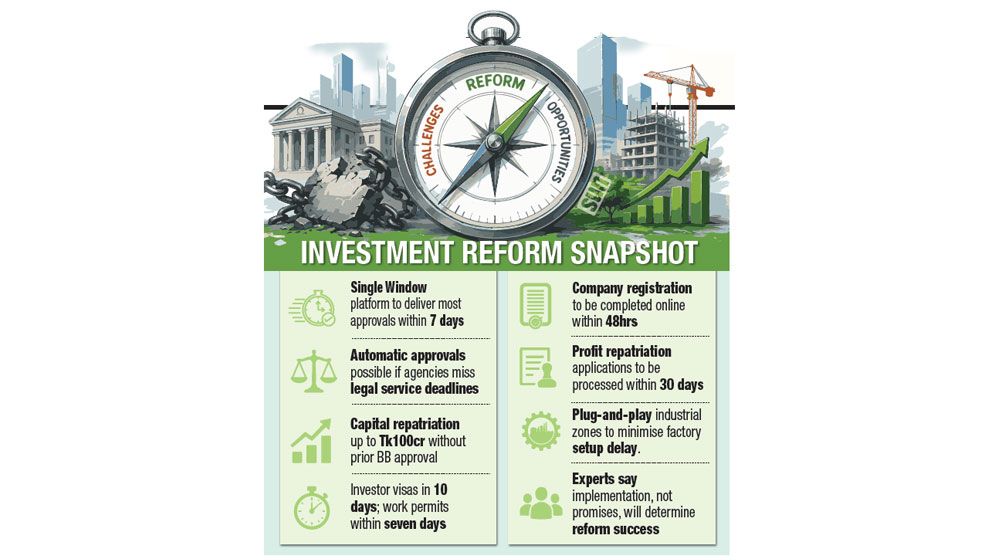
At the centre of the package is a fully digital Single Window platform that will integrate business registration, licensing, approvals, clearances and application tracking into a single online system. Once complete applications are submitted, the government says most services will be delivered within seven days.
To minimise bureaucratic delays, all approving authorities will operate under legally defined Service Level Agreements (SLAs). Where legally applicable, applications may receive deemed or automatic approval if agencies fail to respond within the stipulated timeframe.
Business start-up procedures are also set to become considerably faster. Company registration, including name clearance, fee payment and certificate issuance, will be completed online within 48 hours.
Small and new businesses will be eligible for provisional online approval, allowing them to begin operations immediately while completing regulatory compliance within six to 12 months.
Foreign investors are expected to benefit from work permits for skilled professionals within seven days, investor visas within 10 days and the planned introduction of five-year multiple-entry investor visas.
Large investment projects will receive dedicated case managers through the Bangladesh Investment Development Authority (BIDA), Bangladesh Economic Zones Authority (BEZA), Bangladesh Export Processing Zones Authority (BEPZA) and Bangladesh Small and Cottage Industries Corporation (BSCIC). A 24-hour investor help desk and grievance redress mechanism will also be established.
The government also plans to strengthen legal protection for investors by expanding bilateral investment treaties and updating double taxation avoidance agreements.
Trade licence services provided by local government institutions will gradually be integrated into the national investment platform, enabling businesses to apply, renew licences and make payments online without repeated visits to government offices.
Another major initiative is the introduction of “plug-and-play” industrial facilities in selected economic and industrial zones. Land, utility connections, transport infrastructure and initial regulatory approvals will be prepared in advance so investors can establish factories without lengthy administrative delays.
The reform package also seeks to address one of the most persistent concerns of foreign investors – profit and capital repatriation.
Applications for profit repatriation will be processed within 30 days.
The government has already simplified the repatriation and reinvestment of proceeds from securities purchased through Non-Resident Investors’ Taka Accounts (NITA) by removing the requirement for auditors’ certificates, allowing transactions to be completed within a single working day.
For unlisted companies, valuation reports will no longer be required for transactions worth up to Tk1 crore, while capital repatriation involving deals of up to Tk100 crore will no longer require prior approval from Bangladesh Bank.
A certification board comprising Bangladesh Bank, BIDA, the Bangladesh Securities and Exchange Commission (BSEC), the National Board of Revenue (NBR) and private-sector representatives is also under consideration to standardise business valuation and reduce regulatory disputes.
The government further plans to gradually relax mandatory letter-of-credit requirements for reliable importers by expanding Documents against Payment (D/P) and Telegraphic Transfer (TT) facilities, simplifying foreign trade transactions.
Digital financial services form another major pillar of the reform programme. The government plans to strengthen the Real Time Gross Settlement (RTGS) system, improve interoperability among banks, mobile financial service providers and payment platforms, promote cashless transactions and expand digital lending through e-Loans of up to Tk50,000. Pre-suit mediation will also be encouraged to speed up the recovery of defaulted loans and reduce lengthy court proceedings.
Recognising that construction approvals remain a major obstacle to investment, the government intends to integrate environmental clearance, fire safety, land approvals, building permits and construction approvals into another online Single Window platform. Applications will be processed digitally within fixed timelines, while ministries will share information electronically to eliminate repeated document submissions.
A new risk-based approval framework will also fast-track low-risk projects without compromising inspections for higher-risk investments.
Small businesses are expected to benefit from simplified compliance requirements, lower documentation burdens and easier licence renewal procedures aimed at encouraging informal enterprises to join the formal economy.
To ensure the reforms are implemented effectively, the government plans to establish a high-level task force and launch a dedicated monitoring website where businesses can track progress and report delays or irregularities.