


 For all latest news, follow the Daily Sun's Google News channel.


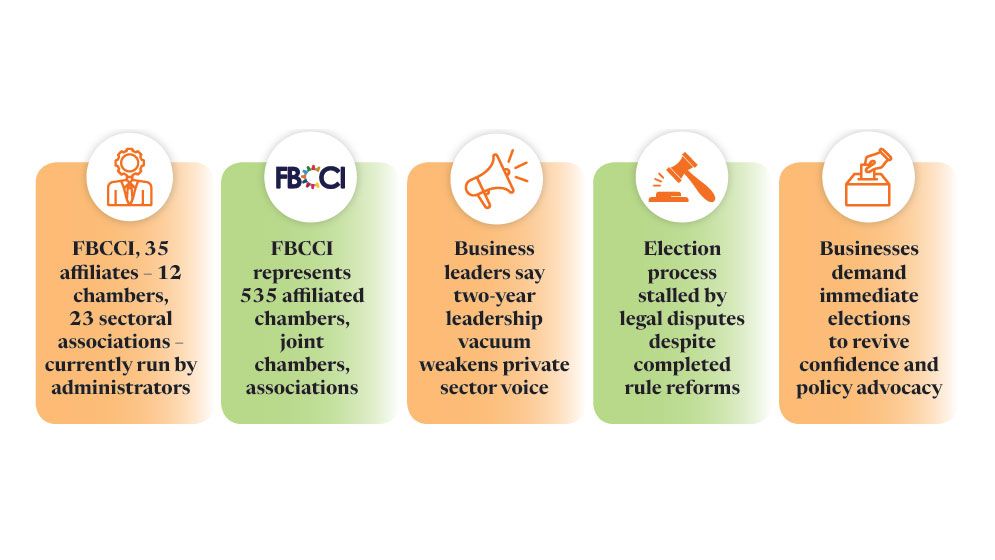
Government-appointed administrators are now running the Federation of Bangladesh Chambers of Commerce and Industry (FBCCI) and 35 of its affiliated trade organisations, prompting growing calls from business leaders for immediate elections to restore representative leadership as industries grapple with rising costs, sluggish investment, foreign exchange pressures and energy shortages.
Business leaders say the prolonged absence of elected leadership has weakened the private sector’s ability to engage effectively with the government at a time when businesses are also facing declining export orders and other economic challenges.
Currently, administrators oversee 12 chambers and 23 sectoral associations affiliated with the FBCCI, while the remaining trade bodies continue to be run by elected committees.
The FBCCI, the country’s apex trade body, has 535 affiliated organisations, comprising 88 chambers, 19 joint chambers and 428 sectoral associations.
The previous interim government appointed an administrator to the FBCCI on 10 September 2024 after then-president Mahbubul Alam resigned amid growing pressure from a section of business leaders following the political changeover that ousted the Awami League government on 5 August 2024. Mahbubul Alam, who assumed office in August 2023, stepped down a day earlier.
Industry insiders say the organisation has since remained largely “inactive” and “motionless”, leaving businesses without an effective platform to raise sector-specific concerns with the government.
Seeking to break the deadlock, the FBCCI Reform Council recently wrote to the commerce ministry, urging it to complete the election process and restore the apex body as an effective and representative institution.
In the letter, signed by the council’s Member Secretary Md Zakir Hossain, the ministry was requested to retain the provision for the direct election of the FBCCI president, vice-presidents and executive committee members by the General Council.
It also called for maintaining the rule requiring elected office-bearers to take a one-term break after serving two consecutive terms.
The council further urged the ministry to preserve the autonomy of chambers and associations by allowing them to function under their respective constitutions and to restore the annual membership fees of FBCCI-affiliated organisations to their previous levels.
According to the letter, former additional secretary Hafizur Rahman, who was appointed administrator in September 2024, held meetings with nearly all members of the FBCCI General Council and completed the long-awaited reform of the Trade Organisations Rules 2025.
Following the reforms, an Election Board and an Appeal Board were formed, and an election schedule was announced. However, the council alleged that the process was stalled after a writ petition was filed challenging both the election and implementation of the new rules.
It further claimed that, subsequently, certain vested groups sought additional amendments to the Trade Organisations Rules 2025 by submitting applications to the then commerce secretary.
The letter said meetings held on 24 October and 8 December between the then commerce secretary Mahbubur Rahman and FBCCI General Council leaders resulted in consensus on key amendments, including retaining direct elections for the FBCCI leadership and limiting the mandatory one-term break to the apex body, while allowing other chambers and associations to continue under their own constitutions.
Speaking to the Daily Sun, Zakir Hossain said the election could be held if the commerce ministry took the necessary initiative.
“The election can be held if the commerce ministry wants. The FBCCI has been inactive for around two years. Now there is no administrator either as Abdur Rahim Khan’s tenure ended. We are trying our best for the election but we aren’t getting cooperation from the commerce ministry,” he said.
He also called for appointing an administrator from the private sector instead of a government official.
Referring to the legal challenge, Zakir said one of the demands in the writ petition was to reduce the annual membership fees.
He said the annual fee for association members had been raised from Tk35,000 to Tk75,000 in 2025, while the fee for chamber members increased from Tk40,000 to Tk100,000.
Immediate past FBCCI administrator Md Abdur Rahim Khan told the Daily Sun that his tenure ended on 26 June and that a new administrator would probably be appointed soon.
He said administrators are generally appointed to arrange elections within four months, but polls in business organisations have been delayed because of various disputes and court cases.
Former FBCCI vice-president Nizamuddin Rajesh said the absence of elected leadership had particularly affected small businesses.
“We have no scope to talk about our problems to the government. Among the members of the FBCCI, more than 80% are small businesses. So, it is crucial that their voices be heard by the government,” he said.
Rajesh said administrators could not effectively run business organisations and warned that the government’s ambitious revenue target for FY27 would be difficult to achieve without a vibrant private sector.
“The newly elected government has set a big revenue target in the budget for FY27. How will the revenues be collected if the private sector is not vibrant? However, the private sector should be revived. So, elections should be held in all business organisations immediately,” he added.