


 For all latest news, follow the Daily Sun's Google News channel.


Fruit imports fall as high taxes keep prices steep
Importers say cumulative duties of up to 126% are passing the high costs onto consumers

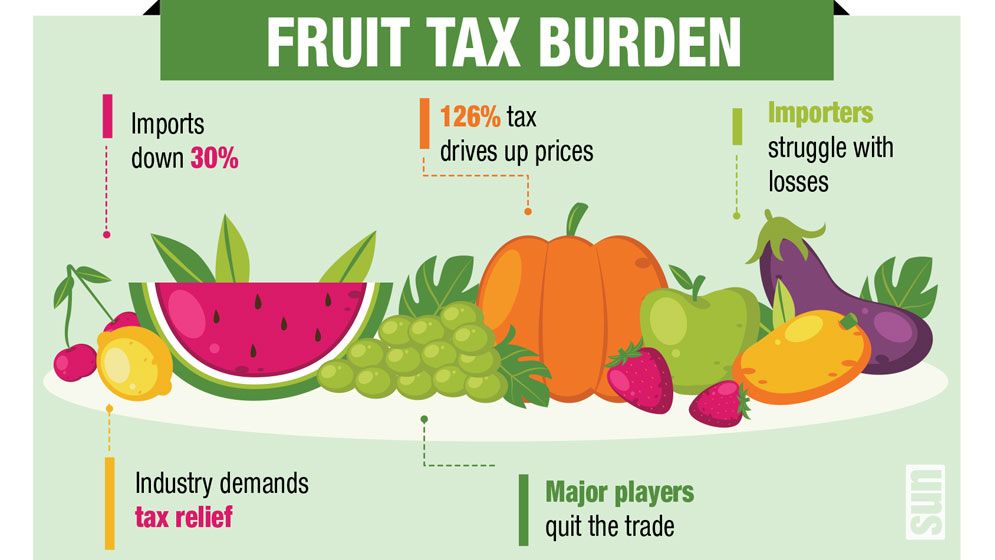
Imported fruits continue to face a cumulative tax burden of up to 126%, while a 2% source tax at the supply stage also remains in force, keeping retail prices high for consumers.
The proposed budget for the fiscal 2026-27 removed only the Regulatory Duty (RD) on dates, leaving the existing tax structure unchanged for other imported fruits.
Bangladesh Fresh Fruits Importers Association (BFFIA) President Md Serazul Islam told the Daily Sun that fruit imports have already fallen by around 30% and are expected to decline further as importers continue to incur losses.
“People are leaving the fruit import business after suffering continuous losses,” he said. “Many local traders have stopped importing foreign fruits. Large companies, including Akij Group, have exited the business. NASA Group also used to import fruits but has withdrawn, while several other major companies have shut down their operations because of persistent losses.”
He argued that higher taxes do not necessarily translate into higher government revenue.
“The government believes that increasing taxes will automatically increase revenue, but that is not always the case,” he said.
The BFFIA president said, “We have repeatedly urged the government to make fruits affordable and accessible so that ordinary people can consume more of them. We import fruits for consumers, but consumers cannot afford to buy them, and importers are also struggling to continue importing.”
Earlier, the BFFIA urged the government to reconsider the Supplementary Duty (SD) and Regulatory Duty (RD) imposed on imported fresh fruits and rationalise the overall tax structure.
The association submitted a written proposal to the chairman of the National Board of Revenue (NBR).
However, traders noted that previous reductions in import taxes had little impact on wholesale and retail fruit prices.
According to the BFFIA, gradual increases in SD and RD over recent years have significantly raised import costs, with the additional burden ultimately being passed on to consumers.
The association warned that the existing high tariff regime is pushing up consumer prices, reducing the competitiveness of legal importers and encouraging smuggling through border areas.
It proposed removing fresh fruits from the luxury goods category and reclassifying them as essential commodities.
The association also recommended reducing the Regulatory Duty from 20% to zero and lowering the Supplementary Duty from 30% to 20%.
According to an analysis by the Bangladesh Trade and Tariff Commission (BTTC), imports of fresh fruits have declined sharply over the past four fiscal years.
Compared with FY22, imports in FY25 fell by approximately 37.35% for apples, 42.77% for oranges, 35.11% for grapes, 24.70% for pears and 94.38% for pomegranates.
The commission estimated that an apple imported at Tk86 currently attracts around Tk105 in taxes and duties.
It also observed that fruits such as apples, oranges, grapes and pears have limited domestic production, reducing the need for high protective tariffs.
Read More