



 For all latest news, follow the Daily Sun's Google News channel.


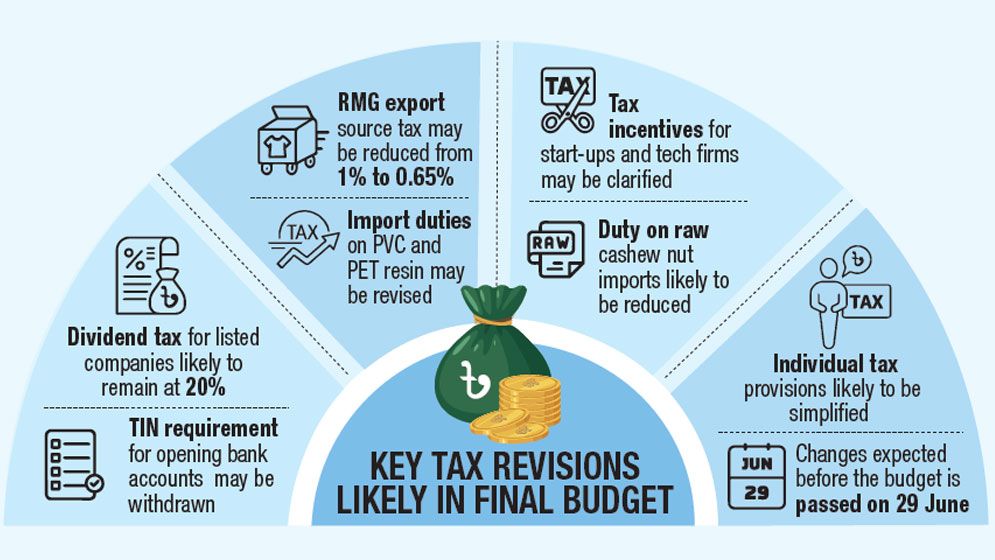
The government is set to revise several major tax and duty proposals in the proposed national budget for the fiscal 2026-27, with the most significant change likely to be the withdrawal of a proposal requiring a Taxpayer Identification Number (TIN) to open bank accounts.
Other proposed changes under consideration include revisions to dividend taxation for listed companies, source tax for the readymade garment (RMG) sector, import duties on industrial raw materials, and tax incentives for small and medium-sized enterprises (SMEs).
According to officials at the Ministry of Finance and the National Board of Revenue (NBR), the issues were discussed at a recent meeting between Finance Minister Amir Khosru Mahmud Chowdhury and senior NBR officials. A final decision is expected before the Finance Bill is passed in parliament on 29 June.
Mandatory TIN requirement may be dropped
The proposed Finance Bill sought to make submission of a TIN certificate mandatory for opening bank accounts as part of efforts to broaden the tax base, curb tax evasion and improve oversight of large financial transactions.
Exemptions were proposed for students, beneficiaries of social safety net programmes, and individuals or institutions covered under special government gazette notifications.
However, the proposal faced strong opposition from businesses, tax experts and other stakeholders, who argued that it could discourage low-income people, small traders and informal-sector workers from opening bank accounts.
Although most of these individuals earn below the taxable income threshold, many fear that obtaining a TIN would automatically require them to file tax returns and expose them to additional administrative burdens.
Snehasish Barua, founder and managing director of SMAC Advisory Services, said the proposal had created concerns among ordinary citizens over possible harassment and procedural complications, potentially undermining the government’s financial inclusion efforts.
Bangladesh currently has nearly 17 crore bank accounts, while a large number of account holders do not have TINs.
Dividend tax proposal under review
The government is also considering changes to the proposed taxation of dividend income earned by listed companies.
The proposed budget recommended abolishing the existing 20% tax on dividend income and instead applying the applicable corporate tax rate. Under the proposal, companies subject to a 27.5% corporate tax rate would have paid tax on dividend income at the same rate.
Following objections from stock market stakeholders, the government is now considering retaining the existing 20% dividend tax, according to NBR sources.
Relief likely for RMG exporters
Export-oriented industries, particularly the RMG sector, may also receive relief in the final budget.
Following long-standing demands from exporters, the government is positively considering reducing the source tax on export proceeds from 1% to 0.65%.
It is also reviewing the proposal to withdraw the additional 1% source tax imposed on subcontracting payments, NBR officials said.
Industrial raw material duties being reconsidered
The government is reviewing proposed tax and duty increases on imported industrial raw materials after businesses warned that higher costs would raise production expenses and ultimately increase consumer prices.
One proposal under reconsideration is raising the import duty on polyvinyl chloride (PVC) and polyethylene terephthalate (PET) resin – two key raw materials for the plastics industry – from 5% to 10%.
Shamim Ahmed, president of the Bangladesh Plastic Goods Manufacturers and Exporters Association (BPGMEA), said more than half of the industry’s raw materials are imported from the Middle East.
Regional conflicts have nearly doubled raw material prices while import volumes have fallen sharply, leaving the industry under significant pressure.
The government is also reviewing the proposed 350% supplementary duty on imports of nicotine granules and nicotine pouches.
Cashew nut duty may be eased
The government is also considering revising the proposed duty structure on imports of raw cashew nuts in shells to support domestic processing industries and boost exports.
Under the proposed budget, imports of raw cashew nuts would be subject to a 15% customs duty and 15% VAT, increasing the overall tax burden from 13.58% to 40.38%.
Following demands from business associations, the government is considering reducing or adjusting the proposed duties to protect local processors.
Other revisions under consideration
The government is also reviewing several other tax measures.
They include withholding tax rates in selected sectors, expanded tax incentives for SMEs, adjustments to supplementary and regulatory duties on specific imported goods, clarification of tax benefits for startups and technology-based companies, and the continuation of certain tax exemptions for export-oriented industries.
Officials are also considering simplifying several tax provisions for individual taxpayers.
Focus on implementation
Finance ministry officials said the proposed budget aims to move the economy from recovery to sustainable growth through revenue reforms, expanded social protection, infrastructure development and greater investment in human capital.
Former finance secretary Mahbub Ahmed told the Daily Sun that while the overall framework of the budget is unlikely to change, several tax and duty proposals could be revised.
He cautioned against revenue measures that might discourage ordinary people and small depositors from using the formal banking system.
M Masrur Reaz, chairman of Policy Exchange Bangladesh, told the Daily Sun that although the proposed budget contains several positive initiatives, it needs clearer policy measures to stimulate private investment and employment.
He said reducing the cost of doing business, easing regulatory complexity and simplifying the tax system would improve the effectiveness of budget implementation.