


 For all latest news, follow the Daily Sun's Google News channel.


Power, charging biggest EV adoption barriers: Experts
Industry leaders call for a national policy and greater investment to accelerate the transition
Daily Sun Report, Dhaka
Published: 28 Jun 2026, 12:00 AM
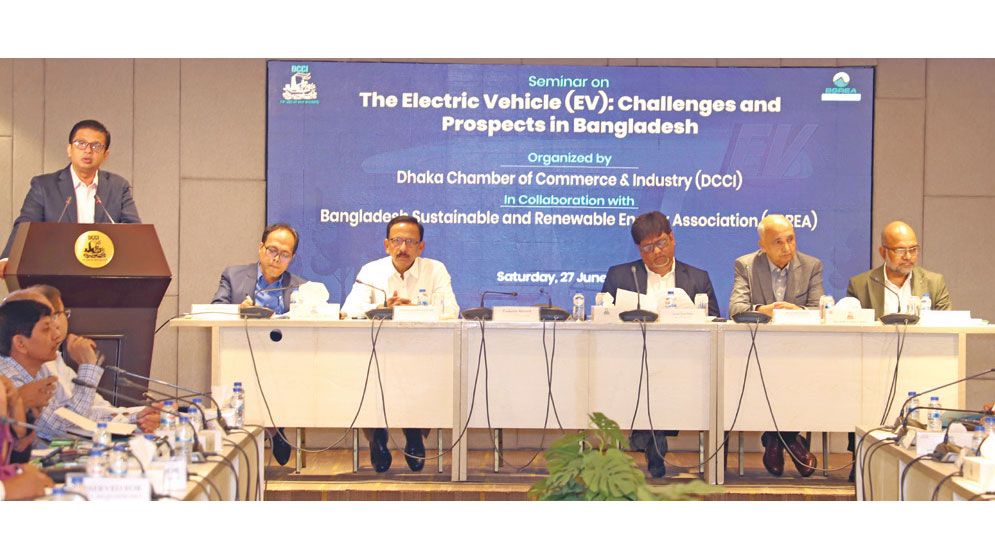
Bangladesh must ensure uninterrupted electricity supply, rapidly expand charging infrastructure and finalise a comprehensive national electric vehicle (EV) policy to unlock the sector’s potential and accelerate the country’s transition to clean transportation, policymakers and industry leaders said.
The recommendations came at a seminar titled “The Electric Vehicle (EV): Challenges and Prospects in Bangladesh”, jointly organised by the Dhaka Chamber of Commerce & Industry (DCCI) and the Bangladesh Sustainable and Renewable Energy Association (BSREA) on Saturday.
Presenting the keynote paper, DCCI President Taskeen Ahmed said the global transport sector is rapidly shifting toward electric mobility, driven by climate commitments, sustainable development goals and efforts to reduce carbon emissions.
Although Bangladesh has introduced tax and duty incentives to encourage EV adoption, he said a stronger policy framework is needed to attract private investment and build a sustainable EV ecosystem.
He called for expanding charging infrastructure through public-private partnerships, ensuring uninterrupted electricity supply, deploying advanced battery management systems and offering additional incentives to investors.
Taskeen noted that while around 60 lakh electric three-wheelers operate across Bangladesh, only 669 electric cars have been registered with the Bangladesh Road Transport Authority (BRTA), highlighting the sector’s vast untapped potential.
Industries Secretary Abdun Naser Khan said the draft national EV policy has completed inter-ministerial and stakeholder consultations and is now being refined by incorporating recommendations from relevant stakeholders.
The policy aims to reduce the country’s dependence on imported fossil fuels while strengthening long-term energy security, he added.
Bangladesh Energy and Power Research Council (BEPRC) Chairman Mohammad Wahid Hossain said a reliable electricity supply would be the cornerstone of a successful EV ecosystem. He proposed establishing a dedicated inter-agency coordination cell involving all government agencies working on EV development, expanding renewable energy generation and creating a national database to support evidence-based policymaking.
Commerce Ministry Additional Secretary Shibir Bicitro Barua said the actual number of EVs operating in Bangladesh is far higher than official registration figures, making accurate data collection essential for effective policymaking. He added that the Ministry of Commerce is working with the National Board of Revenue (NBR) to address tariff and non-tariff barriers facing the industry.
Sustainable and Renewable Energy Development Authority (SREDA) Director Md Aminur Rahman said the authority has approved 32 EV charging stations, nine of which have already been established. He stressed the need to maintain quality standards for both charging infrastructure and imported electric vehicles.
Road Transport and Highways Division Joint Secretary Dr Md Moksed Ali said the government has undertaken several initiatives to promote sustainable transport, including efforts to reduce import duties on EVs.
Bangladesh Power Development Board (BPDB) Chief Engineer Md Mofijul Islam said the lack of a proper registration system for battery-operated vehicles has made it difficult to accurately estimate future electricity demand. He also warned that widespread use of substandard batteries is causing significant energy losses.
Highlighting the economic benefits of electrification, BSREA President Mostafa Al Mahmud said Bangladesh spends nearly Tk65,000 crore annually on transport fuel, most of which is imported.
BUET Professor Dr Md Ehsan said Bangladesh has yet to fully utilise its domestic capabilities in the EV sector.
He noted that the growing use of electric three-wheelers has already reduced diesel imports by an estimated 15 lakh tonnes annually, easing pressure on both government expenditure and foreign exchange reserves.
Industry leaders also stressed the importance of developing a domestic EV manufacturing base.
Runner Automobiles PLC Chairman and Bangladesh Automobiles Assemblers and Manufacturers Association (BAAMA) President Hafizur Rahman Khan said local production of EV components could create jobs and significantly boost export earnings.
Infrastructure Development Company Limited (IDCOL) Vice President Tanvir Ebne Bashar called for faster expansion of charging infrastructure, simplified import procedures and long-term financing to accelerate EV adoption.
Akij Motors Chief Executive Officer Sk Amin Uddin said electric vehicles can reduce fuel costs by around 30%, making them an increasingly attractive option for consumers and businesses.
During the open discussion, BARVIDA President Abdul Haque called for greater emphasis on manufacturing electric three-wheelers and EV components locally, while former DCCI Vice President M Abu Hurairah stressed the need for a comprehensive implementation strategy before introducing the proposed fleet of 2,000 electric buses in Dhaka.
Following the seminar, DCCI and BSREA signed a memorandum of understanding (MoU) to strengthen cooperation in energy policy, innovation, research and market development for Bangladesh’s growing EV sector.