


 For all latest news, follow the Daily Sun's Google News channel.


Can Bangladesh crack Japan’s mango market?
A Japanese trade delegation’s visit to Naogaon signals strong interest, but scaling up infrastructure remain key challenge

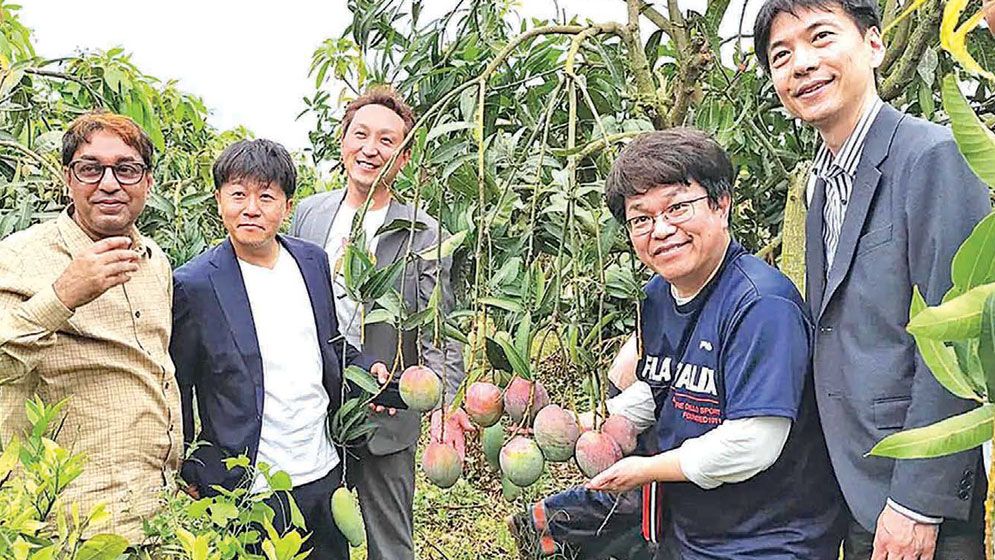
A Japanese trade delegation toured mango orchards in Porsha upazila on Friday, and what they saw appeared to leave a favourable impression.
Four importers and business representatives – Kawamoto, Sakakibara, Ishimoto and Shigimori – spent several hours inspecting rows of Amrapali, Bari-4, Katimon and Banana Mango trees at Fruits Museum Agro Farm in Bondhupara.
The GAP-certified, 50-bigha commercial orchard has spent years preparing to meet the standards of international buyers.
The visit was arranged through the Japanese Embassy in Dhaka.
“Japan has enormous demand for mangoes,” Kawamoto told reporters after the tour. “We are evaluating every stage of Bangladesh’s export system on behalf of our importers and traders. If everything meets our requirements, Japan will import a large volume.”
For Bangladesh’s mango sector, the remark carries significant importance.
A decade of progress
A decade ago, Bangladesh was barely visible in the global mango export market.
While the country produced millions of tonnes of mangoes for domestic consumption, limited cold-chain facilities, weak logistics and inadequate phytosanitary infrastructure prevented it from competing internationally.
That picture is gradually changing
Mango exports reached 2,188 tonnes in 2025, up from 1,321 tonnes a year earlier.
Traders expect exports to rise to around 3,000 tonnes this season as Malaysia and Japan move closer to becoming regular destinations for Bangladeshi fruit.
Even so, the country’s export volume remains modest compared with annual production of an estimated 24 to 25 lakh tonnes.
Bangladesh currently accounts for only a fraction of global fresh mango trade, leaving considerable room for growth.
Why Japan matters
Malaysia has emerged as a promising market, partly because of its sizable Bangladeshi diaspora. Japan, however, presents a different opportunity.
The Japanese market is not known for large import volumes. Its value lies in the premium prices it offers for fruit that meets exceptionally stringent requirements on pesticide residues, quarantine compliance, storage conditions and pest management.
After reviewing Bangladesh’s technical submissions, Japanese authorities requested additional scientific information on 16 quarantine pests that were not fully addressed in earlier documentation.
Industry officials view the request as part of Japan’s rigorous approval process rather than a setback.
The delegation’s visit reflected that thorough approach.
Beyond orchard inspections, the visitors examined grading facilities, sorting lines, packaging operations and treatment centres across Naogaon, Rajshahi and Chapainawabganj, assessing the entire export chain before any sourcing decision was made.
Expectations at the Farm Level
Farm owner Raihan Siddiq guided the delegation through cultivation practices and compliance records at his orchard, which holds a Good Agricultural Practices (GAP) certificate issued by the Bangladesh government.
He noted that mangoes from Naogaon are already being exported to Europe and the Middle East, while Bangladesh made its first mango shipment to China last year.
“Japan is next,” he said. “If we can export there, farmers across Bangladesh will benefit significantly.”
Grower Salauddin emphasised the economic benefits of direct exports, arguing that reducing dependence on intermediaries would allow producers to capture a greater share of the value created by higher-quality fruit.
Bridging the infrastructure gap
Bangladesh has made notable progress in building the infrastructure required for premium export markets.
A Vapour Heat Treatment (VHT) facility – a mandatory quarantine requirement for fresh mango exports to Japan – is now operational at Gabtoli in Dhaka.
At the same time, the Department of Agricultural Extension continues discussions with Japanese authorities to address the remaining pest-risk concerns.
Selim Reza, assistant agriculture officer of Porsha upazila, said local farmers have been receiving regular guidance on GAP compliance.
He added that the Japanese Embassy specifically directed the delegation to Bondhupara because of the orchard’s strong compliance record.
“They visited and expressed satisfaction,” he said. Yet industry stakeholders acknowledge that challenges remain.
Expanding cold-chain infrastructure, strengthening post-harvest handling systems and increasing export volumes beyond current levels will be critical if Bangladesh is to establish itself as a reliable supplier to premium markets.
Looking ahead
Japan is not the world’s largest mango importer, but gaining access to its market would carry significance beyond export volumes.
Meeting Japanese standards would demonstrate that Bangladeshi mangoes can comply with one of the world’s most demanding food safety and regulatory systems.
Such recognition could strengthen Bangladesh’s credibility in other high-value markets as well.
For now, the assessment process continues. Regulatory discussions remain underway, and Japanese buyers have additional data to review.
Should the necessary approvals be secured, Friday’s visit to a mango orchard in Naogaon may ultimately be remembered as an important step in Bangladesh’s effort to expand its presence in premium global fruit markets.