


 For all latest news, follow the Daily Sun's Google News channel.


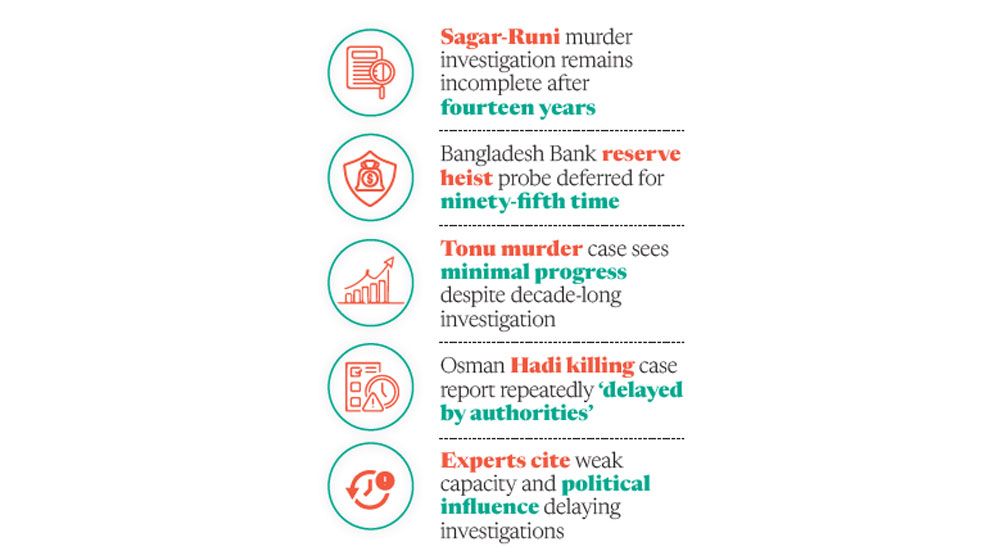
A number of high-profile criminal cases in the country remain stalled in prolonged investigations and trials, with repeated delays in submitting probe reports and slow court proceedings raising fresh concerns over the pace of justice.
From the murder of journalist couple Sagar Sarowar and Meherun Runi, to the Bangladesh Bank reserve heist, and other widely discussed incidents, courts have continued to extend deadlines as investigating agencies fail to complete probes even after many years.
Meanwhile, cases such as the 2015-16 blogger killings and the Rana Plaza collapse case remain stuck at the trial stage, deepening concerns over accountability and judicial delay.
Sagar-Runi murder case
Journalist couple Sagar Sarowar and Meherun Runi were murdered at their rented flat in West Rajabazar, Dhaka, on 11 February 2012, in the presence of their then four-year-old son, Mahir Sarwar Megh.
Fourteen years on, the investigation remains incomplete.
A Dhaka court on 18 June deferred the submission of the probe report for the 127th time, with no significant breakthrough reported in the case.
The responsibility for the investigation has shifted between the Detective Branch (DB), Rapid Action Battalion (RAB), and the Criminal Investigation Department (CID).
Bangladesh Bank reserve heist
The Bangladesh Bank reserve heist case, involving one of the country’s most significant financial crimes, remains under long-running investigation by the CID.
The court has now deferred submission of the probe report for the 95th time, with the next date set for 2 July.
In recent days, reports suggested that the CID had prepared a draft charge sheet and case docket and sent them to the Attorney General’s Office for legal opinion. However, the CID rejected this claim on Friday, saying the investigation is still ongoing.
“In the interest of the investigation, it is not possible to disclose detailed information at this stage,” the agency said in a press release.
Tonu murder case
The murder of Sohagi Jahan Tonu has also seen little progress over the past decade, despite one suspect being arrested in April this year.
Tonu, a history student at Cumilla Victoria Government College and a theatre activist, went missing on 20 March 2016 after attending a tutoring session inside Cumilla Cantonment. Her body was later recovered from bushes near the Power House area within the cantonment.
Her father filed a case with Kotwali Model police station the following day. The case has had around 80 hearing dates and has been investigated by six officers from four different agencies over the years.
Osman Hadi killing case
The investigation into the murder of Inqilab Moncho spokesperson Sharif Osman Bin Hadi has also faced repeated delays, with the submission of the supplementary probe report deferred 16 times. The next date has been set for 28 June.
On 12 December last year, Hadi – then a prospective candidate from Dhaka-8 constituency in the 13th National Parliamentary election – was shot in Dhaka’s Paltan area. He died on 18 December while receiving treatment in Singapore.
A case was filed on 14 December with Paltan Model police station. The investigation was later transferred from the DB to the CID after the complainant filed a no-confidence (naraji) petition against the initial findings.
Salman Shah death case
The investigation into the death of popular film actor Salman Shah has also been repeatedly delayed.
In a recent development, a court last week permitted the exhumation of his remains for further investigation.
Earlier, on 20 October last year, the court ordered the filing of a fresh case nearly 29 years after his death and instructed Ramna Model police station to submit a probe report.
Salman Shah’s body was recovered from his residence in Eskaton, Dhaka, on 6 September 1996.
Expert views
Experts say prolonged delays in sensitive cases reflect both institutional weaknesses and a lack of investigative capacity.
Former additional IGP Dr M Akbar Ali said two main factors lie behind repeated failures to conclude investigations: lack of political will and limited professional capability among investigators.
“In the Sagar-Runi case, there was a lack of goodwill from the previous government. They did not allow the truth to come out,” he said, adding that there is also a shortage of skilled personnel capable of handling complex cases.
He said there is often a tendency to “make things settle” in sensational cases, where charge sheets are submitted quickly to ease pressure rather than ensure thorough investigation.
He called for dedicated investigative officers and stronger institutional continuity. “Those who are in the CID today may not be there tomorrow; the same applies to PBI, which is a barrier to developing expertise,” he said.
He also supported the idea of a permanent independent investigation commission, which he said has yet to be implemented.
Supreme Court lawyer Advocate Manzil Murshid said some investigations are stalled due to influence from powerful individuals. He cited the Sagar-Runi case as an example, while noting that authorities had previously claimed no clear leads were found.
He added that while most cases can be solved with proper clues, a small proportion – around 2%-4% – may remain unresolved due to lack of evidence.
He also pointed to political influence in investigations, saying policing structures remain under the control of those in power. “If the police are made free from political influence, this problem will be reduced,” he said.
Manzil Murshid stressed the need for improved training and increased manpower, arguing that the quality of investigations depends heavily on professional development and adequate staffing.