


 For all latest news, follow the Daily Sun's Google News channel.


PATENGA CONTAINER TERMINAL
Four STS cranes added to fleet, handling capacity rises to 5 lakh TEUs

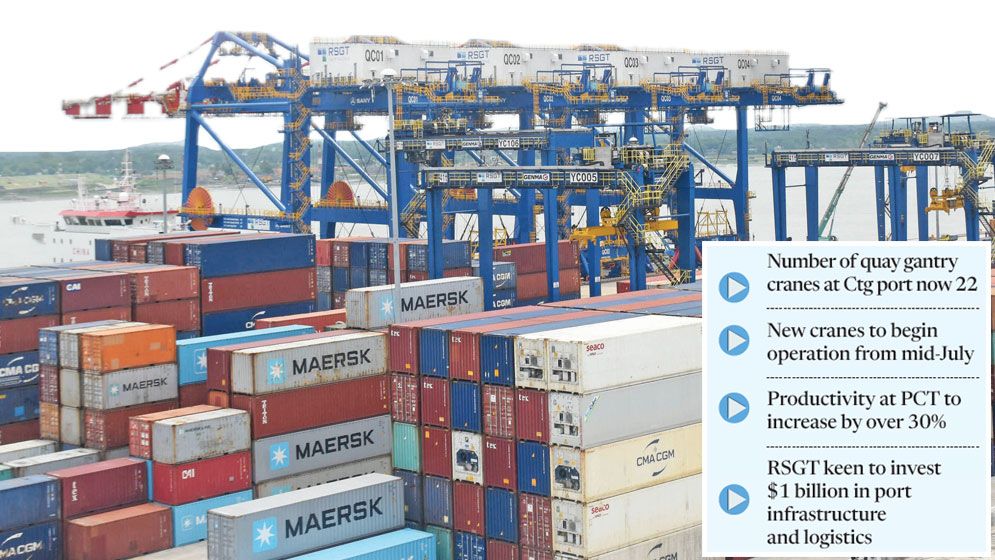
Red-Sea Gateway Terminal (RSGT) Chittagong, the country’s first foreign terminal operator, has added four cutting-edge Ship-To-Shore (STS) cranes, widely known as quay gantry cranes (QGCs), to its fleet at Patenga Container Terminal (PCT), enhancing the terminal’s annual container handling capacity to 5 lakh Twenty-foot Equivalent Units (TEUs).
With the addition, the total number of QGCs at Chattogram Port facilities has risen to 22, further strengthening the country’s logistics sector.
The newly added cranes are expected to boost productivity by more than 30% and reduce vessel turnaround time by 30-40% at the terminal, officials said.
RSGT is also keen to invest $1 billion in the port logistics and infrastructure sectors in Bangladesh.
Under the 22-year concession agreement signed with the Chittagong Port Authority (CPA), the Saudi firm was required to fully equip the PCT with all necessary equipment within two years.
Syed Aref Sarwar, head of commercial and public affairs at the RSGT, told the Daily Sun that they were committed to equipping the terminal with all required facilities by June this year.
“With the arrival of the STS cranes, involving an investment of $30 million, the terminal has transformed into a full-fledged one and is now capable of handling 5 lakh TEUs of containers annually,” he said, adding that they expect to put the cutting-edge cranes into operation by mid-July after successful commissioning.
“Our total investment in the PCT has now reached $170 million. We are also keen to invest $1 billion in Bangladesh’s port infrastructure and logistics sectors as it has immense potential,” he said.
Highlighting the efficiency of the cranes, the official said the terminal currently takes around 48 hours to discharge and load 3,000 to 3,500 TEUs of containers from a vessel.
“Once commissioned, the cranes will significantly enhance productivity, reduce turnaround times, improve safety performance, and enable faster and more efficient container handling through advanced operating systems supported by a highly trained workforce, ultimately lowering costs for importers and exporters,” he anticipated.
Sarwar also credited the CPA, the customs authority, clients and other stakeholders for their continuous support throughout the journey.
RSGT Chief Executive Officer Erwin Haaze said, “The arrival of the STS cranes represents a defining milestone for RSGT Chittagong and demonstrates the strength of our partnership with the CPA and our shared vision of creating a modern, efficient, and globally competitive gateway for trade.”
RSGT officials said the firm placed an order for the STS cranes with China’s Sany Marine Heavy Industry in February last year. A specialised vessel, MV Lan Hai Hing Yun, carrying the cranes berthed at the PCT on Friday evening under enhanced safety measures.
A team of skilled engineers and technicians also arrived with the vessel and will begin offloading and installing the cranes one by one from Sunday.
Each crane, with a lifting capacity of 60 tonnes, can perform 23-24 moves per hour, while four cranes together are capable of handling up to 8 lakh TEUs annually, they said.
The terminal managed a total of 1.55 lakh TEUs of containers in 2025 and 1.50 lakh TEUs as of May this year, serving 80 and 57 vessels respectively.
Notably, although the terminal was formally inaugurated in June 2024, it initially could not process import consignments due to the absence of a required scanner.
Following the formal inauguration of the scanner in May last year and the addition of 14 sophisticated Rubber-Tyred Gantry (RTG) cranes to its fleet in October, the terminal’s operational capacity improved significantly.
The deal with the RSGT Chittagong, an international venture of Red Sea Gateway Terminal (RSGT) that operates the largest terminal facility in Saudi Arabia, for operating the PCT was inked in December 2023.
The construction work on the contemporary, full-fledged and self-sufficient terminal was completed in June 2022.
The government appointed the foreign operator, the first of its kind in the country, for a 22-year term under a government-to-government framework by the Public-Private Partnership Authority.