


 For all latest news, follow the Daily Sun's Google News channel.


The upcoming talks on reopening of the Malaysian labour market for Bangladeshis during the Prime Minister’s visit to the Southeast Asian country have raised key questions over whether the government will secure a transparent and inclusive deal or opt for a quick compromise to resume worker outflow amid shifting global labour dynamics.
Prime Minister Tarique Rahman is scheduled to make his maiden official overseas trip to Malaysia from 21 to 22 June, when apart from discussing resumption of the labour market, Bangladesh will raise the issue of regularisation of undocumented workers and opportunity for 18,000 Bangladeshi workers who could not go to Malaysia despite depositing money and obtaining papers.
The visit comes at a time when labour migration to traditional Middle Eastern destinations has slowed due to geopolitical tensions, including the ongoing US-Israel-Iran conflict, prompting Bangladesh to explore alternative labour markets.
A senior official of the Ministry of Expatriates’ Welfare and Overseas Employment, claiming not to be named, said they have prepared papers for the Prime Minister regarding the reopening proposal of the Malaysian labour market.
“We have formed a proposal keeping multiple options. The final call will be taken by the Prime Minister,” the official said.
Sources at the Ministry of Foreign Affairs have confirmed that it will be a goodwill visit and two new Memorandums of Understanding (MoUs) are likely to be signed. But there may not be any new MoU on labour migration. It means if the market is reopened it will be based on the MoU signed in 2020, which allegedly allowed a syndicate, consisting of a limited number of agencies, to control the whole process.
Expatriates’ Welfare and Overseas Employment Minister Ariful Haque Chowdhury several times said that the current government will never allow any syndicate-based system to send workers in Malaysia.
He also sent a list of 441 recruiting agencies, emphasising the need for transparency and broader participation of licensed agencies.
Despite these assurances, stakeholders in the migration sector remain uncertain about whether the reopening process will truly be free from syndication.
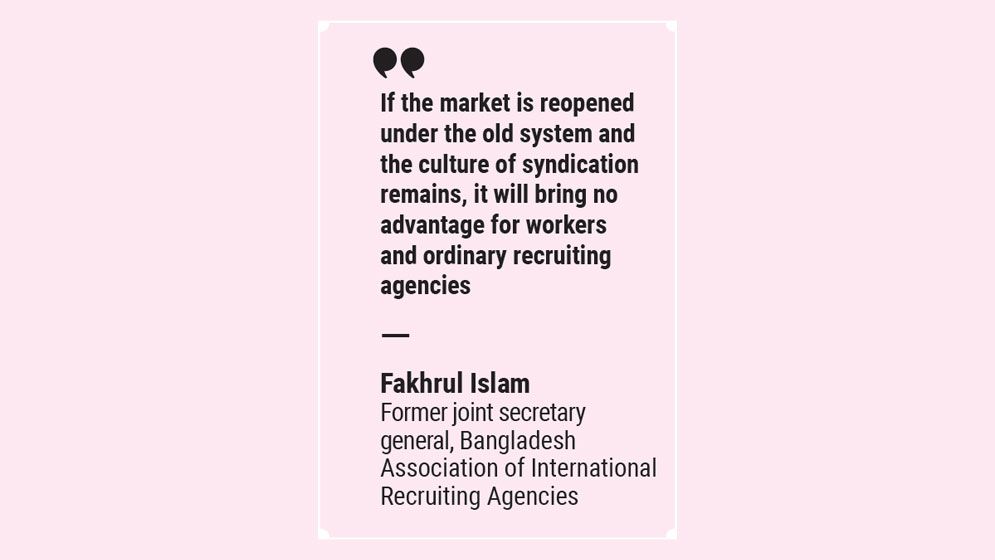
“If the market is reopened under the old system and the culture of syndication remains, it will bring no advantage for workers and ordinary recruiting agencies. We observed during the Awami League’s tenure how a certain group of recruiting agencies, led by influential lawmakers, operated a syndicate to send workers to Malaysia, depriving ordinary agency owners and deceiving workers. This cannot be repeated under the new government,” Fakhrul Islam, former joint secretary general of Bangladesh Association of International Recruiting Agencies (BAIRA), told the Daily Sun.
He shared his optimism that the government will take a strong stance while negotiating with Malaysia, and make sure the introduction of a new system which accommodates all, decreasing cost of migration.
Source of the syndication fear
Bestinet, the company owning the Foreign Workers Central Management System (FWCMS) software MiGRAMS, controlled the recruitment of workers in Malaysia till the market was closed on 31 May 2024, following allegations of corruption. Aminul Islam bin Abdul Noor, alias Dato’ Sri Amin, a Bangladeshi descent Malaysian citizen, reportedly collected large sums of money from each approved agency in Malaysia, while former BAIRA secretary general Ruhul Amin Shawpon, worked as his representative in Bangladesh.
After the fall of the Awami League government, Shawpon reportedly has flown to Malaysia. According to sources, they are is still active there and assuring different manpower exporters in Bangladesh to include them in the short list of recruiting agencies to send workers in Malaysia.
Meanwhile, in April this year, the Bloomberg published a report titled, “Malaysia Plans to Use Tycoon Amin’s New Migrant Worker System” though Malaysian Human Resources Minister Datuk Seri R Ramanan has refuted it.
History trapped in irregularities, corruption
Since Bangladesh first sent workers to Malaysia in 1978, the market was closed five times – in 1986, 1994, 2009, 2018, and in 2024 – often amid allegations of irregularities, corruption, and syndicate-driven recruitment.
In 2022, when the Malaysia’s labour market reopened for Bangladeshis again, the syndicate was resurfaced. Initially only 5 agencies was selected to send workers which later increased to a syndicate of 100 agencies in two phases.
They charged Tk5,44,000 on an average, according to a survey conducted by the US-based NGO Veritas among Bangladeshi workers in Malaysia from May to October in 2023, though the governments of the two countries agreed to limit the migration cost within Tk78,990.
The syndicate allegedly made a business of Tk2,593 crore sending around 476,000 Bangladeshis till the closure of the market.
What expert suggests
Analysing the MoU signed in 2020, Ovibashi Karmi Unnayan Program (OKUP) Chairman Shakirul Islam said it has both positive and negative aspects.
“Some clauses were really excellent as these for the first time specified which part of the migration cost to be borne by employers and which part by workers. But the previous government failed to implement those properly,” he told the Daily Sun.
“But the MoU’s worst part is the provision of allowing the Malaysian authorities solely to select Bangladeshi recruiting agencies. Talking advantage of this, syndicates emerged in the past. Therefore, this clause must be changed if the reopening announced under the existing MoU,” the OKUP chairman added.
He expects that Prime Minister Tarique Rahman will prefer the poor workers’ interests above everything, signaling a strong message to those who want to work for petty political and individual benefits.