



 For all latest news, follow the Daily Sun's Google News channel.


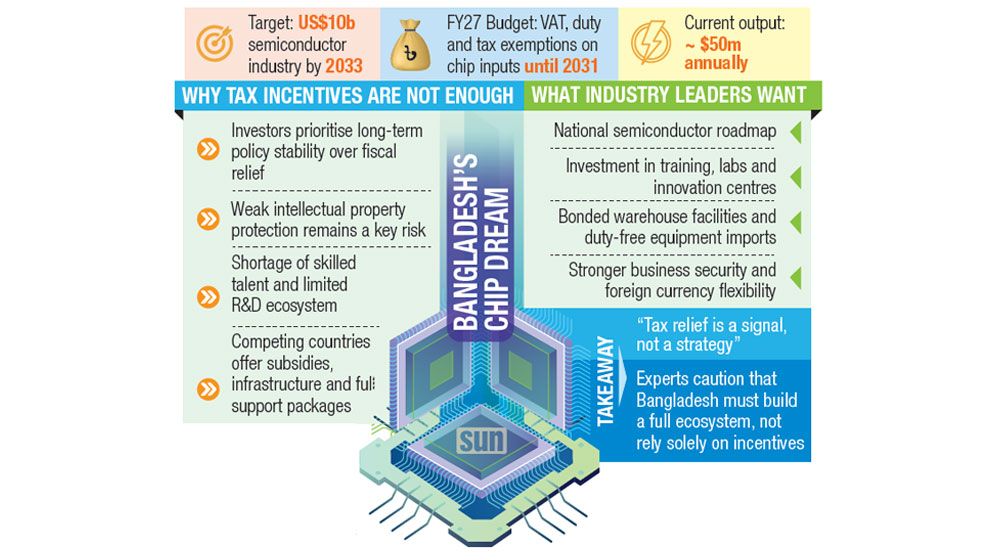
The goal of building a US$10 billion semiconductor industry by 2033 may require far more than tax incentives, industry experts have warned.
They say the fiscal benefits proposed in the fiscal 2026-27 budget will have limited impact unless they are backed by stronger policy support, intellectual property protection, skilled manpower, and a secure investment environment.
In the proposed budget, Finance Minister Amir Khosru Mahmud Chowdhury announced exemptions from regulatory duty, supplementary duty, value-added tax (VAT), and advance tax on raw materials used in semiconductor chip design, testing, and packaging until 30 June 2031. A 1% import duty will remain in place.
The government hopes the incentives will attract investment into a sector expected to reach $1 trillion globally by 2030, driven largely by artificial intelligence. Bangladesh currently earns only about $50 million annually from semiconductor exports.
Industry leaders welcomed the move, describing it as a positive signal that the government is beginning to prioritise the sector.
However, they cautioned that tax relief alone is unlikely to attract the foreign investment needed to transform Bangladesh into a significant semiconductor hub.
Need more than tax incentives
Md Shafil Hosain, director and technical programme manager at Siliconova, said the incentives would benefit local entrepreneurs but would not be sufficient to attract foreign investors.
“We welcome this initiative as it demonstrates the government’s commitment to developing the semiconductor industry. However, VAT and tax exemptions alone will not bring the foreign investment required for the sector’s growth,” he said.
Shafil urged policymakers to look beyond fiscal incentives and adopt models used by countries such as Malaysia and India, where governments provide extensive support packages to semiconductor investors.
“In Malaysia, for example, the government may cover part of the factory set-up costs and even subsidise employee salaries during the initial years. Investors naturally choose destinations offering stronger incentives and policy support,” he said.
He also called for removing the remaining 1% import duty on equipment used in semiconductor testing and packaging, noting that the industry is entirely export-oriented.
“Nothing is consumed locally. After testing and packaging, the products are exported. The government could introduce a bonded warehouse facility and waive this import duty,” he added.
According to Shafil, Bangladesh’s competitive labour costs offer a major opportunity, but attracting global players will require the removal of other barriers and long-term policy commitments.
Dr Muhammad Mustafa Hussain, professor of Electrical and Computer Engineering at Purdue University and founder of Silicon River and CREST, said ensuring a secure business environment should be the government’s top priority.
“Security cannot be taken lightly. A highly secure business environment is essential for attracting semiconductor investment,” he said.
He stressed that intellectual property protection remains a fundamental requirement.
“If intellectual property is not protected, no foreign investor will be interested in investing in Bangladesh’s semiconductor sector,” Mustafa said.
He also highlighted the need for universities to become innovation-driven and play a more active role in developing semiconductor technologies and talent.
“In countries where the semiconductor industry has flourished, universities have been key drivers of innovation. Bangladesh’s universities must play a similar role,” he said.
Mustafa also proposed a government-backed programme to send Bangladeshi graduates to Malaysia for specialised semiconductor training.
“Malaysia is currently facing a shortage of semiconductor workers. The government could send 300 graduates for six months of training and create a pathway for thousands of skilled workers to enter the industry,” he said.
He compared the proposal to the workforce development strategy adopted by President Ziaur Rahman during the early years of the country’s garment industry.
Calls for semiconductor roadmap
Bangladesh Semiconductor Industry Association (BSIA) President M A Jabbar said the tax incentives would create a positive perception among investors but would not, by themselves, trigger large-scale investment.
“It would be unrealistic to expect major investment solely because of duty and tax exemptions,” he said.
Jabbar emphasised the need for substantial investment in human resource development, international-standard training centres, modern research laboratories, and centres of excellence through collaboration between academia and industry.
He also identified several key challenges, including intellectual property protection, faster import-export procedures, greater flexibility in foreign currency management, and policy stability.
“Bangladesh needs a dedicated national semiconductor roadmap, targeted budget allocations, and an integrated implementation framework. With the right policy support, the sector could generate billions of dollars in export earnings within the next few years,” he said.