


 For all latest news, follow the Daily Sun's Google News channel.


Insurers welcome reinsurance tax cut in proposed budget, seek wider reforms
They say move expected to lower costs, improve risk coverage

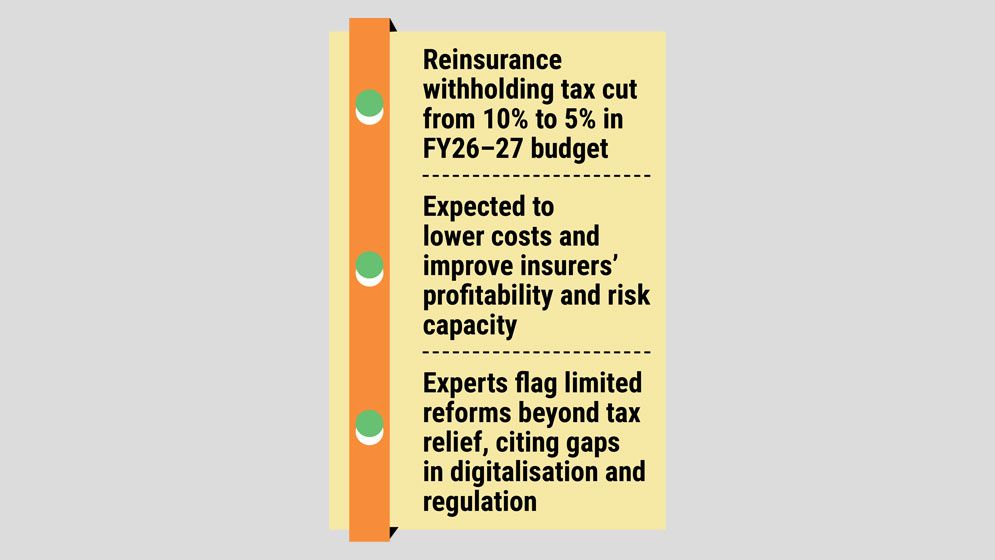
The proposed budget for the 2026-27 fiscal year has offered a major tax incentive to the insurance sector by reducing the withholding tax on foreign reinsurance premiums from 10% to 5%.
Industry stakeholders say the move will lower operating costs, strengthen risk management capacity and enhance insurers’ ability to absorb large-scale risks.
However, sector experts argue that the budget falls short of addressing long-standing structural challenges, including low insurance penetration, digital transformation, claims settlement efficiency and regulatory reforms.
Finance Minister Amir Khosru Mahmud Chowdhury announced the proposal while presenting the national budget in Parliament on 11 June.
Although the budget does not contain any major reform programme specifically targeting the insurance industry, insiders describe the tax measure as one of the most significant initiatives for the sector.
Under existing regulations, non-life insurance companies are required to reinsure 50% of their reinsurance-eligible premiums with the state-owned Sadharan Bima Corporation (SBC).
The remaining 50% may be transferred to foreign reinsurance companies. Until now, insurers had to pay a 10% withholding tax on premiums remitted abroad for reinsurance coverage. The proposed measure would cut that tax burden by half.
SM Nuruzzaman, chief executive officer of Zenith Life Insurance, told the Daily Sun that local insurers often rely on foreign reinsurers to cover large industrial establishments, power plants, infrastructure projects, ships, aircraft and other high-value risks.
“As a result, operating costs increase for local insurers. The reduction in withholding tax will lower reinsurance expenses, helping preserve profitability and capital. At the same time, access to international-standard reinsurance protection will become more affordable,” he said.
Reinsurance is the process through which an insurance company transfers part of its risk to another specialised insurer. For instance, if a local insurer provides coverage worth Tk5,000 crore for a power plant, it may not be able to shoulder the full compensation burden arising from a major accident. By transferring part of the risk to a reinsurer, the financial liability is shared, reducing potential losses.
Industry officials noted that reducing the withholding tax on foreign reinsurance premiums has been a long-standing demand.
They believe the lower rate will improve the competitiveness of local insurers in the global reinsurance market while strengthening their capacity to underwrite large risks and settle claims arising from major disasters or catastrophic losses.
The budget also highlights the government’s efforts to deepen the capital market as a source of long-term financing.
To this end, initiatives have been proposed to increase the participation of pension funds, insurance companies, asset management companies (AMCs), mutual funds and other institutional investors.
Measures have also been suggested to establish new asset management companies, strengthen professional fund management and expand the mutual fund sector.
In terms of taxation, the proposed budget recommends maintaining the corporate tax rate at 40% for non-listed banks, insurance companies and financial institutions. No additional tax incentives or changes to the existing tax structure have been proposed for the sector.
The budget further notes that the government holds significant equity investments in state-owned institutions, corporations, companies, banks, insurance firms and financial institutions.
However, there is currently no comprehensive central database to track these investments and related returns. The government has therefore proposed creating an integrated database of its equity holdings, including those in insurance companies.
Insurance expert Ziaur Rahman said that while the reduction in tax on foreign reinsurance premiums is a positive step, the budget does not introduce new policy measures to accelerate digital insurance services, modernise claims settlement systems, develop innovative insurance products or reform the regulatory framework.
“Alongside tax incentives, ensuring good governance, technology-driven services, stronger customer confidence and regulatory reforms is essential to make the insurance industry more sustainable and dynamic,” he said.