



 For all latest news, follow the Daily Sun's Google News channel.


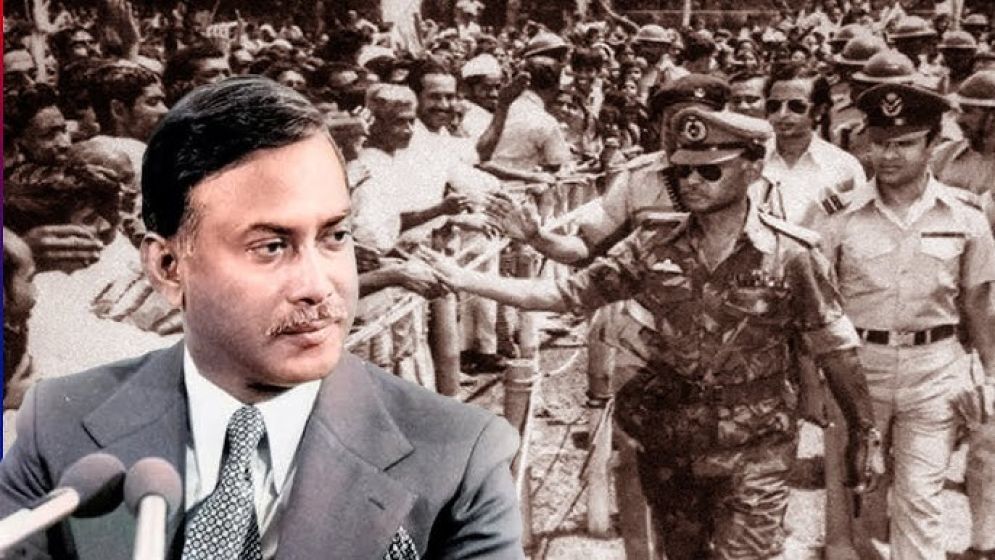
Although the people of Bangladesh have condoned the programmes of Bangladesh Nationalist Party (BNP), many of them could not fully understand the basic philosophy of Bangladeshi Nationalism. There are many reasons for this lack of comprehension. The main reason is that philosophy-based politics never took root in our country. The politics that unfolded in the country in the past were based mainly on hearsay. Whenever there was any crisis, the parties that possessed some leadership, a little organisation, and support among the people formed the government by overcoming others.
In fact, politics in our country has remained self-interest-based and still remains so. Therefore, we have not yet learnt how to uphold party philosophy and put the interest of the country above that of the party. Actually, this philosophy is quite simple. If the mentality is clean and political intention remains correct, then it should not take much time to understand this. But if the purpose is centred on self-interest, then the party philosophy can never be comprehended. One thing needs to be made clear. We cannot survive if we fail to understand party philosophy. The time has come now to ensure that our members survive in the party through concrete work outputs. The programmes undertaken by the party must be implemented, and the party has to preserve its popularity among the people.
Now, the question is: what is nationalism? When we read history, we find many types of nationalism that emerged at different junctures. German nationalism was promoted by Hitler based on the ‘Aryan Race’. Arab nationalism gave rise to the Arab League. Language-based nationalism resulted in Bangali nationalism. Again, some parties advocate religion-based nationalism. This religion-based nationalism was used for creating Pakistan, which ultimately led to exploitation and subjugation of East Bengal. But this politics of exploitation could not keep Pakistan together. As a result, Bangladesh was established as an independent and sovereign country. Nationalism can also be region-based, like the one observed in the European Union. Besides, wars can also be a process for forging nationalism, but that is not essential.
‘Bangladeshi nationalism' has emerged by combining all the above ingredients. Therefore, we claim that it is a holistic nationalism. We have our national pride, a rich language and religious heritage. We are the inhabitants of a geopolitically important region of the world. We harbour dreams for building a new economic structure. And all these emanate from the spirit of a blood-drenched Independence War. The presence of so many ingredients in our nationalism has never been seen elsewhere before.
Therefore, if anyone says that Bangladeshi nationalism does not contain religion, then he is mistaken. Religious faith is a noble and everlasting attribute of Bangladeshi nationalism. At the same time, the Holy Quran says no force should be applied for obeying religion. Therefore, just as Bangladeshi nationalism is not faith-based, similarly, it is not anti-religion. This nationalism upholds the right to practise their respective faiths by all citizens. At the same time, if anyone assumes that this nationalism is only language-based, then he is wrong. Similarly, if anyone claims that it has only an economic programme but no philosophy, then he is also wrong.
Let us now discuss some problems and threats. The country and the nation still face the threats of imperialism, expansionism, neo-colonialism, and cultural imperialism. We had to condone subjugation because of these. However, these threats still persist. But if the people’s representatives discharge their duties with full sincerity and dedication, then none can harm us. These threats have to be faced in a targeted manner for tackling them properly; the citizens have to be organised and made aware of these issues. The people are the source of all power. We are becoming organised up to the village level for this reason. We have established socioeconomically self-reliant village governments based on the same rationale.
All countries and nations harbour dreams. We also have many dreams that shape our philosophy. Bangladeshi nationalism has to be realised by upholding this philosophy. We dream of building an exploitation-free society; we seek to ensure the rights of all through equitable distribution of resources. Therefore, dreams get translated into objectives. However, although we may possess ultimate objectives, those can always be modified if necessary. The same holds true for philosophy, as we should keep pace with changing times, and not doing this may prove counterproductive.
The world does not remain in the same situation every day. What is observed today may not be the same tomorrow. Nature also undergoes constant change. When the Almighty Allah changes nature, why should we not do that? Our demands also change routinely. Because of this reason, we imply equitable distribution when we refer to socialism. That is, our objective is to build a fair and just social system. But we shall have to increase production if we are to build an exploitation-free society. Philosophy loses its meaning and no work or politics is possible when our stomachs are empty. Therefore, production must be increased in all sectors.
Faith-based philosophy is also intertwined with the philosophy of Bangladeshi nationalism. It is not sufficient to consider life in this world alone; the afterlife should also be taken into account. Therefore, this philosophy embodies three features: (1) a call for raising production to meet material needs; (2) providing inspiration for leading a self-reliant life; (3) striving to attain peace for the self through preparing for the afterlife. Consequently, the element of faith should also remain present in politics. Some states call themselves secular. Let us consider the example of England. Words from the Bible are repeatedly quoted during discussions there. Another example is our neighbour India, which claims to be a secular country. But the Hindu philosophy is reflected in all its undertakings, and other religious faiths are not given equal honour. Besides, hundreds of religious minorities are killed there each year during communal riots.
What we want to say is that we do not seek to force people into doing anything. Here lies the difference between us and the socialist countries. They force citizens to work, but we inspire and motivate people to work spontaneously and utilise people power in order to build the nation. For this, we speak about freedom. But freedom does not imply licence for doing anything. The word ‘responsibility’ comes automatically when talking about freedom. If people are not responsible despite enjoying freedom, then it gives rise to flaws and failings. Some of our citizens adhere to ethics, while others do not. As a result, we cannot utilise our human resources fully. Our people are not very organised. We often say that there are fish, water, resources and people in villages. But they all lack proper coordination. We have therefore established self-reliant village governments as socio-economic organisations. There is everything in villages, but they lack leadership. Socio-economic freedom is needed, but organisation is also needed for its proper utilisation.
Self-reliant village government is an output of the philosophy of Bangladeshi nationalism. There are now other claimants to this concept, including the Awami League and the JSD. I do not condone this claim. But it is not enough to have a philosophy. Organisation is required to implement it. Village governments and village defence parties have been formed alongside political organisations for this purpose. And we made a call for a peaceful revolution by combining all these aspects. A blood-drenched revolution like that of 1971 is no longer needed. What is needed today is nation-building. And for that, domestic peace and political stability are a prerequisite. Building the nation through multi-party democracy and peaceful revolution is our ultimate objective.
An outline of this peaceful revolution is as follows:
1. Consolidating national sovereignty and independence;
2. Agricultural reform;
3. Reform of the education sector;
4. Family planning;
5. Industrial production and electrification;
6. Social reform;
7. Administrative reform;
8. Religious faith;
9. Legal reform;
10.Reform of labour laws;
11.Human resource development irrespective of gender;
12.Extraction of natural resources including minerals.
13.Flourishing of Bangladeshi culture.
These are the core ingredients of our revolutionary programme. A question may be asked: what dreams and objectives are sought to be materialised through this revolution? The answer is: establishing an exploitation-free society by meeting five fundamental needs of the people, viz. food, clothing, shelter, education and health. This is our dream as well as the principal objective of Bangladeshi nationalism.
[This is an abridged translation of the article in Bangla “Shaheed Rashtrapati Ziaur Rahmaner Aprokashita Lekha: Bangladeshi Jatiyatabad” (‘Unpublished write-up of Shaheed President Ziaur Rahman: Bangladeshi Nationalism’), published in the 1 June 1983 issue of the Bangla weekly ‘Biplab’]
The writer is a retired Additional Secretary and former Deputy Press Secretary to Prime Minister Begum Khaleda Zia
Read More