



 For all latest news, follow the Daily Sun's Google News channel.


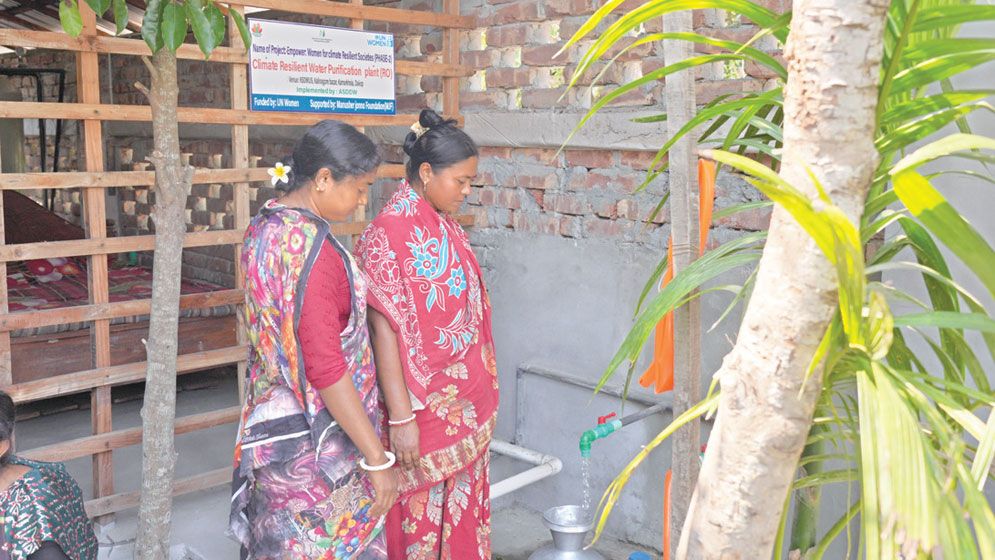
Women in Bangladesh’s south-western coastal belt have long endured a punishing combination of salinity, water scarcity, poverty, and recurring natural disasters.
Yet access to safe water, skills training, and livelihood support is now bringing visible change – improving health, income, food security, and confidence among communities that have historically had little of any.
Water like liquid gold
In disaster-prone Koyra upazila in Khulna, on the edge of the Sundarbans, life has long been defined by hardship.
Cyclones, salinity, tidal surges, and river erosion have made survival a daily contest.
For Nurun Nahar Begum, whose husband is ill and mentally unstable and requires daily medication costing around Tk150, running a small shop from her home is her family’s lifeline – but until recently, her greatest daily concern was not income. It was water.
“Every morning, my first worry was how to collect drinking water,” she said.
With groundwater largely unavailable due to salinity and drought, residents depend on distant or unsafe sources.  During the dry season, as ponds dried up, Nurun Nahar recalled days when she could not cook at all. Fetching water meant walking two to three hours daily, leaving her shop unattended and customers turning away empty-handed.
Local tailor Rehana Parvin put it plainly, “The time spent collecting water could have been used to make a dress. Here, water is more valuable than gold.”
She added that the water table is so deep that even tube wells frequently fail, forcing residents to mix slightly cleaner water with saline pond water simply to get by.
The crisis extends to agriculture. Renting an electric pump for irrigation costs around Tk200 per hour – far beyond the means of most families – leaving farmland uncultivated and deepening food insecurity.
A study titled “A Cross-Sectional View of the Drinking Water Scenario in a Climate-Stressed Setting: Case Study from Southwestern Bangladesh” found that safe drinking water is unavailable for an average of 4.65 months per year, with shortages exceeding seven months in some areas.
Only 16% of households have their own water sources, while low-income families spend up to four per cent of their monthly income on drinking water. Salinity levels in many sources exceed national standards, and tube wells and ponds often contain harmful metals.
The burden falls disproportionately on women and girls, who are responsible for water collection in roughly 80 per cent of households – a task that consumes time, causes physical strain, and exposes them to serious health risks.
A turning point
Change began when Nahar and Rehana participated in activities under the UN Women-supported EmPower: Women for Climate-Resilient Societies project, implemented by Initiative for Right View (IRV) with support from Manusher Jonno Foundation (MJF) and UN Women Bangladesh.
Through community need assessments, district-level farmers’ dialogues, and gender-sensitive disaster response training, they gained knowledge, confidence, and a platform to voice their concerns.
A key intervention was the introduction of rainwater harvesting.
A 2,000-litre water tank installed at Nahar’s home now serves 19 people from five families, drastically reducing the time and effort previously spent on water collection – and freeing women to engage in productive work.
Health toll
The lack of safe water carries a heavy health burden. Lata Sana of Chalna village in Dacope used to walk nearly two kilometres daily for water, and during illness was forced to drink unsafe pond water.
“Sometimes we had to filter the water multiple times, yet we still fell sick,” she said.
Across the region, women report chronic urinary infections from inadequate water intake. In one case, a three-year-old girl was found to have urinary complications. Broader reproductive health consequences – miscarriages, childbirth difficulties, and early marriage – are also linked to the poor water environment.
Signs of progress
In Chalna, a 3,000-litre water supply system installed in October now serves around 3,000 people at Tk0.50 per litre, drawing residents from as far as Saharabadh, four kilometres away.
The system can produce up to 500 litres per hour, though during peak summer months output falls to between 250 and 400 litres daily – well short of demand.
Frequent power outages remain a disruptive obstacle. In the river-surrounded upazila of Dacope, ensuring uninterrupted supply continues to be a major challenge.
For now, women like Nurun Nahar Begum represent a quiet but meaningful transformation – moving from daily struggle towards self-reliance, one drop of safe water at a time.
_______________________________________
The reporter can be reached at: [email protected]