


 For all latest news, follow the Daily Sun's Google News channel.


Business bodies welcome budget, call for policy refinements, effective implementation
Daily Sun Report, Dhaka
Published: 12 Jun 2026, 12:00 AM
Major business chambers, professional bodies and industry associations on Thursday welcomed the proposed national budget for the 2026-27 fiscal year, describing it as a forward-looking and investment-friendly framework designed with the aim of supporting economic recovery, growth and competitiveness.
The stakeholders within the business community praised several reform measures related to taxation, investment facilitation, digitalisation and ease of doing business and highlighted a number of concerns, including rising business costs and sector-based policy gaps.
Across the board, business leaders stressed that the ultimate success of the budget will depend on effective execution, policy certainty, fiscal discipline and continued engagement with the private sector.
FICCI praises 3R framework
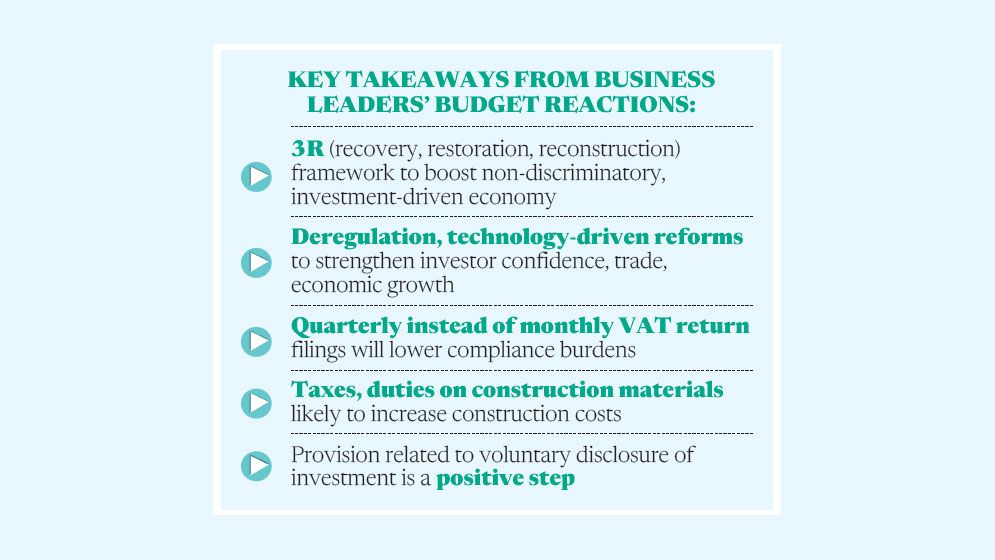
In an instant reaction, the Foreign Investors’ Chamber of Commerce and Industry (FICCI) welcomed the government’s strategic 3R (Recovery, Restoration and Reconstruction) framework in the proposed national budget aimed at building an inclusive, non-discriminatory and investment-driven economy.
The FICCI views the Finance Bill 2026 as a progressive, business-friendly initiative that demonstrates a clear commitment to improving the investment climate through enhanced clarity, simplification, predictability and digitalisation across the tax, VAT and customs regimes.
The emphasis on deregulation and technology-driven reforms is expected to strengthen investor confidence and contribute positively to trade, investment and sustainable economic growth, the FICCI said.
The decision to treat tax deducted at source as advance tax instead of minimum tax aligns with international standards and will significantly relieve corporate working capital constraints, while the proposed automated and faceless refund system will help maintain stable business cash flows.
Under the VAT regime, transitioning from monthly to quarterly VAT return filings will significantly lower compliance burdens and administrative costs for enterprises.
Besides, the increase in the highest personal income tax rate to 35% will escalate the cost of employing skilled foreign professionals, while the lack of specific clarification regarding expense deductibility during global inflation may increase compliance costs.
The FICCI strongly recommended withdrawing the proposed Advance Income Tax (0.2%) collection obligations at the retailer level due to significant operational challenges, extending cashless transaction incentives to private limited companies, and restoring investment rebate benefits for individual taxpayers to encourage domestic savings.
Finally, the chamber emphasised that all fiscal measures must be implemented prospectively, as retrospective applications create market uncertainty and deter long-term investment.
REHAB sees limited support for housing sector
The Real Estate and Housing Association of Bangladesh (REHAB) has expressed concern that the proposed national budget falls short of providing the policy support and incentives needed to stimulate the housing sector.
In its initial reaction, REHAB President Dr Ali Afzal said that new taxes and duties on construction materials, particularly the imposition of specific VAT on rods, are likely to increase construction costs, leading to higher apartment prices for consumers.
He, however, welcomed the provision related to voluntary disclosure of investment as a positive step and urged the government to reduce property registration costs, adopt housing-friendly tax policies, expand access to long-term affordable financing and consider the sector’s proposals during post-budget consultations to sustain investment, employment, and economic growth.
At least 269 industries are directly or indirectly related to the real estate sector, he said, urging the government to review its budgetary decision to ensure a smooth pace in one of the country’s key economic driving forces.
ICAB terms national budget as strategic, forward-looking
NKA Mobin, president of the ICAB, congratulated the government for presenting a strategic, forward-looking and time-befitting budget after careful consideration of the prevailing domestic and global economic challenges.
Despite the Iran-Israel war and other international conflicts, fuel crises, high inflation, rising commodity prices, slowdown in business investment and employment and other global uncertainties, the government has taken up the challenge of implementing the budget, which is a very encouraging step for a developing economy to move forward.
Deficit financing has been projected at Tk2.43 lakh crore, while the target of financing 23% of the deficit through internal revenue is undoubtedly encouraging, but it is a matter of deep concern that 35% of the development budget equivalent to 46% of the deficit finance (Tk1.12 lakh crore) is expected to be financed through bank borrowing.
This may constrain credit availability for the private sector and impede private investment. Furthermore, the imposition of a 0.2% tax on retail businesses, together with a 0.5% tax on mostly agricultural products, may increase inflationary pressures. “Expanding the tax net is a pressing demand to enhance the tax-to-GDP ratio. We believe that the joint initiative of NBR and ICAB in implementing the Document Verification System (DVS) will significantly facilitate achieving the targeted revenue,” he said.
Business-friendly budget, effective implementation essential: DCCI
The Dhaka Chamber of Commerce and Industry (DCCI) President Taskeen Ahmed said that the proposed national budget can be considered as business and investment-friendly and its actual success will depend on achieving the ambitious revenue targets and ensuring the effective implementation of the announced reforms. In his instant reaction, he, however, said that the aimed revenue growth of 30.34% is highly challenging under the current economic circumstances and the reliance on borrowing to finance the budget deficit may not be favourable for the recovery of the banking sector.
The DCCI also welcomed the government's decision to broaden the tax base without increasing VAT rates, as well as the provision for quarterly online VAT return submission.
However, it said that keeping the tax-free income threshold unchanged despite persistent inflation and setting the highest personal income tax rate at 35% are disappointing and urged the government to raise the tax-free income threshold to Tk5 lakh.
AmCham calls for stronger implementation
The American Chamber of Commerce in Bangladesh (AmCham) has welcomed the proposed national budget, describing it as a balanced framework focused on macroeconomic stability, social protection and long-term growth.
It also stressed the need for effective implementation, tax reforms and continued public-private collaboration.
The chamber also welcomed the measures aimed at supporting export competitiveness and trade facilitation, including reductions in certain import and export-related taxes.
As Bangladesh prepares for LDC graduation, AmCham emphasises the need for structural reforms, policy predictability, and alignment with post-LDC obligations to ensure sustained competitiveness.
BUILD terms budget ‘pro-business’
The Business Initiative Leading Development (BUILD) has welcomed the proposed national budget, describing it as a creative, business-friendly fiscal plan that prioritises deregulation, investment, job creation and the ease of doing business. While praising tax incentives, automation initiatives and support for green energy, the BUILD cautioned that the budget’s ambitious goals, including 6.5% GDP growth and 7.5% inflation, will be difficult to achieve amid fiscal pressures, weak banking sector health and global uncertainties.
It also stressed that effective implementation, stronger revenue administration and improved project execution will be critical to translating the budget’s positive intent into tangible economic outcomes.