


 For all latest news, follow the Daily Sun's Google News channel.


Agriculture sector gets Tk43,335cr in FY27 budget
Govt prioritises lower farm production costs through cheaper inputs and mechanisation
Daily Sun Report, Dhaka
Published: 12 Jun 2026, 12:00 AM
The agriculture sector, comprising agriculture, fisheries and livestock, has been allocated Tk43,335 crore in the proposed FY27 budget, an increase of Tk6,209 crore from the previous fiscal year.
Presenting the budget in parliament, Finance Minister Amir Khosru Mahmud Chowdhury said transforming agriculture into a key driver of national prosperity remains a core government priority.
He said emphasis has been placed on reducing farmers’ production costs by ensuring affordable access to fertilisers, seeds and irrigation, while also promoting agricultural mechanisation.
“For FY27, I propose Tk43,335 crore for the Ministries of Agriculture, Food, Fisheries and Livestock, equivalent to 0.63% of GDP,” the minister said, noting that the revised allocation for FY26 stood at Tk37,126 crore.
The allocation was Tk35,880 crore in FY24 and Tk33,698 crore in FY23.
Market reform and farmer support
The government is prioritising fair prices for farmers by reducing intermediary dominance and developing modern marketing systems and cold storage facilities.
It also aims to ensure food safety and nutritional security through improved agricultural practices.
To expand direct service delivery, the Farmer Card programme has been launched.
A pre-pilot covering 22,065 farmers was implemented in FY26, including fish, livestock and salt farmers. In FY27, 42.5 lakh Farmer Cards will be distributed across 100 upazilas, with nationwide rollout planned later.
An initial allocation of Tk1,062.5 crore has been proposed for the Krishak Card (Farmer Card) programme.
Credit, subsidy and input support
Agricultural credit programmes will be expanded through scheduled banks, while concessional loans at 4% interest for pulses, oilseeds, spices and maize cultivation will continue to reduce import dependency.
Under the Agricultural Rehabilitation and Incentive Programme, farmers will receive free seeds, fertilisers and input support.
The government has also strengthened agricultural mechanisation to reduce production costs and subsidy dependence.
A farmer database is being developed to improve distribution of inputs and streamline support programmes, alongside refinancing mechanisms to maintain agricultural credit flows.
Water management and irrigation
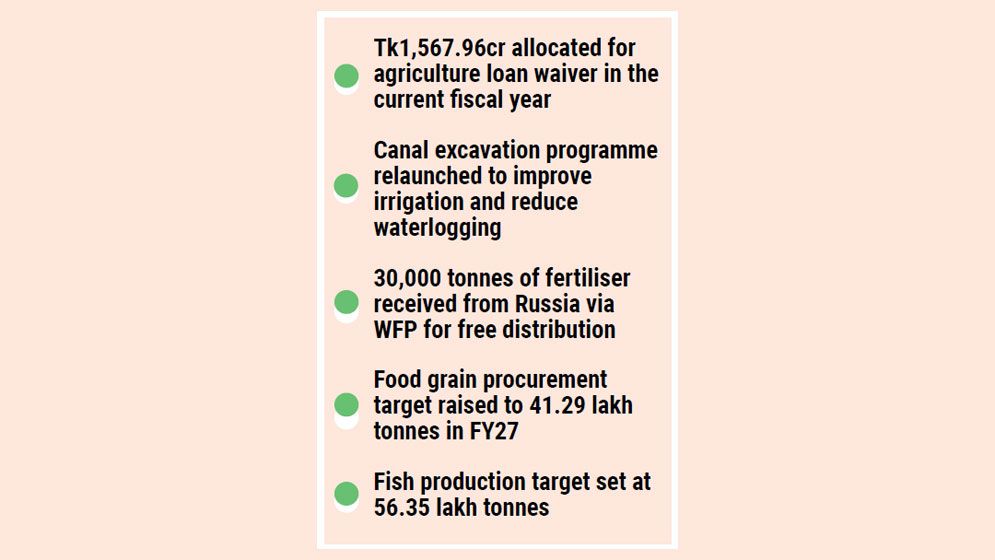
The Voluntary Canal Excavation Programme has been relaunched to improve water management, reduce groundwater pressure and enhance irrigation efficiency. The initiative aims to restore natural water flows and reduce waterlogging.
To promote sustainable irrigation, 98 solar-powered irrigation pumps and 27 solar-powered dug wells will be installed.
Food security measures
Food grain procurement targets have been increased to 41.29 lakh tonnes in FY27, up from 38.19 lakh tonnes in the revised FY26 budget.
Total food storage capacity is also expected to rise from 23.16 lakh tonnes in FY25 to 24.50 lakh tonnes in FY27.
Digitalisation efforts include direct paddy procurement from farmers through the “Krishaker App” and training programmes on safe food practices.
Fisheries, livestock and blue economy
The government has prioritised fisheries and livestock sectors to ensure protein supply, nutrition and rural economic development.
Fish production is targeted at 56.35 lakh tonnes in FY27.
Under its blue economy strategy, Bangladesh plans to expand deep-sea fishing, increase seaweed cultivation and raise fisheries export earnings to US$1 billion by 2030.
Kuakata and Salimpur will be declared Marine Protected Areas, while a modern fishing port is planned at Matarbari to improve sustainable marine resource use.
The government is also implementing projects to improve fish landing centres in Cox’s Bazar.