



 For all latest news, follow the Daily Sun's Google News channel.


The government has unveiled an ambitious roadmap to transform the ICT and telecommunications sector into a key driver of economic growth, aiming to raise its GDP contribution from around 2% to 10% over the next five years.
In the proposed 2026-27 fiscal year budget, the government pledged to develop the sector as a priority industry through digital infrastructure expansion, internet connectivity enhancement, skilled workforce development, investment-friendly policies, and the introduction of a “One Citizen, One ID, One Digital Wallet” system.
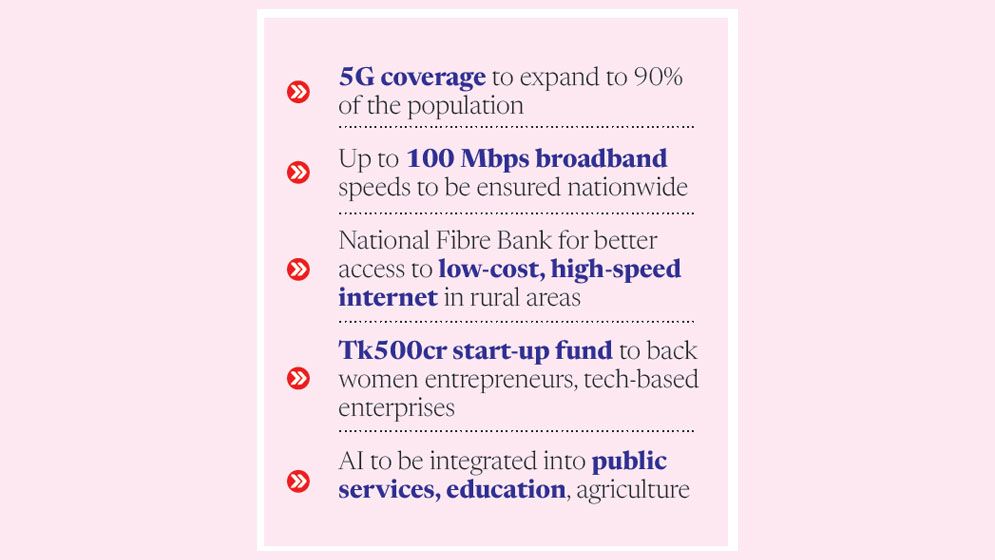
To advance its digital transformation agenda, the government plans to expand 5G coverage to 90% of the population and ensure broadband speeds of up to 100 Mbps nationwide. It also announced plans to establish a National Fibre Bank to improve access to affordable high-speed internet, particularly in rural and remote areas.
According to the budget speech, 41 lakh new 4G mobile connections and four lakh high-speed broadband connections have been added over the past four months. Free high-speed internet services have also been introduced at railway stations and airports.
The budget places strong emphasis on artificial intelligence (AI), electronics manufacturing and youth entrepreneurship. The government plans to integrate AI into public services, education, healthcare and agriculture to improve efficiency and service delivery, while also pursuing policies aimed at positioning Bangladesh as a global electronics manufacturing hub.
To support innovation and start-up growth, the government proposed a Tk500 crore start-up fund for FY27 to assist women entrepreneurs, young innovators and technology-based enterprises.
It also announced plans to establish a unified start-up financing mechanism and formulate a modern start-up policy to accelerate entrepreneurship, freelancing and digital business development.
Taimur Rahman, chief corporate and regulatory affairs officer of Banglalink, said, “We welcome the government’s measures to support the telecommunications sector, including recognising telecom as a national thrust sector and reducing certain taxes. These steps will help accelerate digital inclusion, attract investment and further advance the country’s digital transformation,” he said.
“The aspiration to increase the ICT and telecom sector’s contribution to GDP to 10% within the next five years reflects Bangladesh’s strong digital ambitions. Banglalink remains committed to supporting this journey and creating a better life for all through connectivity and technology,” he added.
Tanveer Mohammed, chief corporate affairs officer of Grameenphone, also welcomed the proposed withdrawal of SIM tax, calling it a positive step for digital inclusion and narrowing the digital divide.
He appreciated the five-year tax rate framework for providing investor certainty, but said high sector-specific taxes still offer limited relief to the industry.
He urged a phased reduction roadmap for telecom taxes, including corporate tax and supplementary duty, and a broader review of the tax structure to strengthen investment, attract FDI and support Bangladesh’s digital ambitions.