


 For all latest news, follow the Daily Sun's Google News channel.


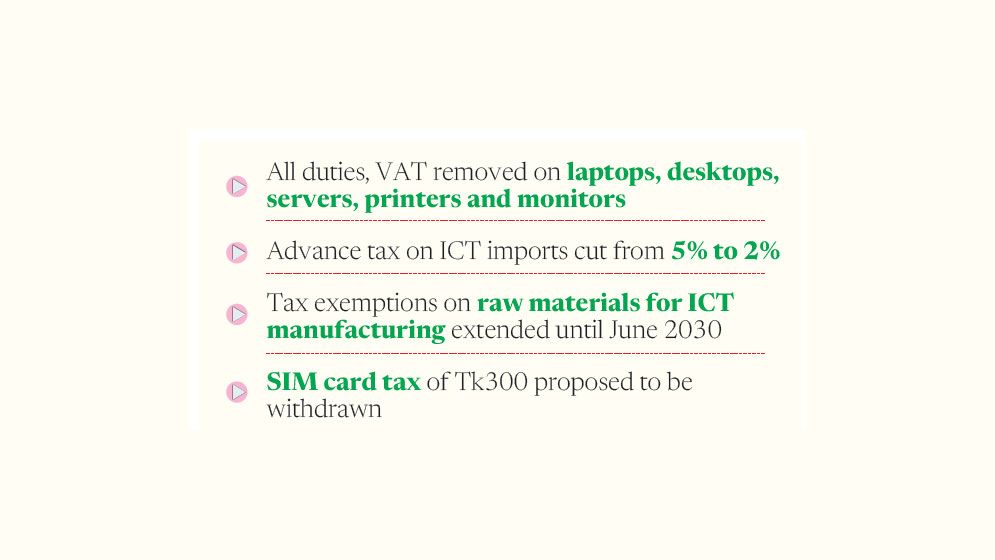
Prices of laptops, desktop computers, printers and other information technology products are likely to decline as the government has proposed sweeping tax and VAT concessions for the ICT sector in the 2026-27 fiscal year budget.
In his budget speech, Finance Minister Amir Khosru Mahmud Chowdhury said the measures are aimed at building a technologically advanced Bangladesh and creating large-scale employment opportunities in the ICT industry.
To support the sector, the minister proposed the withdrawal of all import duties, regulatory duties, supplementary duties and VAT on laptops, desktop computers, servers, printers and computer monitors.
He also proposed eliminating regulatory duties, supplementary duties and VAT on solid-state drives (SSDs), while retaining only a 5% import duty.
In addition, advance tax on imports of computers, printers, portable automatic data processing machines, flash memory devices and monitors would be reduced from 5% to 2%.
Industry stakeholders welcomed the proposals, saying they would lower costs for consumers and accelerate the country’s digital transformation.
Sanjoy Sarker, general manager of Global Brand, described the proposed budget as a “historic turning point” for Bangladesh’s technology ecosystem.
“For years, industry stakeholders have advocated regulatory relief, and the newly announced measures address many of those concerns,” he said.
He noted that a product imported at a value of Tk100 currently costs around Tk170 after taxes, duties and VAT, and that the proposed reductions would significantly lower the final retail price.
However, he cautioned that despite lower taxes on SSDs, global semiconductor supply constraints and exchange rate pressures could continue to influence market prices.
Incentives for local manufacturing
The government has also proposed extending tax and duty benefits for local manufacturing of ICT products.
The finance minister announced plans to continue exemptions on imported raw materials used in the production of computers, laptops, components, printers, toners and other devices until 30 June 2030.
The measure is intended to accelerate the growth of Bangladesh’s domestic ICT and digital device manufacturing industry.
Mobile phone industry gets support
The budget includes additional incentives for the local mobile handset manufacturing sector.
Advance tax on imports of 22 categories of raw materials used by local mobile phone manufacturers would be reduced from 5% and 2% to 1%.
The government has also proposed extending VAT exemptions on mobile phone manufacturing and assembly until 30 June 2030, subject to conditions.
Industry insiders said the measures could reduce production costs and help lower retail prices of locally assembled handsets.
SIM card tax proposed for withdrawal
In a major relief for consumers, the government has proposed withdrawing the Tk300 tax imposed on mobile SIM cards.
The finance minister told parliament that the telecommunications sector continues to face a tax burden of nearly 50%, while the ICT sector bears around 25%, both significantly higher than in many comparable economies.
“As part of efforts to rationalise taxation and make mobile services more affordable, I propose the complete withdrawal of the Tk300 tax imposed on each mobile SIM card,” he said.
The move is expected to reduce entry costs for mobile users and expand access to digital and telecommunications services across the country.
Taimur Rahman, chief corporate and regulatory affairs officer of Banglalink, welcomed the proposal, saying it would promote digital inclusion, encourage investment and support Bangladesh’s digital transformation agenda.