


 For all latest news, follow the Daily Sun's Google News channel.


Excess liquidity rises sharply as investment slows
High lending rates curb borrowing, pushing bank surplus funds to Tk3.86 lakh crore

The banking sector is witnessing a sharp rise in excess liquidity as high interest rates continue to dampen private sector investment, putting growing pressure on banks struggling to deploy increasing deposits.
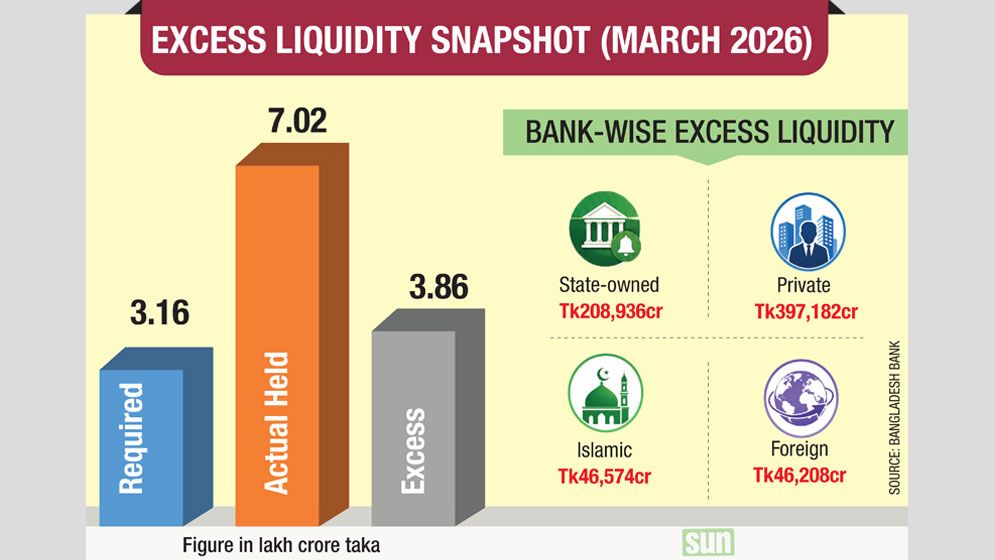
According to Bangladesh Bank (BB) data, excess liquidity in the banking sector stood at Tk3.86 lakh crore at the end of March, marking a 61.6% increase from Tk2.39 lakh crore a year earlier.
To curb inflation, the central bank has significantly raised lending rates over the past two years.
However, the tighter monetary policy has slowed investment activity as businesses have become increasingly reluctant to borrow at elevated rates.
At the same time, the removal of the lending rate cap has triggered a surge in deposits at financially stronger banks.
While deposits continue to grow, weak credit demand and economic uncertainty have limited lending opportunities, resulting in a sharp increase in idle funds across the banking system.
Bankers said the political transition following the fall of the Awami League government exposed the fragile financial condition of several banks, prompting depositors to shift funds from weaker institutions to those perceived as financially stable.
Although this trend has boosted deposits at stronger banks, political uncertainty and high borrowing costs have reduced private sector appetite for loans.
In March, banks were required to maintain Tk3.16 lakh crore in liquidity under regulatory requirements. However, as several banks held liquidity well above the mandatory level, total liquidity in the banking system reached Tk7.02 lakh crore.
Of the total liquidity, private commercial banks held Tk3.97 lakh crore, state-owned banks Tk2.09 lakh crore, Islamic banks Tk46,574 crore and foreign banks Tk46,208 crore.
Excess liquidity is calculated after banks maintain the required Statutory Liquidity Ratio (SLR) and Cash Reserve Ratio (CRR). Under current regulations, banks must keep 4% of total deposits as CRR with Bangladesh Bank and 13% as SLR.
Despite weak loan demand, banks must continue paying interest to depositors. To utilise surplus funds, many banks are investing in government securities, including treasury bills and bonds, while also extending loans to priority sectors.
Liquidity conditions, however, vary significantly across the banking sector. While some banks are holding large surpluses, others continue to face acute shortages.
Banks with substantial surplus liquidity include Sonali Bank, BRAC Bank, Pubali Bank, Agrani Bank, Bank Asia, Dutch-Bangla Bank, Jamuna Bank, Rupali Bank, City Bank and Standard Chartered Bank.
In contrast, National Bank, AB Bank, Premier Bank, Social Islami Bank, Union Bank, Bangladesh Commerce Bank, Padma Bank, First Security Islami Bank and Global Islami Bank recorded liquidity shortfalls.
Former Bank Asia Managing Director Arfan Ali told the Daily Sun that high interest rates and economic uncertainty are discouraging borrowers.
Mustafa K Mujeri, executive director of the Institute for Inclusive Finance and Development (InM), said many banks remain in weak financial condition, causing depositors to place their savings in institutions they consider trustworthy.
“In many cases, funds are being withdrawn from weak banks and deposited in stronger banks. This is causing liquidity in stronger banks to rise rapidly,” he said.
“However, while liquidity is increasing quickly, lending cannot expand at the same pace because identifying creditworthy borrowers takes time. As a result, liquidity is growing faster than loan demand.”
He said banks still need to utilise these funds efficiently because they are paying interest on deposits. As a result, many are increasing investments in government securities and extending credit to priority sectors.
To address the imbalance, the central bank has announced a Tk61,000 crore stimulus package aimed at channeling excess liquidity into productive sectors.
Of the total amount, Tk41,000 crore will come from banks’ own funds, while Tk19,000 crore will be provided through the central bank’s refinancing scheme.
Under the initiative, the central bank plans to mobilise idle funds from stronger banks and redirect them across the banking sector to support lending and broader economic activity.