


 For all latest news, follow the Daily Sun's Google News channel.


RAMISA MURDER TRIAL
Sohel, Swapna face gallows
Trial concludes in just 19 days after the incident

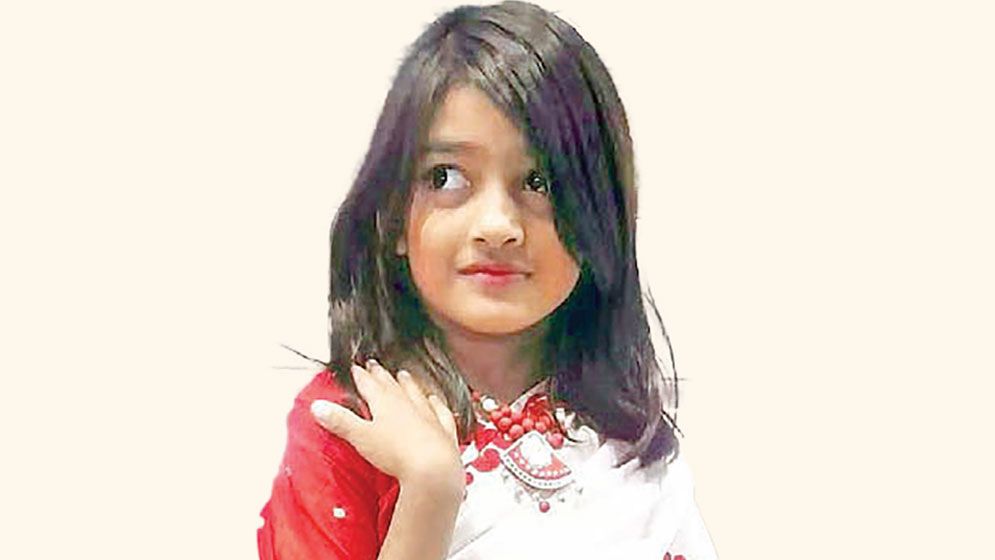
A special tribunal in Dhaka on Sunday sentenced the Sohel-Swapna couple to death for the rape and murder of eight-year-old Ramisa Akter, whose throat was slit after she was sexually assaulted at a neighbouring flat in Mirpur last month – a case that shook the country and was resolved from charge sheet to verdict in under a fortnight.
Judge Masrur Salekin of the Dhaka Metropolitan Children Violence Suppression Tribunal announced the verdict at 11:37am, concluding the proceedings within four minutes.
The convicted couple – Sohel Rana and his wife, Swapna Akter – were also fined jointly: Tk5 lakh for Sohel and Tk2 lakh for Swapna, to be paid to Ramisa’s legal heirs.
The court ordered that their movable and immovable properties be seized and auctioned if the fines go unpaid.
The two had been brought from prison in a van at around 8:30am and held in the lock-up of the Dhaka Metropolitan Sessions Judge’s Court before being escorted into a jam-packed courtroom under tight security.
Ramisa’s father Abdul Hannan Mollah was present as the verdict was read out.
As the convicts were led back to the prison van after noon, agitated members of the public gathered outside began chanting “murderer, murderer.”
Verdict and court’s observations
The tribunal found the accusations proved beyond any doubt. According to the verdict, Sohel raped the child and slit her throat believing she was already dead; his wife, Swapna, abetted him throughout – from the rape to helping him flee.
In its observations, the court said the case was “not merely a criminal trial but also a profound test of society’s conscience, humanity, law enforcement system, and commitment to the rule of law,” describing each page of the case record as filled with “pain, anger, concern, and an expectation of justice.”

The tribunal stated that when a child falls victim to sexual abuse, violence, or murder, it not only devastates a family but wounds society at large and raises hard questions about the justice system’s effectiveness.
The court also noted the weight of its broader responsibility – roughly 1,800 cases remain pending before the tribunal, and behind each, it observed, lies “the unbearable suffering of a child, the anguish of a family, and the hopes of countless people awaiting justice.”
Stating that the Ramisa case would serve as a model for handling future cases of child abuse and violence, the judge said the proceedings carried special significance because investigation, trial, and evidence recording had all been completed comparatively swiftly.
“The duty of the court is not to be guided by emotion but to uncover the truth through law, evidence, and the enduring principles of justice,” the court said.
Family, prosecution, and defence
Ramisa’s father expressed unqualified satisfaction. “I am 100% happy, Alhamdulillah. I have received the outcome and justice I had hoped for from this verdict. InshaAllah, I am fully hopeful that the verdict will be implemented soon,” he said.
He also said, “By the mercy of Almighty Allah and within the timeframe given by the honourable prime minister, we have received the expected verdict. I sincerely thank the honourable judge, the police administration, journalists, and the people of Bangladesh who supported me and my family during our difficult time.”
State-appointed Special Public Prosecutor Azizur Rahman Dulu said the trial’s conclusion within five days was remarkable.
“We are satisfied with the verdict, as both accused have been convicted in accordance with their guilt,” he said.
Even the state-appointed defence lawyer, Musa Kalimullah, said justice had been served.
“The offenders have been held accountable for their crimes, and I am satisfied with the verdict,” he added.
Public reaction: swift implementation urged
Satisfaction with the verdict was widespread, but so was the demand that it be carried out without delay.
Ayesha Saleh, a faculty member in the Department of Law and Land Administration at Jagannath University, said the verdict brought hope, but stressed that implementation must follow quickly.
“It is very unfortunate that our children are not safe in the environment in which we live. This verdict should be implemented soon to serve as a precedent that will strike fear into potential offenders before they commit such brutal crimes,” she said.
Rahat Islam, a student who had come to court to witness the proceedings, pointed to an unresolved precedent.
“We have seen in Achia’s case that the conviction has still not been implemented. There should be a special bench in the higher court as well to hear the death reference in such cases in order to expedite implementation,” he said.
Responses from senior officials
Attorney General Barrister Ruhul Quddus Kazal attributed the speed of justice to the coordinated role of all organs of state.
“We will try to ensure its hearing in the shortest possible time. In this case, a special directive from the Chief Justice may be required,” he said, adding that provisions exist to prepare the death reference for hearing once it reaches the High Court.
Law, Justice and Parliamentary Affairs Minister Md Asaduzzaman said, “We cannot bring Ramisa back; we cannot return her to her parents. But we tried to do our best to ensure justice.”
He described the case as the first in the country’s judicial history to be concluded in so short a period.
Home Minister Salahuddin Ahmed said the matter would be brought to the attention of the Supreme Court and that a request would be made to lawfully advance the death reference hearing.
“Justice has been delivered in the case. It is a landmark case in the country’s judicial history as well as in the history of police arrests and investigations. This is how we want to establish the rule of law in line with the expectations of the people,” he said.
Case background
Ramisa Akter was raped and murdered on 19 May at a flat neighbouring her home in Pallabi, Mirpur.
Her father filed a complaint with Pallabi police station the following day.
Swapna was detained at the scene; Sohel was arrested in Narayanganj and subsequently confessed before the court under Section 164 of the Code of Criminal Procedure.
Police filed a charge sheet on 24 May. The case was transferred to the specialist tribunal the same day and charges were framed on 1 June.
Testimony from 16 of 18 listed prosecution witnesses, including cross-examination, was recorded in a single sitting on 2 June.
Closing arguments were heard on 4 June before the verdict was delivered on 7 June.
