


 For all latest news, follow the Daily Sun's Google News channel.


Nearly half of CEOs doubt firms’ long-term survival
Bangladeshi firms diversify and embrace AI, but weak returns cloud long-term outlook, PwC survey finds

Bangladeshi companies are rapidly expanding into new industries to remain competitive, yet nearly half of chief executives are uncertain whether their businesses will survive the next decade, according to a new PwC survey.
The PwC 29th Annual CEO Survey – Bangladesh Edition 2026 found that 73% of Bangladeshi CEOs have entered entirely new sectors over the past five years – almost double the global average of 42%.
However, the diversification push has yet to generate substantial financial returns, raising questions about whether companies are transforming quickly enough to secure long-term resilience.
The survey found that 46.7% of CEOs are concerned about the long-term viability of their organisations, making business survival one of the most pressing issues facing corporate Bangladesh.
Despite aggressive expansion into new sectors, only 15% of companies said their new ventures contribute more than 20% of total revenue, highlighting a significant gap between strategic ambition and commercial outcomes.
The findings come at a time of growing economic uncertainty, driven by inflation, geopolitical tensions and rapid technological disruption, particularly the rise of artificial intelligence (AI).
AI: Opportunity and challenge
AI is emerging as both a growth catalyst and a structural challenge for businesses.
Around one-quarter of CEOs reported cost reductions linked to AI adoption, while one in five said the technology has already contributed to revenue growth.
However, large-scale deployment remains limited. Fewer than 20% of CEOs said their AI systems have full access to organisational data, while talent shortages continue to hamper implementation. Only 40% reported having a clear roadmap for AI integration.
“AI is no longer an experiment. It is becoming the backbone of growth for diversified businesses, provided organisations get their data and governance foundations right,” said Asif Bhuiyan, Group CEO of AK Khan & Company Ltd.
Workforce impact
The survey also points to significant changes in employment structures.
One-third of CEOs expect AI to reduce demand for junior-level positions within the next three years, while nearly 30% anticipate a decline in mid-level roles.
Senior positions, however, are more likely to be augmented by AI rather than replaced.
Overall, the findings suggest targeted workforce restructuring rather than widespread job losses, underscoring the need for reskilling and workforce adaptation as AI adoption accelerates.
Inflation remains top concern
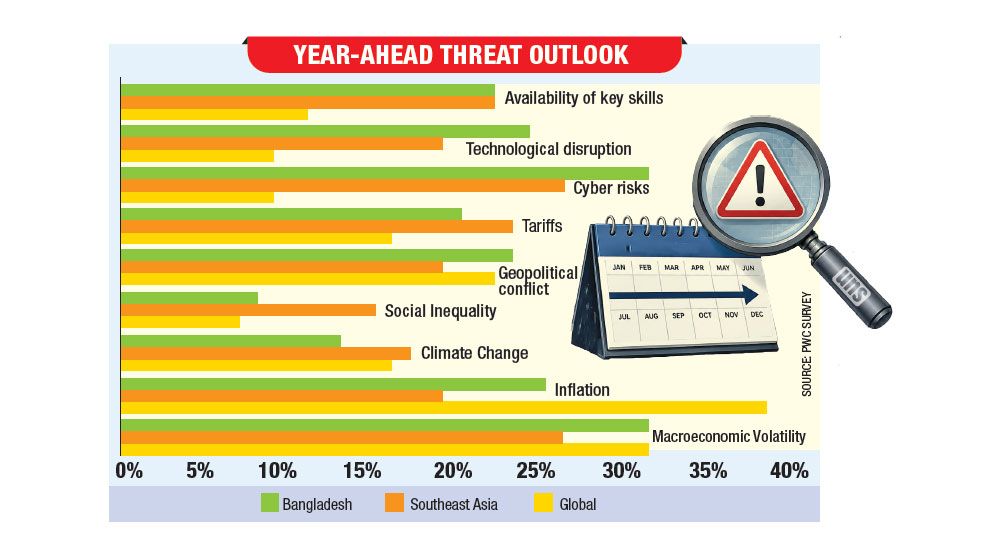
Inflation and broader macroeconomic volatility remain the leading short-term concerns for Bangladeshi CEOs, with risk perceptions significantly higher than global averages.
In the report’s foreword, PwC Bangladesh Country Managing Partner Shams Zaman said inflation, tariffs, geopolitical risks and macroeconomic instability are already influencing investment decisions.
He stressed that businesses should focus on improving the quality of investments rather than simply increasing investment volumes.
He also noted that while companies are actively experimenting with AI, significant gaps remain in enterprise-wide integration, climate preparedness and disciplined capital allocation.
To strengthen resilience, 44% of CEOs are prioritising cybersecurity investments, while nearly 30% are reducing dependence on technology providers from countries they consider less trustworthy.
The report concludes that Bangladesh’s corporate sector is undergoing rapid reinvention, but many firms still lack the foundational capabilities needed to achieve sustainable growth.
Yasir Azman, CEO of Grameenphone Ltd, said future competitiveness would depend on balancing innovation with responsibility, adding that AI adoption and sustainability have become core business imperatives.
PwC said the companies that succeed over the next decade will be those that can turn experimentation into execution by building stronger capabilities in innovation, data governance, cybersecurity and climate resilience.
The survey was conducted between 30 September and 10 November, 2025, covering 4,454 CEOs across 95 countries and territories. The Bangladesh findings are based on responses from 45 CEOs and qualitative interviews conducted across the manufacturing, telecom, paints and chemicals sectors.
Read More