


 For all latest news, follow the Daily Sun's Google News channel.


Airport area, Dhaka’s other silent zones now even noisier
No noise pollution will be tolerated there, says DNCC Administrator Shafiqul

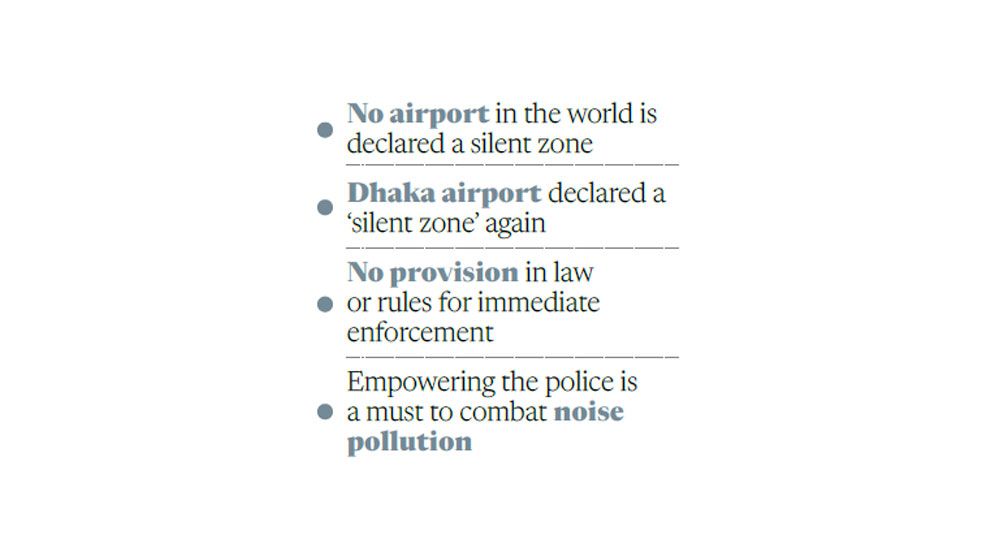
Instead of any improvement in the noise pollution situation around the Hazrat Shahjalal International Airport – the only “silent zone” in Dhaka city declared during the Dr Yunus-led interim government – the noise level in the area has increased compared to earlier times.
The noise pollution is even more severe in other areas that were previously declared silent zones. Meanwhile, nowhere in the world is an airport area declared a silent zone, said experts.
In this situation, the airport was declared a silent zone again on Friday.
“Is the airport area declared a silent zone anywhere in the world? Since the Dhaka airport area was declared a silent zone, the noise level has increased further. We have found the noise level here to be higher than in the past at various times,” said Prof Dr Ahmad Kamruzzaman Majumder, an expert on sound pollution and chairman of the Centre for Atmospheric Pollution Studies (CAPS).
“The airport area has been declared a silent zone. From today, it is a silent zone. No noise pollution will be tolerated there. Anyone violating the law will face action in accordance with the law,” said DNCC Administrator Shafiqul Islam Khan.
He made the announcement verbally while addressing a noise-awareness rally at Gulshan-2 Circle in the city on the occasion of World Environment Day 2026. The event was jointly organised by DNCC, Department of Environment (DoE), Dhaka Metropolitan Police (DMP) and the Bangladesh Road Transport Authority (BRTA).
Shafiqul Islam said that Gulshan, Banani, Niketan and Baridhara had also been designated as silent zones. He sought public cooperation to reduce noise and air pollution in the city.
DoE DG Dr Md Lutfor Rahman said that steps are being taken to combat noise pollution. DMP’s additional commissioner of police (traffic) Anisur Rahman said that they have intensified efforts to curb noise pollution.
However, from dawn to late night, the Dhaka airport area and other declared silent zones are abuzz with noise. The ‘no-honking’ signs are blatantly ignored by drivers.
Loopholes in law and rules, lack of enforcement, lack of awareness campaigns, lack of adequate research and promotional activities before declaring a silent zone, hasty declaration without taking opinions from experts, limitations in identifying quiet areas, lack of proper awareness of drivers and passengers, bus stands in the airport area, and U-turns in front of the main gate of the airport are mainly responsible for the failure to properly establish the ‘silent zone’ around the Dhaka airport and other areas.
The Sound Pollution (Control) Rules, 2025, the Environment Conservation Rules, 2023, the Road Transport Act, 2018, and the Dhaka Metropolitan Police Ordinance, 1976 cover the traffic horns and sound pollution issues. However, no provision has been made for the immediate enforcement of the law or for taking measures to control illegal honking of traffic horns.
The Sound Pollution (Control) Rules designate hospitals, educational institutions, and office areas as silent zones and prohibit honking within a 100-metre radius of these institutions.
However, from early morning till late night, a chaotic cacophony reigns over the Shahbagh crossing, where two of the country’s largest hospitals – Bangabandhu Sheikh Mujib Medical University and BIRDEM General Hospital – are situated.
Advocate Syed Mahbubul Alam, secretary of the Centre for Policy and Law Affairs (CLPA), told the Daily Sun that loopholes in the laws and regulations are mainly responsible for the problem. He emphasised the need to empower the police in this regard. Mobile courts can only try crimes committed in their presence. After power is given to the police, the tendency of honking will decrease; this will ultimately reduce noise pollution, he said.
Dr Ahmad Kamruzzaman Majumder, who is also chairman of the Department of Environmental Science at Stamford University, said that some other issues need to be addressed properly. Declaring a silent zone without adequate assessment and proper expert opinion will not be successful. A scientific solution should be adopted and then a silent zone should be declared, he opined.