


 For all latest news, follow the Daily Sun's Google News channel.


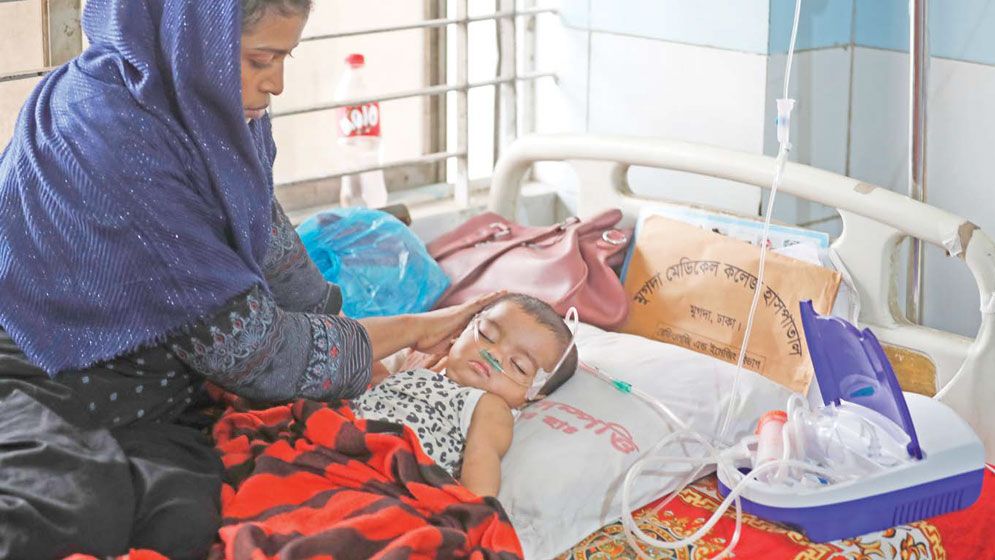
For one and a half months, tea-seller Parvez Mosharraf and homemaker Rupa Akter carried their 18-month-old son Rafsan from one hospital to another as he battled measles.
On 13 May, the child died at the measles isolation ward of Mymensingh Medical College and Hospital after failing to secure a Paediatric Intensive Care Unit (PICU) bed.
Rupa now spends hours arranging her son’s clothes and searching for traces of him. Parvez believes his son might have survived had proper critical care been available.
“We did everything to save our son,” he told the Daily Sun. “My only regret is that if there had been a PICU at Mymensingh Medical College and Hospital, my son might have survived. There is no PICU for children in a divisional city. This cannot be acceptable at all.”
The hospital has no ICU facilities at all.
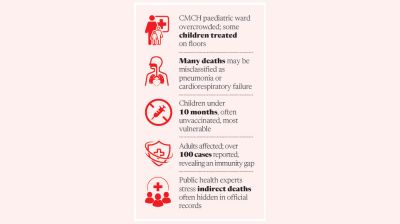
Since the measles outbreak began in mid-March, many families have faced similar experiences, as around 601 children have died either from measles or measles-related complications, exposing the country’s severe shortage of ICU and PICU facilities.
Abu Hossain Md Mainul Ahsan, director of the hospital division at the Directorate General of Health Services, acknowledged the shortage.
“It is true that we do not have the necessary number of ICUs,” he said. “This is the reality.”
Doctors said measles patients do not always require intensive care. However, PICU support becomes critical when children develop severe pneumonia, breathing complications requiring oxygen, or inflammation affecting the brain.
Ayesha Parveen, senior consultant at BRB Hospital, said children under one year old, elderly people, cancer patients and those with weakened immune systems are particularly vulnerable.
Bangladesh currently has three types of intensive care facilities – adult ICU, paediatric ICU and neonatal ICU.
Jayanta Kumar Mukhopadhyay, chief technical manager of the National Electro Medical Equipment Maintenance Workshop and Training Center, said government hospitals across the country had only 1,620 ICU beds.
A 2022 study published in the Bangladesh Critical Care Journal estimated the total number of ICU beds in both public and private hospitals at 2,856.
Specialists believe the number has since risen to nearly 3,000 following the Covid-19 pandemic.
Referring to an international study conducted between 2017 and 2019, the report said Bangladesh had only 0.7 critical care or ICU beds per 100,000 people. The report also noted that this figure was significantly lower than in other South Asian countries.
Dr Ashraf Jewel of United Medical College Hospital said nearly 25% of ICU beds were neonatal units while only 3% were PICU beds.
Doctors also observe that among the children died of measles a significant portion struggled for pediatric ICU or PICU support.
Health experts say the crisis cannot be resolved quickly and requires long-term planning, investment and specialised manpower.
Muhammad Asaduzzaman, associate professor and head of critical care at the National Institute of Cancer Research and Hospital, said the country failed to develop permanent critical care infrastructure even after recruiting more than 400 specialists during the COVID-19 pandemic.
He said Bangladesh also lacked adequate focus on tertiary healthcare because of the high costs involved.
“As time is invaluable for critical patients, ICU facilities must gradually be established at district hospitals across the country,” he said.
He further said that decentralised critical care services would reduce pressure on divisional hospitals and healthcare facilities in the capital.
__________________________________
The reporter can be reached at: [email protected]