



 For all latest news, follow the Daily Sun's Google News channel.


The government is preparing to offer major tax incentives to solar power producers in a move aimed at attracting private investment, expanding renewable energy generation and reducing the country’s dependence on imported fuels.
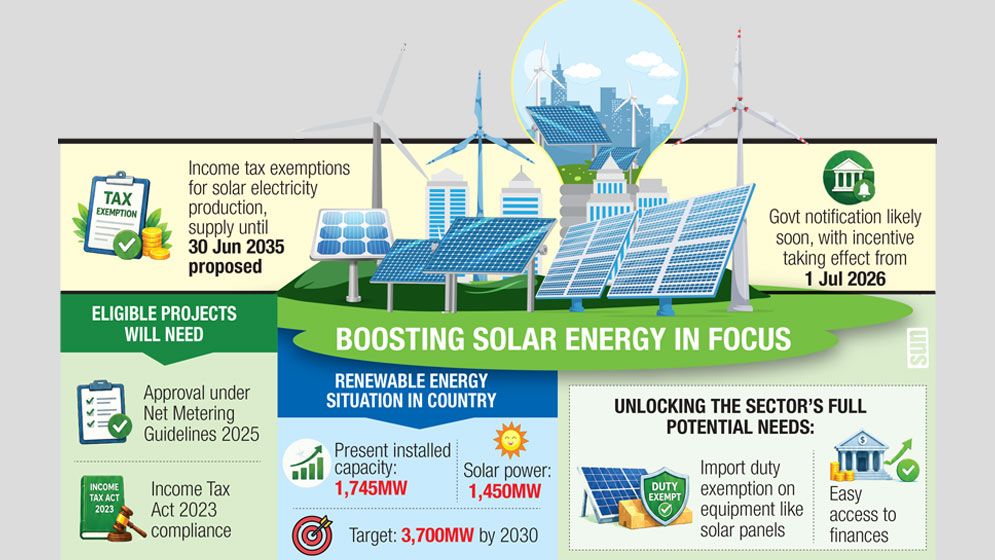
Under a proposed measure being considered by the National Board of Revenue (NBR), companies engaged in the production and supply of solar electricity could receive income tax exemptions on earnings generated from their operations until 30 June 2035.
Officials familiar with the proposal said a government notification could be issued shortly, with the incentive expected to take effect from 1 July 2026.
The move comes as Bangladesh seeks to accelerate its transition to clean energy and achieve ambitious renewable energy targets amid rising electricity demand and growing concerns over energy security.
Boost for solar investors
The proposed tax relief will apply to companies that establish and operate solar power plants under their own financing and management. Eligible projects will need approval under the country’s Net Metering Guidelines 2025 and must comply with all provisions of the Income Tax Act 2023.
Businesses that consume electricity generated from solar plants are also expected to receive incentives. Under the proposal, companies could claim a tax rebate equivalent to 5% of their solar electricity bill against their total payable income tax.
Industry stakeholders say the incentives address a long-standing demand from the renewable energy sector.
“Tax benefits will encourage investors and create a more favourable environment for renewable energy development,” Mostafa Al Mahmud, president of the Bangladesh Sustainable and Renewable Energy Association (BSREA), told the Daily Sun.
He described the initiative as a positive step toward Bangladesh’s energy transition, particularly for companies operating under the OPEX model, where solar power developers invest in and operate systems while selling electricity directly to consumers.
“For a long time, these businesses were excluded from many of the tax benefits available to independent power producers. This measure should help stimulate investment, although it may not create a dramatic change on its own,” he said.
More reforms needed
While welcoming the proposed tax exemption, industry leaders argue that additional policy support will be required to unlock the sector’s full potential.
BSREA has called for temporary reductions in import duties on solar panels, batteries, inverters and other renewable energy equipment. The association has also proposed easier access to low-cost financing, wider net-metering opportunities, and stronger support for solar-powered irrigation systems.
According to industry estimates, total tax incidence on some renewable energy components ranges from 25% to nearly 90%, significantly increasing project costs.
“Tax relief is important, but financing remains a major challenge,” Shafiqul Alam, lead energy analyst at the Institute for Energy Economics and Financial Analysis (IEEFA), told the Daily Sun.
“The new incentives will encourage businesses involved in rooftop solar and OPEX-based projects. Combined with easier access to finance, they could help create a significant expansion of the sector,” he added.
Alam also noted that incentives for electricity consumers would help increase demand for solar energy and improve the overall investment climate.
Ambitious renewable energy targets
Bangladesh currently has an installed renewable energy capacity of about 1,745MW, according to the Sustainable and Renewable Energy Development Authority (SREDA).
Solar power accounts for more than 1,450MW of that capacity, making it the country’s largest renewable energy source.
The government aims to increase renewable energy generation capacity to 3,700MW by 2030 as part of its broader strategy to reduce carbon emissions, strengthen energy security and lower dependence on imported liquefied natural gas (LNG), coal and oil.
However, experts caution that reaching the target will require more than tax incentives alone.
Challenges including limited land availability, high import duties, complex approval procedures, financing constraints and weaknesses in transmission infrastructure continue to slow project development.
A recent report by IEEFA found that renewable energy contributes only 2.3% of Bangladesh’s grid-based electricity generation, significantly below the global average of 33.8%.
At the same time, electricity demand is rising rapidly. Data from the Bangladesh Investment Development Authority (BIDA) projects peak electricity demand could exceed 25,000MW by 2030.
A step towards energy security
Policy experts believe expanding renewable energy could reduce industrial production costs, improve export competitiveness and ease pressure on foreign currency reserves used to import fuel.
“Export-oriented industries will increasingly need renewable energy to meet international buyers’ sustainability requirements,” said Dr Khondaker Golam Moazzem, Research Director at the Centre for Policy Dialogue (CPD).
He added that greater investment in renewable energy could help Bangladesh reduce fuel import costs while supporting long-term economic growth.
As the government finalises the FY27 budget, the proposed tax incentives are being viewed as one of the most significant policy measures yet to encourage private-sector participation in clean energy.
Industry leaders say the initiative sends a positive signal to investors, but stress that broader reforms will be needed if Bangladesh is to meet its renewable energy ambitions and build a more sustainable energy future.