


 For all latest news, follow the Daily Sun's Google News channel.


Over Tk5,800cr in shareholder funds remain in limbo
Six months after five Islamic banks were merged, investors still await clarity on compensation

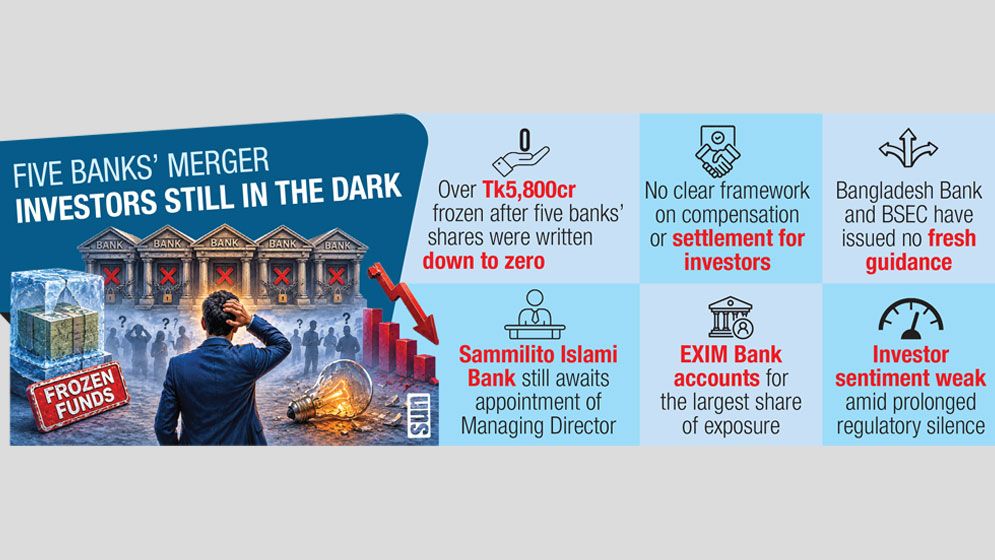
More than six months after the shares of five Shariah-based banks were effectively written down to zero as part of a major banking sector restructuring initiative, investments worth nearly Tk5,820 crore remain in limbo, leaving thousands of retail and institutional investors uncertain about the fate of their holdings.
Despite progress in the merger and restructuring process, authorities have yet to announce a clear roadmap for shareholders.
Market participants say neither the government nor the Bangladesh Securities and Exchange Commission (BSEC) has provided any recent policy guidance on whether investors will receive compensation, ownership in the merged entity, or any other form of settlement.
The government has also yet to appoint a managing director for the newly formed bank, raising further questions about the pace of implementation.
On 5 November 2025, Bangladesh Bank (BB) reduced the share value of EXIM Bank, First Security Islami Bank, Global Islami Bank, Social Islami Bank and Union Bank to zero as part of the merger process.
Investors argue that while regulators have taken several steps to facilitate the merger, no clear explanation has been provided regarding the treatment of ordinary shareholders. As a result, uncertainty among small investors continues to grow.
When contacted, BSEC spokesperson Abul Kalam said the commission had not received any further information beyond the decision to reduce the banks’ share value to zero.
“Since then, no new decision has been communicated to us. However, BSEC officials have already met with the Governor of Bangladesh Bank and requested that the interests of general capital market investors be taken into consideration,” he said.
Prof Abu Ahmed, chairman of the Investment Corporation of Bangladesh (ICB) and a capital market expert, said the merger decision itself was a positive step that could help address longstanding weaknesses in the banking sector.
“However, despite six months having passed, there has been no visible progress,” he said.
According to him, ordinary investors have borne the brunt of the restructuring because the shares of the listed banks were reduced to zero.
“The government could have confiscated the shares held by sponsor-directors while gradually purchasing the shares of general investors at market value. After all, the shares themselves were not the problem,” he added.
Ahmed said a final decision should be taken without further delay in the interest of the broader financial sector.
Tk5,820cr in shareholder investments remain stuck
According to the latest data from the Dhaka Stock Exchange (DSE), a total of 581.96 crore shares were outstanding in the five merged banks.
Based on the face value of Tk10 per share, shareholders’ investment amounts to Tk5,819.57 crore, which has remained unresolved for more than six months.
Among the five banks, EXIM Bank shareholders have the largest exposure, with investments worth Tk1,447.56 crore represented by 144.76 crore shares.
First Security Islami Bank accounts for Tk1,208.14 crore in shareholder investment through 120.81 crore shares, while Social Islami Bank shareholders hold investments worth Tk1,140.16 crore through 114.02 crore shares.
Investors in Union Bank have Tk1,036.28 crore tied up in 103.63 crore shares, while Global Islami Bank shareholders hold investments worth Tk987.44 crore through 98.74 crore shares.
Although the face-value-based investment exceeds Tk5,819 crore, the combined market value of the shares stood at only Tk1,329.17 crore based on their last traded prices on 5 December 2025.
Market observers say the prolonged uncertainty has left shareholders with no indication of whether they will receive compensation, ownership rights in the merged entity, or another form of settlement.
Controversy over bank resolution act
A fresh debate has emerged over Section 18A of the newly enacted Bank Resolution Act 2026, which some capital market investors fear could allow former owners of troubled banks to regain control.
Sources said a draft implementation guideline for the law has already been prepared, but it does not include any provision related to Section 18A.
Policymakers are reportedly awaiting the government’s final decision before incorporating the section into the guidelines.
The central bank has also informed senior policymakers that implementing the provision would be highly complex.
The section begins with the phrase, “Notwithstanding anything contained in any other law or in any other provisions of this Act.”
Under the provision, former owners could potentially regain control of a merged bank by depositing 7.5% of the funds injected by the government and BB.
Azmal Hossain, an investor at Wang Fu Securities, questioned the rationale behind the policy.
“If the banks are eventually returned to the same sponsor-directors whose actions led to their collapse, then what was the purpose of reducing the share value to zero? Thousands of crores of taka belonging to investors are stuck here,” he said.
He added that many investors whose funds remain trapped in the five banks are unable to make new investments in the stock market.
Formation of Sammilito Islami Bank
Under the Bank Resolution Ordinance 2025, the interim government merged EXIM Bank, Social Islami Bank, First Security Islami Bank, Union Bank and Global Islami Bank into a single entity named Sammilito Islami Bank.
The paid-up capital of the new bank has been set at Tk35,000 crore. Of this amount, the government has injected Tk20,000 crore, while the remaining Tk15,000 crore will be allocated to depositors in the form of shares.
In addition, Tk12,000 crore has been provided from the Deposit Insurance Trust Fund, while the central bank has extended loans worth Tk45,000 crore. The decision followed audits and assessments conducted by international firms.
Massive loan defaults and capital deficit
According to BB data, the five merged banks had outstanding loans of Tk1.97 lakh crore as of December.
Of that amount, Tk1.65 lakh crore had become non-performing, resulting in a non-performing loan (NPL) ratio of 84.23%.
By comparison, the banking sector’s overall NPL ratio stood at 30.60%. The five banks also account for more than half of the sector’s capital deficit.
As of December, 22 banks collectively faced a capital shortfall of Tk2.82 lakh crore, of which Tk1.50 lakh crore originated from these five institutions alone.