



 For all latest news, follow the Daily Sun's Google News channel.


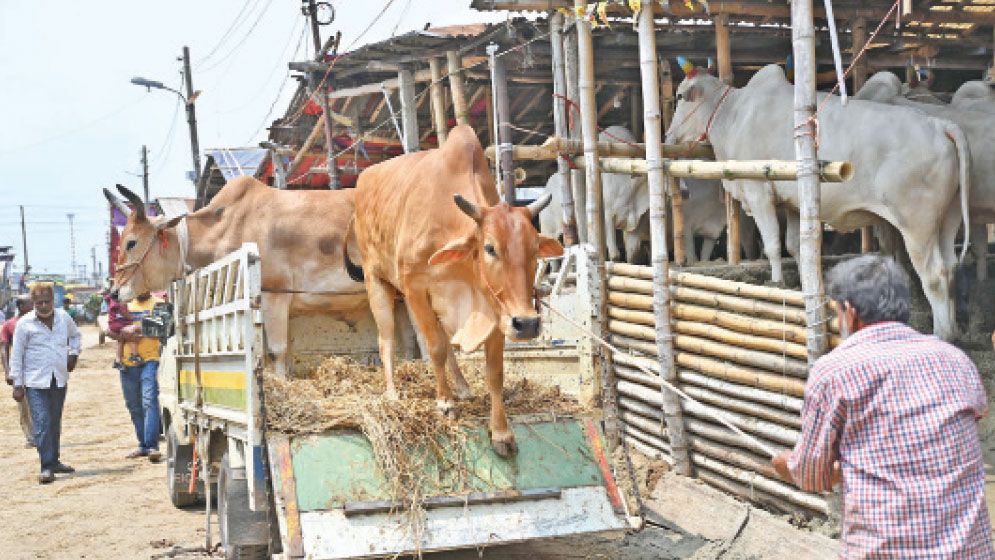
High truck fares pushing up cattle prices. The photo was taken at the Sagorika cattle market in Chattogram. PHOTO: DAILY SUN
At 2pm on Monday, the heat at Chattogram’s Sagorika cattle market was a suffocating 33 degrees celsius. Sweat dripped steadily down the faces of buyer Minhajul Islam and trader Nazim Member, their voices strained as they bargained over the price of a lone cow.
But after nearly an hour of tense negotiations, the two could not reach an agreement. Frustrated, Minhajul, a private bank official, eventually walked away after hearing the trader’s final offer.
“Last year, I bought a cow of this size for Tk1.10 lakh. This year they are asking Tk1.60 lakh,” he said while leaving the market. “How can the price of a single cow increase by Tk50,000 within a year?”
The seller, Nazim Member, reacted sharply when asked about the higher prices.
“Everyone only sees that we are unwilling to lower prices. Feed prices have doubled, and transporting the cattle here costs an extra Tk20,000,” he retorted.
Visits to Sagorika, Bibirhat, and several nearby farms, along with interviews with traders, farmers, and buyers, suggest that soaring feed prices and transport costs are the main drivers behind this year’s unusually expensive Eid cattle market.
Traders also blamed high market lease fees and unofficial roadside charges for pushing prices to unprecedented heights.A market yet to fully take off With only two days left before Eid-ul-Azha, trading at Chattogram’s major cattle markets has yet to gain full momentum. Humid weather and sticker shock have kept many buyers at bay.
Market observations showed that cattle prices varied widely, with some of them selling between Tk7 lakh and Tk9 lakh, while premium offers were going beyond Tk10 lakh.
Buyers noted that prices have jumped by Tk30,000 to Tk70,000 per animal compared to last year. Smaller cattle have seen some of the steepest percentage hikes, with even low-range cows rarely available below Tk70,000.
Touhidul Islam, a private employee from Muradpur, sat exhausted at a tea stall beside the Bibirhat market after visiting three different spots with a strict budget of Tk65,000.
“No one is even negotiating below Tk75,000,” he said, staring blankly at the crowds. “Last year, I could easily get a cow of this size for Tk55,000. This year, the markets are packed with cattle, yet the prices just won't drop.”
Truck fares eating into the margins
Most of Chattogram's sacrificial animals are trucked in from northern and western districts like Kushtia, Pabna, Natore, Sirajganj, and Meherpur. Traders say transport costs from those regions have surged drastically this year.
Under normal seasonal conditions, hiring a large truck to carry 15 to 18 cattle to Chattogram costs around Tk35,000 to Tk40,000. This year, however, transport costs have skyrocketed to between Tk55,000 and Tk65,000 per truck.
Saidul Islam, a trader who traveled from Bheramara in Kushtia, explained how the mathematics of supply lines trickles down to the consumer.
“I brought 15 cows in one truck and paid Tk60,000 in transport fare,” Saidul explained. “Another Tk5,000 went into highway tolls and unofficial payments on the road. By the time I set foot in Chattogram, transport costs alone had added roughly Tk4,300 to the price tag of every single cow.”
“Feed, medicine, labour, and electricity costs have all increased on the farm. Then we get here and face market expenses. Naturally, we have to pass those costs onto the buyers,” he added.
The compounding costs of waiting
The financial bleeding doesn't stop upon arrival. Ananda Mohan Tripura, who brought six cows from Sitakunda to the Sagorika market, said he had to pay Tk2,000 in space rent immediately after unloading.
“If the cattle remain unsold today, I may have to pay that rent again tomorrow. Eventually, all of these compounding daily costs are reflected in the final price of the animal,” he said.
According to Nurur Huda, president of the Chattogram District Dairy Farmers Association, feed prices remained volatile throughout the year, putting independent farmers under severe financial strain long before Eid approached.
“Farmers have been forced to increase cattle prices simply to survive and recoup their investments in feed and veterinary medicine,” Huda said.
Analysing the situation, Prof Alauddin Majumder of the Economics Department at the University of Chittagong noted that while supply chain pressures are real, market psychology also plays a massive role.
“Feed and transport costs are clearly the primary foundation behind this price hike,” Prof Majumder said. “However, because the Eid cattle market is highly emotional and strictly time-sensitive, some opportunistic traders will always take advantage of the final hours of seasonal demand to maximise their profit margins.”
Read More