


 For all latest news, follow the Daily Sun's Google News channel.


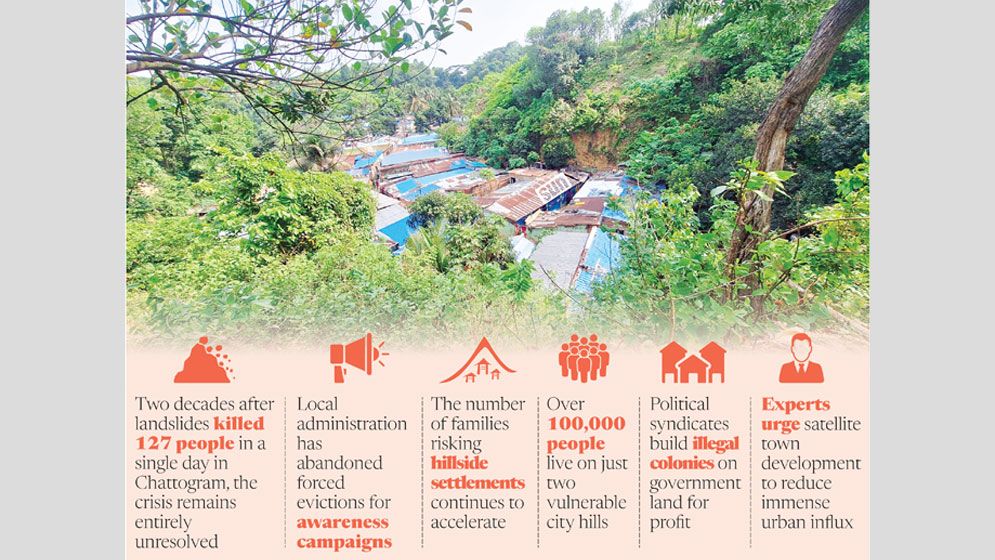
Photo: Daily Sun
Nearly two decades after rain-induced landslides killed 127 people in Chattogram in a single day, efforts to resolve the crisis of illegal and perilous hillside settlements remain entirely stalled.
In a significant shift in strategy, the local administration has stepped back from forced evictions, choosing instead to focus on seasonal awareness campaigns – a move critics describe as inadequate.
Meanwhile, the scale of the danger is accelerating. Official data illustrates a staggering trajectory: in 2019, some 835 families were recorded across 17 hills. By June 2024, that figure had climbed to 6,558 families across 26 hills.
The true scale of the crisis, however, is far greater.
At a Hill Management Committee meeting in January, the Chattogram City Corporation’s then chief executive officer revealed that approximately 100,000 people reside on the Motijharna and Batali Hills alone, with 10,000 families facing imminent risk.
Recent visits to Matijharna, Batali Hill, Akbar Shah, and Firoj Shah confirm that settlements on these precarious slopes continue to expand.
Following the June 2007 tragedy, the high-powered Hill Management Committee was formed in 2008.
While it put forward extensive recommendations for evictions and rehabilitation, the vast majority have never been implemented.
Periodic eviction drives over the years have failed to yield results, as encroachers routinely return due to a lack of permanent safeguarding measures by both landowners and the state.
Defending the current approach, Shakhawate Jamil Saikat, the committee’s member secretary and additional deputy commissioner (revenue), stated that an action plan is now underway to raise awareness.
"Those living on the hills are homeless and not landowners. We are not currently considering eviction and are instead prioritising their safety during the rainy season through awareness programmes launched since April," Saikat said.
"Forced eviction will not provide a lasting solution, as the areas will be re-encroached within a short time. We are also trying to help the residents through employment opportunities and social safety allowances," he added, noting that resettling such vast numbers within the city limits is simply "not feasible."
Urban planning experts, however, argue that the crisis cannot be solved without addressing its structural socioeconomic drivers.
Professor Muhammad Rashidul Hasan, dean of architecture and planning at the Chittagong University of Engineering and Technology (CUET), urged the government to provide affordable housing for the low-income workforce.
"Due to a lack of cheaper accommodation, poor people often end up living in risky settlements built on government khas land by politically influential people for commercial gain," Professor Hasan said, adding that to prevent further encroachment, the hills must be transformed into "green and open spaces, parks, or public walking areas."
Md Abu Issa Anshary, deputy chief town planner at the Chattogram Development Authority (CDA), noted that the settlements are driven primarily by land-grabbing, exacerbated by lopsided regional development.
"There is a strong tendency among people to move towards the city centre as urbanisation in nearby growth centres like municipalities has not been developed as expected," Issa Anshary said.
He suggested that developing satellite towns in nearby upazilas is essential to curb the rural-to-urban influx.
Engineers and civic activists argue that the core issue is accountability.
Engineer Delwar Majumder, former president of the Institution of Engineers, Bangladesh (IEB) Chattogram centre, stated that a permanent solution depends entirely on political will.
Criticising the authorities for limiting their role to "seasonal awareness and temporary relocation during the monsoon," Delwar insisted that the landlords themselves must be held accountable. "There are owners of these hills and they should be brought to justice for the casualties at the risky spots," he said.
Read More