


 For all latest news, follow the Daily Sun's Google News channel.


Every Eid-ul-Azha, Bangladesh is handed one of its most valuable natural resources almost free of charge: the hides of more than a crore sacrificial animals. And every year, a substantial portion of that bounty rots before it can be turned into money.
The numbers tell a damning story. A trader who has worked the rawhide markets of Shariatpur’s Goshairhat thana for over three decades, Hasan Bepary, recalls when a single cowhide fetched around Tk2,000 during the festival.
Last year, he was buying them for between Tk250 and Tk700 each. “I don’t buy goat rawhides now,” he told this correspondent. “Wholesalers refuse to take them from us.”
The losses are not merely commercial. Last year, 37 of Bepary’s purchased hides decomposed entirely – unsalted for too long whilst he gathered consignments from multiple locations.
“As a small trader, such a loss severely affects my ability to support my family,” he said.
The hides had come largely from madrassas and individuals, and the delay between slaughter and salting had simply been too long.
That delay is at the heart of what experts describe as a preventable crisis.
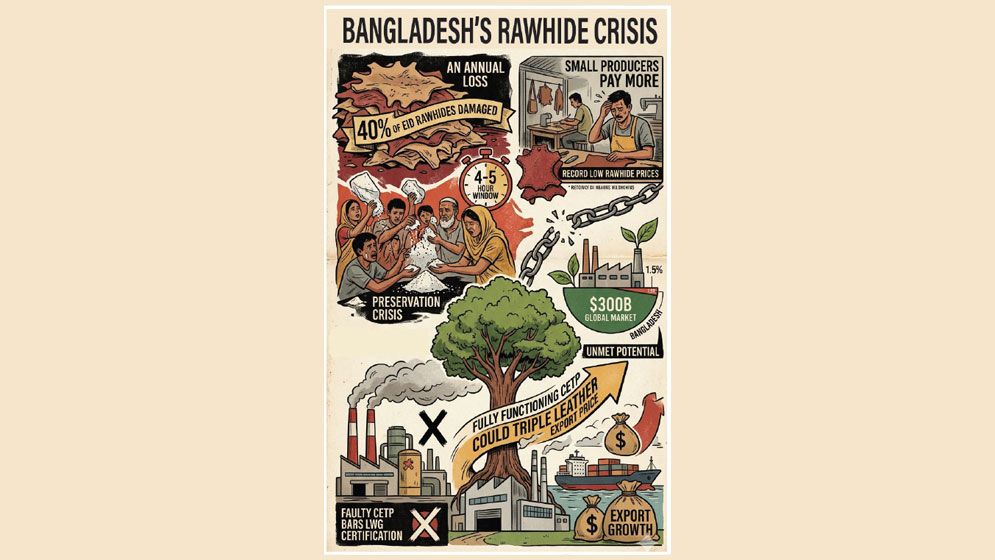
According to Dr Mohammed Mizanur Rahman, former director of the Institute of Leather Engineering and Technology (ILET) and a professor at Dhaka University’s Department of Applied Chemistry and Chemical Engineering, around 40% of rawhides are damaged every year during the Eid season alone – most of it avoidable.
“If we preserve rawhides properly, sprinkle salt on them in time to prevent bacterial attack, and slaughter by skilled hands,” Dr Mizanur said, “the price of rawhides can be increased by up to ten times from current levels.”
He urged the government to train slaughtermen and modernise the Central Effluent Treatment Plant (CETP) at the BSCIC Tannery Industrial Estate in Savar, arguing that without credible environmental compliance, Bangladesh will remain locked out of the lucrative markets it is trying to enter.
The stakes could hardly be higher. The global leather and leather goods market is worth approximately $300 billion.
Bangladesh currently holds a roughly 1.5% share of it – a figure that Commerce Minister Khandakar Abdul Muktadir has said could be transformed if the sector were properly harnessed.
“If we were able to export all the leather produced in Bangladesh, this sector could become an export industry worth at least $12 billion,” the minister said.
Currently, the country utilises only 0.26% of its leather potential.
Industry leaders point to the CETP as the single most critical bottleneck.
Asikur Rahman, vice chairman of the Bangladesh Tanners Association, explained that the plant can currently treat between 14,000 and 18,000 cubic metres of waste – far short of the approximately 45,000 cubic metres required during the post-Eid peak period.
Without a fully functional CETP, tanneries cannot obtain Leather Working Group (LWG) certification, which European and other Western buyers increasingly require as a condition of doing business.
“Now, we sell rawhide to China at very reasonable prices, as we cannot attract other international buyers,” Asikur said.
“If our CETP is approved, many companies will get LWG certification. We can increase our product prices from 40-50 cents to $1.20. The benefits would flow down to individuals at the local level.”
The relocation of tanneries from Hazaribagh to Savar – a process that disrupted the industry’s growth significantly – compounded these compliance difficulties.
Many tannery owners emerged from the shift financially strained, with reduced production capacity and the added burden of environmental costs that made purchasing rawhides at competitive prices increasingly difficult.
Whilst large-scale structural problems hobble the sector from above, small producers are being squeezed from below.
Maksuda Khatun, proprietor of Shabab Leather, has spent 11 years making shoes, bags, and belts for export markets including Italy, China, Japan, and Malaysia.
She told this correspondent that small businesses like hers see little benefit from the depressed rawhide prices that make headlines each Eid.
“I have to buy leather at higher prices to manufacture leather goods,” she said. “The prices of leather have increased two to three times in the last five years. There may be a syndicate taking the benefits. Small business people don’t get the advantages.”
She added that despite strong global demand for leather products, Bangladeshi producers lack adequate exhibition platforms abroad and receive insufficient government support for international marketing.
Manjur Hasan, president of the Bangladesh Hide and Skin Merchant Association, was blunt about what it would take to reverse the trend.
“The rawhide market will not change except with the development of the CETP,” he said, adding that his association stands ready to pay government-fixed prices for good-quality hides – but cannot justify those rates for deteriorated stock. “Rawhides should be salted within four to five hours to get good prices.”
The government has taken some steps.
This year, it allocated Tk17.60 crore for the nationwide distribution of salt to prevent post-slaughter spoilage – building on last year’s programme, in which over 8,000 tonnes of salt were distributed through madrassas, orphanages, and charitable institutions, helping to preserve an estimated 13.8 lakh hides.
The commerce minister has also fixed prices for salted cowhide at Tk62 to Tk67 per square foot in Dhaka, and Tk57 to Tk62 outside the capital.
Yet experts argue that salt distribution alone will not rescue a sector that requires modernised abattoirs, trained slaughtermen, and an internationally credible waste treatment infrastructure.
The data from the Ministry of Fisheries and Livestock show that around 1.23 crore sacrificial animals are expected to be slaughtered this Eid – a vast annual replenishment of raw material that most competing nations simply do not have.
(This is the first instalment of a two-part series on Bangladesh’s leather sector.)