


 For all latest news, follow the Daily Sun's Google News channel.


Over 4.26 lakh sacrificial animals ready ahead of Eid in Dinajpur
Daily Sun Report, Dinajpur
Published: 23 May 2026, 12:00 AM
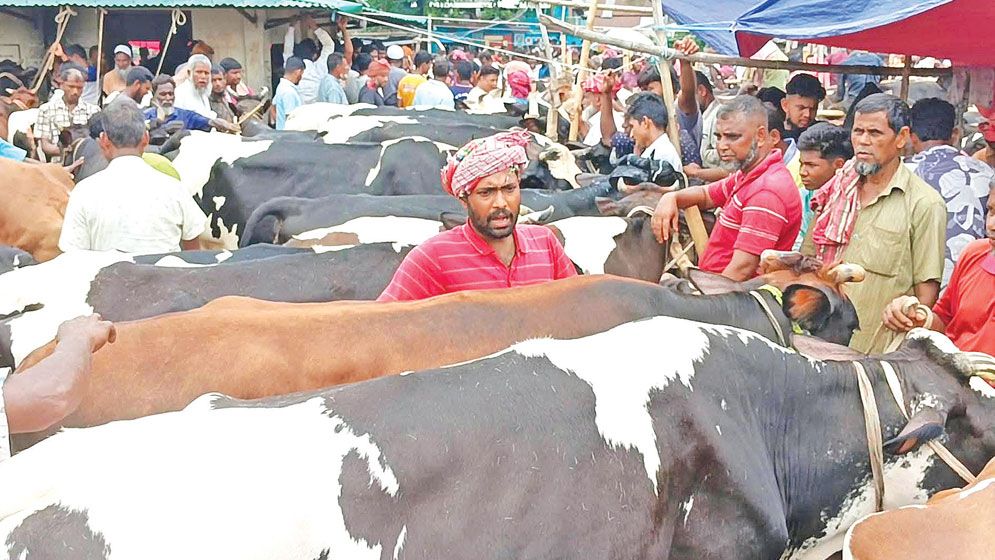
A surplus of sacrificial animals has been prepared in Dinajpur ahead of Eid-ul-Azha, with more than 4.26 lakh cattle and goats ready for sale against the district’s demand.
According to the District Livestock Department, 62,408 farmers and private entrepreneurs have prepared 4,26,523 animals for sacrifice this year. The stock includes 1,77,546 cows, 248 buffaloes, 2,34,990 goats, 13,729 sheep and 21 lambs.
Farmers have already started bringing animals to 68 cattle markets across 13 upazilas of the district, while wholesalers from different parts of the country have also begun purchasing animals in advance.
Major cattle markets, including Ranirbandar in Chirirbandar upazila, Raniganj in Ghoraghat, Ambari in Parbatipur and Kaharol, have also witnessed increasing arrivals of wholesalers.
However, traders said the number of general buyers remains low so far as many are waiting until the final days before Eid to purchase animals. Wholesalers said demand is higher for small and medium-sized cows compared to large-sized cattle.
District Livestock Officer Dr Md Abdur Rahim said the district currently has more than twice the number of animals needed for Eid sacrifice. “We have encouraged farmers to rear animals naturally without harmful substances,” he said.
Farmers, however, expressed concern over low prices despite high production costs caused by increased feed prices. Farmer Hares Ali, who brought five Shahiwal bulls to Ambari cattle market in Parbatipur, said he was seeking Tk2.5 lakh for each animal, but buyers were offering only Tk1.5 lakh to Tk1.7 lakh.
Buyers said cattle prices appear slightly lower this year compared to previous years, while many prefer to purchase animals closer to Eid to avoid the hassle of keeping them at home for several days.
Superintendent of Police Md Zedan Al Musa said strict security measures have been taken at cattle markets, including deployment of plainclothes police to prevent counterfeit currency transactions.
Veterinary teams and bank representatives have also been stationed at markets to check animal health and detect fake notes, officials said.
The Livestock Department said mobile courts are operating to prevent excessive toll collection at cattle markets and ensure fair trading conditions.