


 For all latest news, follow the Daily Sun's Google News channel.


Researchers have revealed the presence of microplastics in the edible parts of fish in the Halda River, the lone natural carp breeding ground in South Asia.
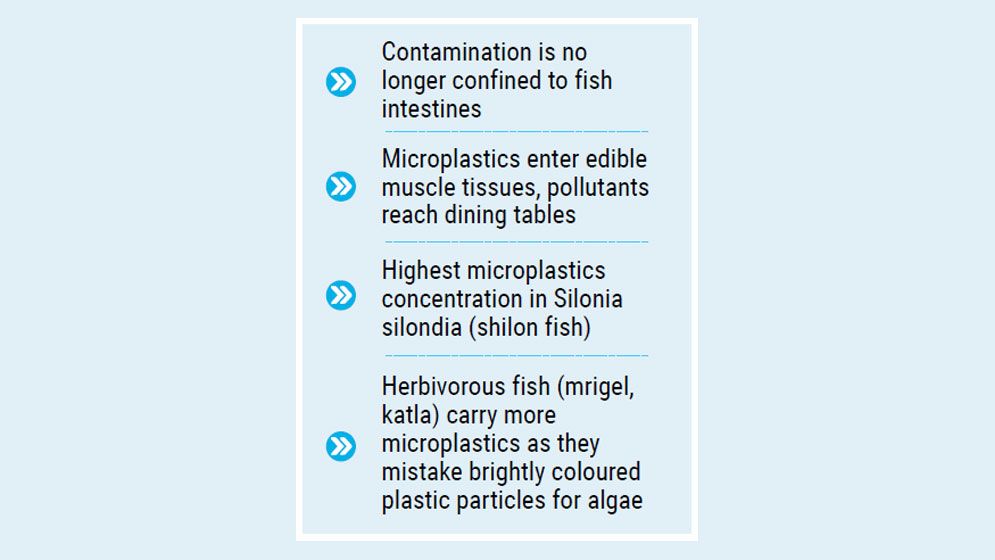
In a study, they found that contamination is no longer confined to fish intestines. Microplastics have also entered edible muscle tissues, meaning the pollutants are directly reaching dining tables through fish consumed across the country.
The study, titled "Microplastic pollution in fish from Halda River, a natural carp breeding habitat in Bangladesh," was published in a recent issue of the Dhaka University Journal of Biological Sciences.
It marks the first comprehensive survey of the prevalence of microplastics in the Halda River.
The research team included research fellow Shanjida Akter as lead author, corresponding author Dr Gautam Kumar Kundu, research fellows Saikat Das and Md Monirul Islam, all from the Fisheries department of Dhaka University, Bangladesh Council of Scientific and Industrial Research (BCSIR) Senior Scientific Officer Muhammad Saiful Islam, and Halda River Research Laboratory founder and BGC Trust University Vice Chancellor Professor Dr Md Manzoorul Kibria.
In 2022, the research team collected 48 individual fish belonging to eight species from three points along the Halda - Nazirhat, Sattarghat and Modunaghat.
The gastrointestinal tract (GIT) and muscle tissue of each fish were examined separately using hydrogen peroxide digestion and advanced ATR-FTIR spectroscopy.
Separate examinations of fish gastrointestinal tracts and muscle tissues revealed microplastics in every single specimen tested.
On average, researchers found 6.5 plastic particles in the gastrointestinal tract and 6.1 particles in muscle tissue per fish.
Scientists say the presence of microplastics in edible flesh significantly heightens food safety concerns.
Talking to the Daily Sun, lead researcher Shanjida Akter said, “Microplastics in muscle and gastrointestinal tissues indicate that the contamination has moved beyond external exposure and entered biological tissues.”
“This creates a direct pathway for microplastics to enter the human body through fish consumption,” she said.
The study also notes that plastic particles can remain attached to fish skin even after washing, increasing risks for people who consume small fish whole.
Species at risk
Researchers found the highest concentration of microplastics in Silonia silondia, locally known as shilon fish.
The species contained an average of 10.8 microplastic particles in the gut and 8.2 particles in muscle tissue.
Scientists believe the fish’s feeding behaviour explains the elevated contamination. The species feeds on small bottom-dwelling organisms that themselves accumulate plastic particles from river sediments.
As a result, the fish is exposed to plastics from both the river surface and benthic layers, offering insight into how pollution spreads across the Halda ecosystem.
Herbivorous more contaminated than carnivorous
One of the study’s more surprising findings was that herbivorous fish, including mrigel and katla, carried higher concentrations of microplastics than carnivorous species.
Researchers say brightly coloured plastic particles floating near the water surface are often mistaken for algae or natural food sources.
“The higher concentration of plastics in herbivorous fish suggests that the pelagic zone of the Halda the upper water layer - is more heavily polluted,” said Prof Kibria.
Industrial waste identified as major source
The study estimates that 53% of the pollution originates from industrial waste.
Textile factories, packaging industries, tanneries, paper mills and power plants were identified as major contributors.
Most of the recovered particles were fibre-shaped and green in colour.
Using ATR-FTIR spectroscopy, researchers found that nearly half of the detected plastics were polypropylene (PP), a material widely used in packaging products and textile manufacturing.
The study also points to synthetic fibres released from laundry wastewater and discarded fishing nets as additional sources of contamination.
Lead, mercury & cadmium - A ‘Double Toxicity’
Researchers warned that the health risks extend beyond plastic particles themselves.
Bangladeshis consume an average of 62.58 grams of fish daily, meaning contaminated fish could become a significant route of human exposure to microplastics.
Scanning Electron Microscope (SEM) analysis showed that weathered plastic particles contain cracks and grooves capable of absorbing toxic heavy metals such as mercury, lead and cadmium from river water.
Scientists describe the process as “double toxicity” because fish ingest both plastic particles and toxic chemicals simultaneously.
Prof Kibria warned, “If industrial discharge is not controlled immediately, the reproductive capacity of carp species will decline, while long-term health complications in humans will continue to rise.”
“Microplastics, which enter the human body through food, may increase the risks of chronic inflammation, cellular damage, hormonal imbalance and cancer,” added the researcher.
Impact on Fish Biology
The study further found that microplastic pollution may be affecting the biological and neurological functions of fish.
Researchers noted that microplastics can reduce the activity of acetylcholinesterase (AChE), an enzyme essential for nerve signal transmission in fish brains.
Reduced enzyme activity may lead to behavioural abnormalities, feeding difficulties and impaired movement.
“If the reproductive cycle is disrupted, Halda could lose its unique ecological identity,” said Shanjida Akter.
“This is not only an environmental crisis; it is also a serious warning for Bangladesh’s fisheries economy,” she added.
A Window for Action
Despite the alarming findings, researchers say the Halda ecosystem has not yet reached irreversible collapse, as no strong evidence of biomagnification was found.
They believe immediate action - including strict industrial waste control, better plastic waste management and continuous monitoring — could still save the river.