


 For all latest news, follow the Daily Sun's Google News channel.


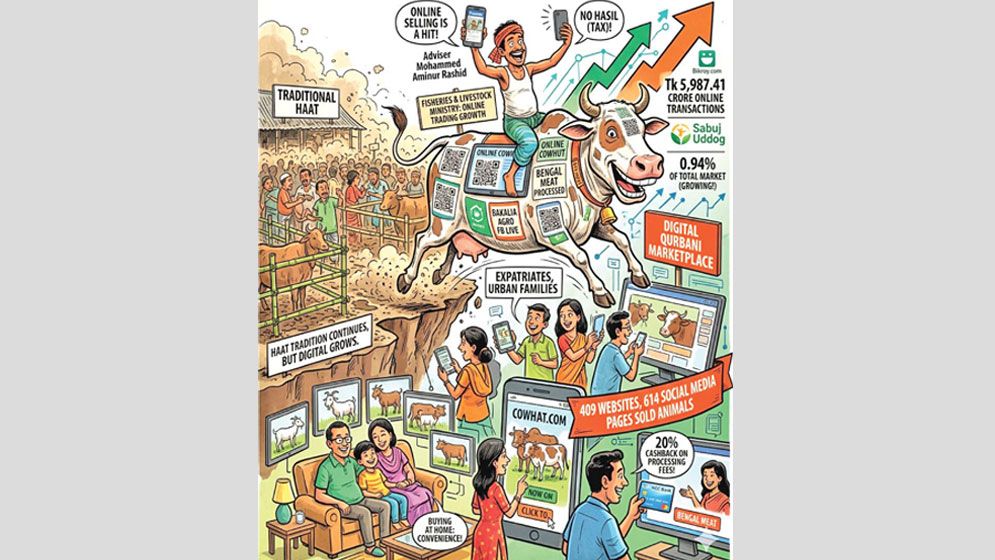
Online sales of sacrificial animals are gradually transforming Bangladesh’s traditional Qurbani cattle market and offering buyers greater convenience while helping farmers and businesses reach wider customers through digital platforms.
Although visiting cattle markets remains a long-standing Eid-ul-Azha tradition, online buying and selling of sacrificial animals has steadily expanded in recent years after the Covid-19 pandemic in 2020.
According to the Ministry of Fisheries and Livestock, a total of 409 websites and 614 social media pages sold Qurbani animals in 2025. Last year, around 91.36 lakh animals were sacrificed across the country, of which 85,626 were sold online through transactions worth Tk5,987.41 crore. Online sales accounted for around 0.94% of the total market.
The government is encouraging online cattle trading. On 3 May, Fisheries and Livestock Adviser Mohammed Aminur Rashid said no tax or “hasil” would be imposed on online Qurbani animal purchases to make digital trading more popular.
Many farm owners now use social media and websites to market animals. Bakalia Agro owner Mohammad Forhad said he promotes cows through his Facebook page by posting photos, videos and contact details.
“Interested buyers contact me after seeing the posts. Most still prefer visiting the farm before buying, though some purchase directly online. After payment, we deliver the animals to customers’ homes,” he said.
Forhad, who has been in the business for 14 years, said online promotion has become an effective way to reach customers.
Pabna-based entrepreneur Sagor Ahmed launched the website cowhut.com during the Covid-19 outbreak in 2020 and now sells cattle year-round, including during Eid season.
“I initially received orders from previous customers. Now we get orders regularly, especially from expatriates and people unable to visit cattle markets physically,” he said, adding that cows are delivered to Dhaka and other areas.
Besides individual farms, established businesses are also entering the online Qurbani market.
Sabuj Uddog, which sells food products online and offline, offers goats at Tk20,000 each and provides home delivery of meat after Qurbani. It also offers shared cow sacrifices for Tk27,000 per share.
Bengal Meat, another major platform, sells cows priced between Tk1.6 lakh and Tk4.1 lakh, while sheep and goats range from Tk16,000 to Tk49,000. The company provides detailed information on each animal, including age, weight, breed, colour, feed management and health condition.
Customers can buy live cattle, order processed meat with home delivery on Eid day or participate in shared Qurbani arrangements.
Online marketplace Bikroy.com is also widely used for cattle sales, with sellers posting animal photos, prices and contact details.
Financial institutions have also joined the trend. NCC Bank recently announced up to 20% cashback, capped at Tk5,500, on Bengal Meat processing fees for payments made through its credit cards.
The growing use of digital platforms in Qurbani cattle sales is gradually reshaping Bangladesh’s livestock market by combining traditional trade with modern technology.
Read More