



 For all latest news, follow the Daily Sun's Google News channel.


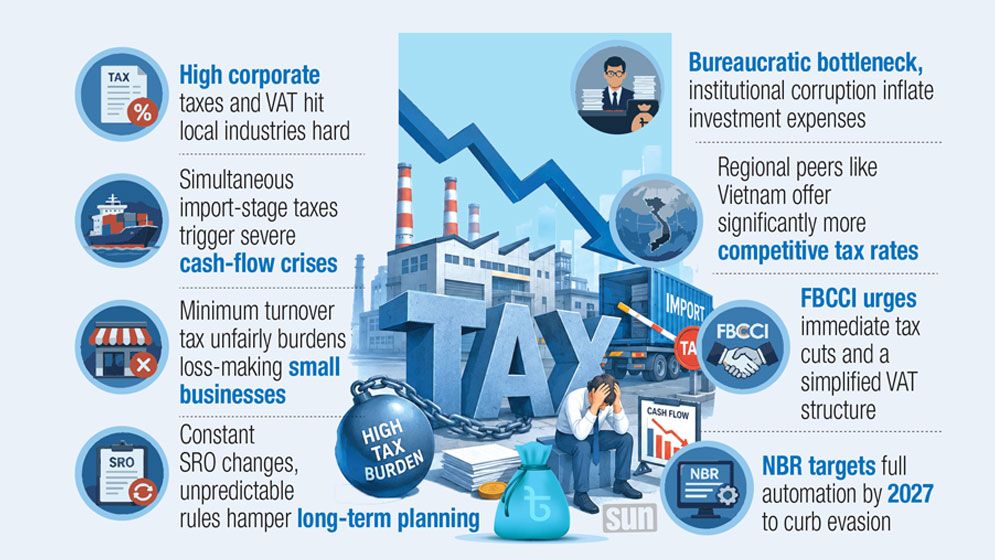
Bangladesh’s local industries are facing a severe squeeze as high VAT and corporate tax rates erode competitiveness, drain liquidity, and stall fresh investment.
Business leaders warn that the current fiscal framework has become a primary cost driver, leaving firms under acute financial distress.
Working capital is under particular strain due to the simultaneous payment of Advance Income Tax (AIT), Advance Tax (AT), VAT, and customs duties at the import stage – forcing import-dependent sectors to pay crippling taxes long before production even begins.
Barriers to entry remain high
Compounding these cash-flow pressures are high corporate tax rates that limit reinvestment capacity, alongside rising interest rates, surging energy costs, and currency volatility.
The turn-over-based minimum tax has drawn fierce criticism for forcing even loss-making enterprises to pay taxes on revenue, a structure hitting fragile SMEs hardest.
Furthermore, multiple VAT stages are fueling inflationary pressures, as businesses are often unable to absorb or pass on these costs in a competitive market.
At a recent briefing, the Japan-Bangladesh Chamber of Commerce and Industry (JBCCI) noted that Bangladesh’s corporate tax structure lags far behind regional peers like Vietnam and Thailand, both of which maintain rates around 20%, making them significantly more attractive to foreign investors.
Launching a business also remains a bureaucratic minefield.
An SME Foundation study revealed that 57% of entrepreneurs view the tax structure as their biggest hurdle to operating legally, while over half struggle with trade licence renewals and compliance costs.
Worse still, corruption remains institutionalised; a joint survey by the Centre for Governance Studies (CGS) and the Center for International Private Enterprise (CIPE) found that 52% of SME owners had to make unofficial payments to secure licences, with 90% reporting widespread corruption in business services.
Despite digital drives, physical interactions and middlemen continue to drive up costs.
Complex VAT system under scrutiny
The National Board of Revenue (NBR) currently enforces a 15% VAT on annual turnovers above Tk50 lakh, and a 3% turnover tax for those between Tk30 lakh and Tk50 lakh – a threshold entrepreneurs argue disproportionately penalises smaller firms.
Constant amendments to Statutory Regulatory Orders (SROs) only add to the unpredictability, hamstringing long-term corporate planning.
While competing economies like Singapore and Vietnam use seamless “one-stop” digital portals to register companies within days, Bangladesh remains bogged down by paperwork.
Delays in utility connections, land registration, and customs clearance continue to stack up hidden costs for investors.
What the experts say
Analyses from industry insiders suggest that policy overhauls are long overdue. “Businesses require stronger policy support to survive and grow,” noted former NBR chairman Badiur Rahman, though he cautioned that safeguards must remain to prevent the misuse of tax incentives.
FBCCI Administrator Md Abdur Rahim Khan was more direct, stating that the existing regime has severely weakened industrial competitiveness.
He proposed slashing the minimum turnover tax from 1% to 0.25% before phasing it out entirely, alongside tax exemptions for new, loss-making, or crisis-hit enterprises.
The FBCCI has also urged the government to lower corporate tax rates, raise the tax-free income threshold to Tk500,000, and introduce a uniform 2% VAT on locally traded goods to simplify compliance and curb inflation.
NBR targets digital overhaul
In response, NBR Chairman Md Abdur Rahman Khan said that the upcoming budget will focus on expanding VAT coverage and automating administration to cut evasion.
According to NBR sources, preparations for the national budget for 2026-27 fiscal year are centered on a technology-driven model.
Plans include QR code-based tracking for packaged goods to monitor supply chains, alongside the rollout of e-VAT and digitised income tax refund systems to eliminate manual intervention.
The revenue authority aims for a fully automated monitoring system by 2027, relying on real-time data and risk-based audits to streamline compliance.
Read More