




 For all latest news, follow the Daily Sun's Google News channel.


Commentary
Citizens unprotected under Cyber Protection Act
Special Correspondent, Dhaka
Published: 18 May 2026, 12:00 AM
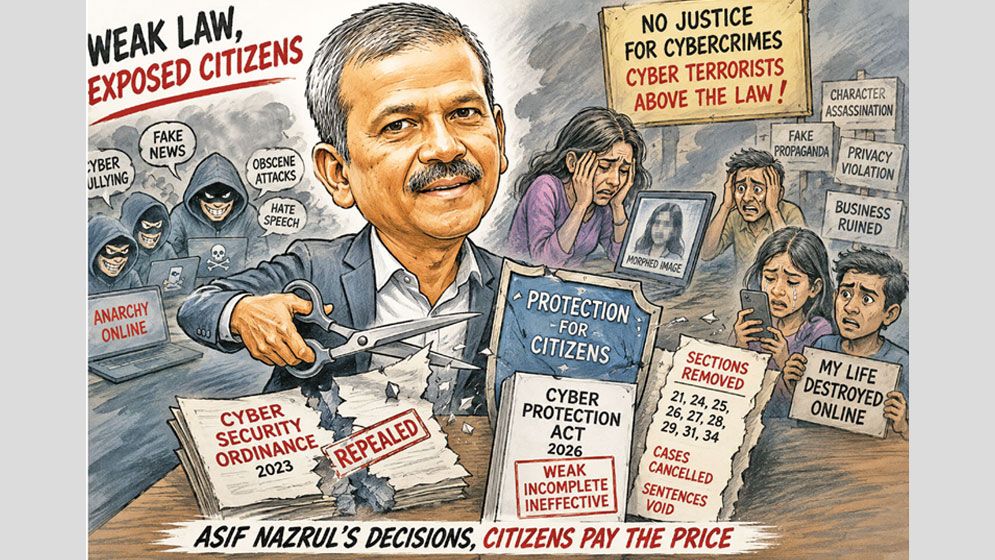
Currently, there is no law in the country against crimes committed on social media. On 10 April, the “Cyber Security Ordinance” – initially formulated by former law adviser Asif Nazrul – was renamed and enacted as the Cyber Protection Act. However, this law is weak and ineffective in suppressing the alarmingly rising rate of cybercrime.
Unregulated social media is detrimental to any society. Instead of fostering mutual communication, social media has now become a tool to attack, humiliate, and crush others using filthy, obscene, and malicious language. The primary occupation of a section of twisted-minded individuals is character assassination, blackmail, and extortion. Due to unregulated social media, public life is endangered today, and people are living in fear. The personal privacy and security of citizens are being severely disrupted. Victims of vile social media attacks, particularly many women, are choosing suicide. Numerous families are breakingapart because of social media, and businesspeople are living in extreme fear. A form of anarchy and lawlessness is prevailing throughout society.
Various countries around the world have enacted different laws to prevent the harmful use of social media, ensuring the protection of their citizens. However, Bangladesh lacks any effective law to halt this social media autocracy. Although the Jatiya Sangsad (National Parliament) passed the Cyber Protection Act 2026 during its first session on 10 April, the law remains incomplete. This law is not only inadequate but also completely helpless against cyberbullying and social media propaganda. As a result, cybercriminals are becoming more reckless, engaging unimpeded in character assassination.
Previously, the Digital Security Act (DSA) was enacted in 2018 to counter unrestrained autocracy in Bangladesh’s cyberspace. However, that law faced widespread criticism because of its extensive abuse. Certain ambiguities in the law granted immense power to the police and law enforcement agencies, leading to its misuse to suppress dissent and political opponents. Consequently, it was quickly deemed an anti-people law. Nevertheless, the law had correctly identified cybercrimes and included provisions for protecting citizens against them. It prescribed prison sentences and fines for publishing offensive, false, or threatening data; publishing defamatory information; hurting religious sentiments; deteriorating law and order; spreading hatred; and collecting, publishing, or using personal information without permission. In such cases, the law provided for three to seven years’ imprisonment, fines, or both, and 10 years’ imprisonment for repeat offences. In today’s reality, many believe that, despite its flaws, such a law was urgently needed to control these crimes. Whether a law is good or bad depends on its application. Due to its misuse and the excessive power given to law enforcement agencies, it became known as a controversial law, prompting various quarters to demand its amendment. Against this backdrop, the government introduced the Cyber Security Act (CSA) in 2023. This was essentially a rehashed version of the Digital Security Act. One of the primary concerns regarding the Cyber Security Act 2023 was its vague terminology and phrasing. Critics argued that this ambiguity allowed the text to be intentionally interpreted in ways that restricted freedom of speech, posing a potential risk of misuse against journalists and ordinary dissenting citizens.
Following the regime change on 5 August 2024, demands to repeal the Cyber Security Act came to the forefront. At that time, the then law adviser Asif Nazrul announced the repeal of the Digital Security Act without proper planning. Without reviewing the ground realities or seeking feedback from stakeholders, the Digital Security Act was repealed in 2025. In its place, Asif Nazrul promulgated the Cyber Security Act Ordinance. The ordinance stated that the following ordinance, framed and enacted by the President of the People’s Republic of Bangladesh on 21 May 2025, was being published for public information (Ordinance No. 25, 2025). The ordinance noted that the Cyber Security Act 2023 was being repealed to formulate provisions for ensuring cyber security, as well as detecting, preventing, suppressing, and prosecuting crimes committed in cyberspace, along with ancillary matters.
According to the official gazette, while the Cyber Security Act 2023 was repealed, Sections 17, 18, 19, 20, 22, 23, 30, 32, and 35 of that Act remained in force. However, the law was subsequently amended. In the Cyber Protection Ordinance, Sections 21, 24, 25, 26, 27, 28, 29, 31, and 34 of the Cyber Security Act were omitted. The ordinance specified that any pending cases, proceedings, or investigations under these omitted sections would stand cancelled, and no further action could be taken. Furthermore, any sentences or fines imposed by courts or tribunals under these sections would be void.
The sixth chapter of the law (Sections 17 to 30) identifies various cybercrimes and their punishments. Illegal access to or hacking of critical information infrastructure; unauthorised entry into computers, digital devices, or computer systems; causing damage to computers, computer systems, and the physical infrastructure of cyberspace; online gambling; fraud; deception; terrorist activities; sexual harassment; blackmail; publishing obscene videos; religious incitement; and spreading racial animosity and hatred have been categorised as offences. However, this law completely overlooks issues such as personal attacks, false propaganda, the spread of fake news, and violations of the right to personal privacy.
Upon coming to power, the BNP government introduced certain changes to the Cyber Security Ordinance during the first session of the Jatiya Sangsad and passed the Cyber Protection Act. Yet this Act also fails to provide protection to citizens. Cyber experts point out that, under this law, there is no punishment for relentlessly cyberbullying an individual. There is no legal remedy if someone attempts character assassination by using AI to splice a person’s photograph onto another’s. The law offers no legal recourse if false propaganda is spread to ruin a businessperson’s reputation, nor is there any scope to take action if a woman is attacked with obscene language. Critics argue that Asif Nazrul, without understanding the gravity of the situation, has left ordinary citizens exposed to cyber risks, effectively holding the general public hostage to cybercriminals.
Currently, there is no justice for cybercrimes, and cyber terrorists operate above the law. It is the immediate responsibility of the current government to ensure the cyber security of its citizens. Otherwise, not only ordinary citizens but the government itself will not be spared from their clutches.
Recommended Stories