


 For all latest news, follow the Daily Sun's Google News channel.


Motorcycles, auto-rickshaws to face new tax; Tk1,500cr revenue expected
Daily Sun Report, Dhaka
Published: 13 May 2026, 12:00 AM
 The government is set to bring motorcycles and battery-run auto-rickshaws under a new tax regime in the national budget for upcoming 2026-2027 fiscal year (FY27) in a bid to increase revenue collection.
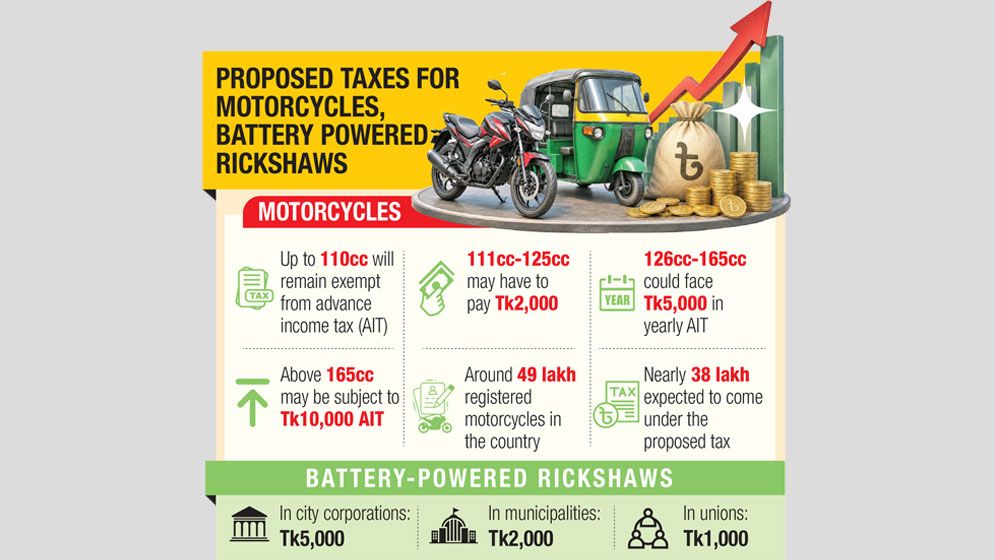
According to a proposal prepared by the National Board of Revenue (NBR), an Advance Income Tax (AIT) ranging from Tk2,000 to Tk10,000 per year may be imposed on motorcycles based on engine capacity (cc or the total volume of an engine's cylinders, measured in cubic centimeters). At the same time, annual taxes are also being planned for battery-run auto-rickshaws depending on operational areas.
The government estimates that the initiative could generate around Tk1,500 crore in additional annual revenue from the motorcycle sector alone.
Under the proposal, motorcycles up to 110cc will remain exempt from advance income tax (AIT). However, owners of motorcycles between 111cc and 125cc may have to pay Tk2,000 annually, while bikes between 126cc and 165cc could face Tk5,000 in yearly AIT. Motorcycles above 165cc may be subject to Tk10,000 annually.
According to the latest data from the Bangladesh Road Transport Authority (BRTA), the number of registered motorcycles in the country currently stands at approximately 49 lakh. Of them, nearly 38 lakh motorcycles are expected to come under the proposed tax structure.
Based on preliminary NBR estimates, if an average of Tk4,000 is collected from each taxable motorcycle, the government could earn nearly Tk1,520 crore annually.
Currently, motorcycle owners are required to pay a one-time registration fee and periodic road taxes. For motorcycles between 50cc and 125cc, the registration fee is around Tk9,291, followed by road tax payments in installments every two years. Registration fees are higher for motorcycles above 125cc. However, no separate advance income tax is currently imposed on motorcycles.
If the new proposal is approved, the AIT will have to be paid during fitness renewal or related service procedures. Motorcycle owners will later be allowed to adjust the amount against their annual income tax return.
Battery powered rickshaws likely to be taxed
The government is also planning to bring battery-powered auto-rickshaws under the tax net. According to the NBR proposal, auto-rickshaws operating in city corporation areas may be charged Tk5,000 annually, while those operating in municipalities may have to pay Tk2,000 and those in union-level areas Tk1,000.
Stakeholders say the auto-rickshaw sector remains one of the country’s largest unregulated transport sectors.
According to estimates by different organisations, between 5 million and 7 million battery-run auto-rickshaws are currently operating across the country, including nearly 1 million to 1.4 million in the capital alone.
A large number of these vehicles operate without formal registration, meaning the government lacks accurate information on ownership, numbers and income generated from the sector.
To address the issue, the government has already drafted the “Electric Three-Wheeler Management Policy 2025”, which proposes mandatory registration certificates, fitness certificates and tax tokens for battery-run three-wheelers. Officials believe bringing these vehicles under formal registration would not only increase revenue collection but also improve traffic management and road discipline.
Experts welcome tax proposal cautiously
Transport experts say imposing advance income tax on motorcycles is not unreasonable, as motorcycles are no longer used solely for personal transportation; many are also used commercially for delivery and ride-sharing services. They argue that expanding the tax net could reduce the burden on existing taxpayers.
However, they also warned that the government should proceed cautiously regarding battery-run auto-rickshaws. According to them, many cities, including Dhaka, are already struggling with excessive numbers of slow-moving three-wheelers, contributing to traffic congestion, road disorder and accidents. Therefore, they suggest bringing the sector under proper regulation before implementing taxation.
Former World Bank Dhaka office Lead Economist Zahid Hussain told the Daily Sun that imposing advance taxes could create additional financial pressure on ordinary citizens, particularly middle- and lower-income motorcycle users. He also noted that implementing taxation in the largely unregulated auto-rickshaw sector could prove difficult.
Meanwhile, industry insiders have expressed concerns over the possible impact of the proposed tax on motorcycle sales and investments. Over the past decade, Bangladesh has seen significant investment in the motorcycle manufacturing and assembly sector.
Currently, companies such as Honda, Yamaha, Suzuki, Bajaj Auto and TVS Motor Company are assembling and marketing different motorcycle models in Bangladesh.
Industry representatives fear the new tax burden could reduce motorcycle sales further at a time when the market is already facing sluggish demand due to fuel shortages and broader economic pressure.
Leaders of the Motorcycle Dealers Association said motorcycle sales have declined over the past several months because of rising fuel costs and weak consumer purchasing power. They warned that adding advance income tax would increase buyers’ expenses and further shrink the market.
Besides the transport sector, the upcoming budget may also introduce several changes to the VAT system.
The government is planning simplified VAT facilities for newly registered businesses and is considering launching instant online BIN (Business Identification Number) registration.
Currently, obtaining a BIN involves lengthy verification procedures. Under the proposed system, businesses may be able to obtain BIN registration instantly online from home.
Changes in VAT exemptions are also under consideration. The government plans to exempt VAT on certain medical products, including heart stents and dialysis tubes, which may reduce healthcare costs for patients.
On the other hand, discussions are underway to increase VAT on rods and photo studio services, which could raise construction and consumer costs.
NBR officials say the overall objective of these measures is to expand the tax net, formalise informal sectors and boost government revenue collection.
However, the proposals are yet to receive final approval and may only be incorporated into the FY27 budget after approval from the prime minister.