


 For all latest news, follow the Daily Sun's Google News channel.


A decades-old blueprint to overhaul the water landscape of the country’s southwestern region is set to take a definitive step forward today.
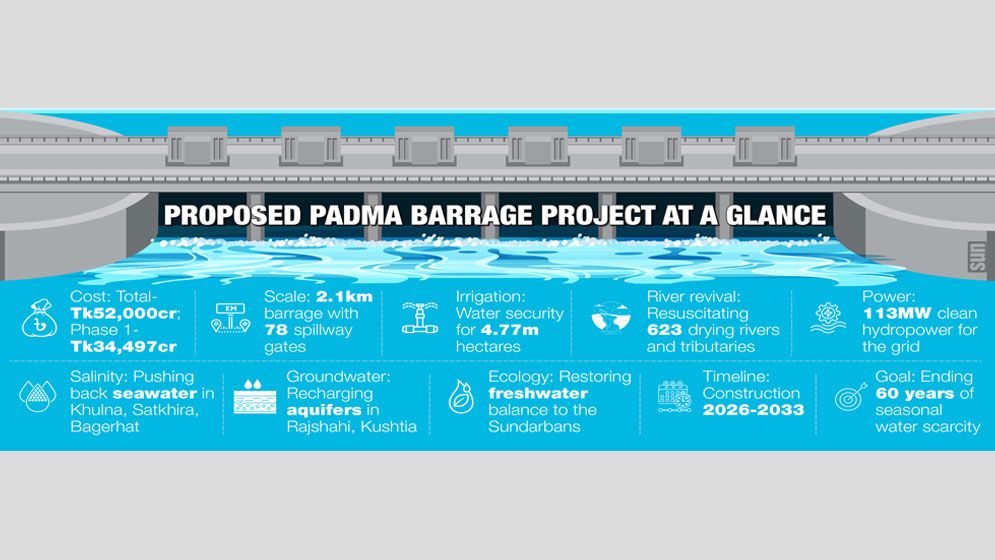
The ambitious Padma Barrage project, a mega-infrastructure scheme involving an estimated cost of Tk34,497 crore in its first phase, is set to be placed before the Executive Committee of the National Economic Council (ECNEC) for formal approval.
If green-lit, the project will represent one of the most significant engineering interventions in the country’s history, aimed at reversing decades of ecological decline, salinity intrusion, and seasonal desiccation across the southwest and northwest regions.
First conceived in the 1960s, the barrage has remained a phantom of national planning for over half a century, repeatedly sidelined by prohibitive costs, technical hurdles, and the delicate geopolitics of transboundary water sharing.
Now, under a renewed developmental mandate, the project has been fast-tracked with a projected completion date of June 2033.
Md Mahmudul Hossain Khan, member (secretary) of the Agriculture, Water Resources and Rural Institutions Division, confirmed to the Daily Sun that the proposal follows exhaustive feasibility studies.
“The Detailed Development Project Proposal (DPP) was submitted and rigorously reviewed. Given its strategic necessity for water security, we have recommended it for approval,” he said.
Engineering a revival
At the heart of the proposal is a 2.1-kilometre barrage across the Padma.
Designed to capture monsoon surplus and regulate flow during the lean dry season, the structure will feature 78 spillway gates and 18 under-sluice gates. Beyond water management, the site is intended to host a 113MW hydropower plant, a navigation lock for river transport, and dedicated fish passages to protect aquatic migration.
The primary objective is the resuscitation of some 623 rivers and tributaries within the Padma basin. Once-mighty waterways that have been reduced to seasonal trickles could see a return of year-round flow.
“The first phase focuses on the main barrage and the Gorai river intake, alongside dredging key systems like the Chandana,” explained Abdul Hamid, Additional Chief Engineer of the Bangladesh Water Development Board (BWDB).
“By maintaining dry-season flow, we can expand cultivation and enable multiple cropping cycles across nearly 4.77 million hectares of farmland.”
Countering the salt
For the coastal districts of Khulna, Satkhira, and Bagerhat, the project is framed as an existential necessity.
Reduced upstream flow has allowed seawater to push further inland, poisoning drinking water and crippling traditional agriculture.
Simultaneously, inland areas like Rajshahi and Kushtia have seen groundwater tables plummet.
A senior BWDB engineer noted that the barrage offers a structural solution to these twin crises: “Regulated freshwater distribution will push back the saline front and reduce our over-reliance on dwindling groundwater.”
Economic hope vs environmental caution
While the potential for a structural shift in agricultural productivity is vast, experts remain divided on the project’s execution and long-term impact.
Dr Mustafa K Mujeri, former chief economist of Bangladesh and executive director of the Institute for Inclusive Finance and Development, told the Daily Sun that the project could be transformative – provided it escapes the “mega-project trap” of delays and graft.
“If technical discipline and quality standards are maintained, the southwest will see a revolution in agriculture,” Dr Mujeri said, adding, “However, ensuring implementation integrity in a project of this magnitude remains the primary challenge.”
Environmental advocates, meanwhile, warn against the hubris of “taming” a river as dynamic as the Padma.
Alamgir Kabir, general secretary of the Bangladesh Environmental Lawyers Association (BELA), urged caution.
“We must ask if similar interventions have truly delivered. Without rigorous, transparent environmental reviews, we risk permanently damaging the natural rhythm of our river systems,” he warned.
A phased approach
To mitigate financial strain – with total costs potentially rising to Tk52,000 crore – the government is opting for a staggered execution.
This first phase prioritises the main barrage and the restoration of the Gorai and Mathabhanga rivers.
Subsequent phases will target the Chitra and Ichamati systems, allowing the deltaic environment time to adjust to the new flow regime.
The reporter can be reached at: [email protected]