




 For all latest news, follow the Daily Sun's Google News channel.


When police entered a house in Rautkona village in Gazipur’s Kapasia upazila on Saturday morning, they found a scene of almost unimaginable carnage.
Three children lay dead on the floor. A young woman’s body hung near a window, bound with rope. A young man was motionless on a bed. All five had their throats slit.
The suspected killer was not a stranger.
He was the husband and father – Forkan Mia – who investigators believe murdered his wife Sharmin, 30, their daughters Mim, 15, Maria, 8, and Faria, 2, and Sharmin’s younger brother Rasel Mia, 22, before fleeing under cover of darkness.
No one in the village knew until morning.
The Kapasia massacre is not an aberration. It is part of an accelerating national emergency.
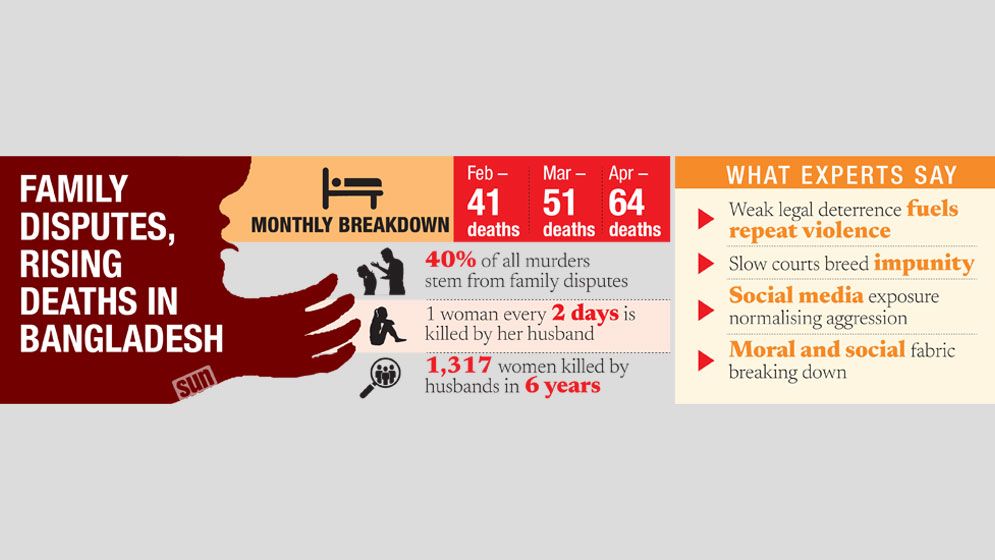
Data compiled by the Human Rights Support Society (HRSS) shows that 156 people were killed in domestic and family violence between February and April this year alone – 41 in February, 51 in March, and 64 in April. The trend is moving in one direction only.
Police headquarters figures suggest that nearly 40% of all murders in Bangladesh are rooted in family disputes.
For women, the danger is most acute within marriage.
According to legal aid organisation Ain o Salish Kendra (ASK), 1,317 women were killed by their husbands over the past six years and three months – an average of 208 deaths a year, or more than 17 a month.
Put another way, a woman in the country is killed by her husband roughly every two days.
In the first three months of this year alone, 41 such killings were recorded.
The cases documented in recent months span the country and defy easy categorisation.
In Naogaon’s Niamatpur upazila on 22 April, a husband, wife and their two children were murdered; police arrested three relatives and said the motive was a property dispute within the family.
On 5 March, in Naogaon’s Atrai upazila, a man killed his wife and young daughter before taking his own life.
On 21 February in Lakshmipur’s Ramganj upazila, a man was beaten to death following a row over a five-taka electricity bill shared between two brothers.
On 2 May in Narsingdi, a CNG driver was killed by his younger brother during a family altercation.
Experts say the violence, though varied in its triggers, shares common roots.
“Relationship struggles and financial hardships are normal, but they are increasingly leading to extreme violence because of a severe lack of personal integrity,” said Dr Tawohidul Haque, associate professor at the Institute of Social Welfare and Research at Dhaka University.
“This crisis is made worse by a slow legal system that fails to deter criminals. If we continue to prioritise materialism over moral education, the family structure itself will be endangered.”
HRSS Executive Director Ejajul Islam pointed to a combination of low public awareness and a sluggish judicial process as key factors allowing such violence to persist and escalate.
Dr Md Kamal Uddin, a professor of psychology at the University of Dhaka, said the violence is typically the product of long-term psychological and social processes that go unaddressed.
“Structural problems in society, delays in justice, weak enforcement, and exposure to violent content on social media all contribute,” he said, adding, “We must act in a planned way for long-term change.”
Bangladesh is not without laws on the books.
The Domestic Violence (Prevention and Protection) Act of 2010 exists specifically to protect victims – but according to Supreme Court lawyer Ishrat Hasan, it remains largely ineffective in practice.
Complaints are routinely treated as private family matters, victims do not receive timely protection, and the judicial process is too slow to act as a deterrent.
“Delays in justice create fear and distrust, and they encourage a culture of impunity,” she said.
Some special tribunals have recently been established, but no visible improvement has yet been observed.
Former Inspector General of Police Muhammad Nurul Huda was candid about the limits of law enforcement in this domain.
“The scope for police to act preventively is very limited,” he said. “Social control has gradually become very fragile. You cannot monitor what is happening inside families.”
Meaningful change, he argued, will only come if society is willing to hold itself to a higher standard and reassert the social norms that once kept such violence in check.