


 For all latest news, follow the Daily Sun's Google News channel.


Electric vehicle market gains pace amid rising fuel costs
Local, foreign automakers expand EV investments as incentives


The electric vehicle (EV) market is gaining momentum as rising fuel prices, persistent energy shortages and growing environmental concerns drive consumers and businesses toward cleaner transportation alternatives.
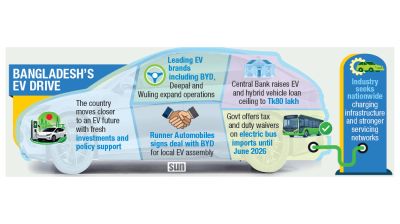
Supported by government policies, tax and duty incentives, easier bank financing and new investments from local and international automobile companies, Bangladesh is gradually moving toward an EV-based future.
Global brands such as BYD, Deepal and Wuling, along with local firms including Runner Automobiles PLC, RANCON Auto Industries and Bangladesh Auto Industries Limited, are expanding their presence in the country’s growing EV sector through new electric and plug-in hybrid vehicle models, local assembly initiatives and manufacturing plans.
Ashraf, in-charge of the Paltan branch of CG Runner Bangladesh Limited, the distributor of BYD in Bangladesh, said the company has already sold nearly 1,000 vehicles and expects sales to rise to between 2,000 and 2,500 units next year.
He said the company has expanded its lineup in response to growing consumer demand.
Previously, BYD offered three models in Bangladesh, but the number has now increased to five, allowing buyers from different income groups to choose vehicles according to their needs and budgets.
One of the key factors driving the popularity of EVs is their lower operating cost. Ashraf said a brand-new Toyota Corolla Cross currently costs around Tk71 lakh, while BYD’s plug-in hybrid model “Sealion-5” is priced at approximately Tk48 lakh.
He added that when driven solely on electric power, the vehicle costs around Tk2.5 to Tk3 per kilometre to operate. A fully charged battery can provide a range of about 71 kilometres, while a combination of a full charge and a full fuel tank allows the vehicle to travel more than 1,000 kilometres.
Business operators say charging infrastructure remains one of the key requirements for expanding EV use in Bangladesh.
Ashraf said charging points are gradually being installed across the country. In addition, every vehicle comes with two charging cables – one for home use and another for portable outdoor charging.
However, due to the limited number of charging stations, many customers remain concerned about long-distance travel.
Industry insiders believe establishing charging networks at fuel stations nationwide could help address the issue.
Businesses call for infrastructure development
Abdul Haque, president of the Bangladesh Reconditioned Vehicles Importers and Dealers Association (BARVIDA), said adequate infrastructure must be developed before large-scale expansion of EV use in the country.
He noted that the government has already formulated the “Automobile Industry Development Policy 2021” and the “Electric Vehicle Industry Development Policy 2025.”
However, considering local investment, employment opportunities and the demand for quality Japanese reconditioned vehicles, he said a comprehensive automobile development policy is necessary.
Quoting JICA, Abdul Haque said Bangladesh would need an annual domestic market of at least one lakh vehicles to justify establishing a large-scale automobile manufacturing industry.
Currently, the country’s automobile market stands at only 25,000 to 30,000 units annually. In this context, BARVIDA has recommended moving forward with a long-term master plan.
According to him, increasing EV adoption in Bangladesh will require more than tax waivers or easy financing.
The country must ensure sufficient charging stations, uninterrupted electricity supply, resilience against waterlogging and a strong servicing network.
The BARVIDA president also called for increased tax and duty benefits for hybrid and plug-in hybrid vehicles.
Growing corporate interest in EVs
Chinese automobile manufacturer Wuling has officially entered the Bangladeshi market.
The brand’s vehicles are being marketed by RANCON Auto Industries, which has announced plans to introduce its plug-in hybrid electric vehicle (PHEV) model “Darryon.”
Company officials claim the vehicle can run up to 125 kilometres solely on battery power and nearly 1,000 kilometres with a full fuel tank and battery charge combined.
RANCON Auto Industries currently has three Wuling models in its lineup. Among them, “Darryon” is the plug-in hybrid model, while the “Almaz RS” and “Cortez” models are being assembled locally in Bangladesh.
Meanwhile, Bangladesh Auto Industries Limited is working on plans to manufacture EVs domestically. The company is preparing to introduce EVs under the brand name “MEV.”
At the exhibition, the company showcased a prototype model named “Surge Z,” which will be available in both fully electric and plug-in hybrid versions.
According to the company, the fully electric version will be capable of running between 350 and 450 kilometres on a single charge.
Managing Director of Bangladesh Auto Industries Limited Mir Masud Kabir said, “Assembly of the vehicle will begin in Bangladesh within the next six months. Initially, the price of the vehicle will range between Tk40 lakh and Tk45 lakh.”
In addition, the recently held 19th Dhaka Auto Series of Exhibitions at the International Convention City Bashundhara (ICCB) showcased a range of new electric and plug-in hybrid vehicles.
More than 70 companies from 10 countries, including Japan, China, India, Malaysia and Germany participated in the exhibition, with many focusing on fuel-efficient, environmentally friendly, electric and hybrid vehicle technologies for the Bangladeshi market.
Runner to manufacture EVs
Runner Group has taken initiatives to manufacture electric vehicles locally in Bangladesh.
Runner Automobiles PLC, a subsidiary of the group, has signed a “Master Supply and Manufacture Agreement” with China’s BYD Auto Industry Company.
Shanat Datta, chief financial officer of Runner Group, said the company is highly interested in manufacturing EVs in Bangladesh.
However, the total investment required for the project has not yet been finalised, and detailed information is expected to be disclosed by next July.
He said although the government is providing various incentives for the sector, infrastructure development must come first.
According to Shanat, the country needs charging facilities at fuel stations, skilled technicians and a reliable servicing network to ensure the long-term sustainability of EV use. He also said Runner has already established charging points in several districts on its own initiative.
Some automobile businesses have expressed concerns that electric vehicles could be vulnerable during waterlogging and flooding, which remain major issues in Bangladesh.
Responding to these concerns, Shanat said the company’s vehicles are designed to withstand waterlogging conditions without sustaining damage.
He added that the company’s EVs have received an overwhelming response from customers.
Runner has already opened seven branches across the country and plans to expand further in the coming years.
Special incentives for buying EVs
To encourage the use of electric vehicles, the government and Bangladesh Bank have announced several financial incentives.
According to Bangladesh Bank’s latest directive, customers can now receive auto loans of up to Tk80 lakh to purchase electric and hybrid vehicles.
While the loan limit for conventional fuel-powered vehicles remains Tk60 lakh, the ceiling has been increased for environmentally friendly vehicles.
Special benefits have also been introduced in the loan-to-equity ratio.
Under the new policy, banks can finance up to 80% of the value of an electric or hybrid vehicle. This means a customer purchasing a vehicle worth Tk1 crore can receive up to Tk80 lakh in financing and only needs to contribute Tk20 lakh from personal funds.
Government offers tax and duty exemptions
The government has also announced tax and duty incentives to promote electric vehicles.
In a recent cabinet meeting, authorities approved duty and tax exemptions on the import of new electric buses.
Under the decision, electric buses with more than 17 seats will be exempted from customs duty, regulatory duty, supplementary duty, advance tax and advance income tax. Only the existing 15% VAT will remain applicable.
Similar facilities are expected to be extended to electric trucks with a carrying capacity of five tonnes or more. The incentives will remain effective until 30 June 2026.