



 For all latest news, follow the Daily Sun's Google News channel.


Special measures taken to reduce staggering case backlog
A huge number of people are waiting for justice in nearly 47 lakh pending cases in all tiers of the courts across the country

A huge number of people are waiting for justice in nearly 47 lakh pending cases in all tiers of the courts across the country while they lose their assets and valuable time.
To get rid of the problems that hinder speedy delivery of justice, the government and the judiciary are taking special measures to tackle the country’s staggering case backlog.
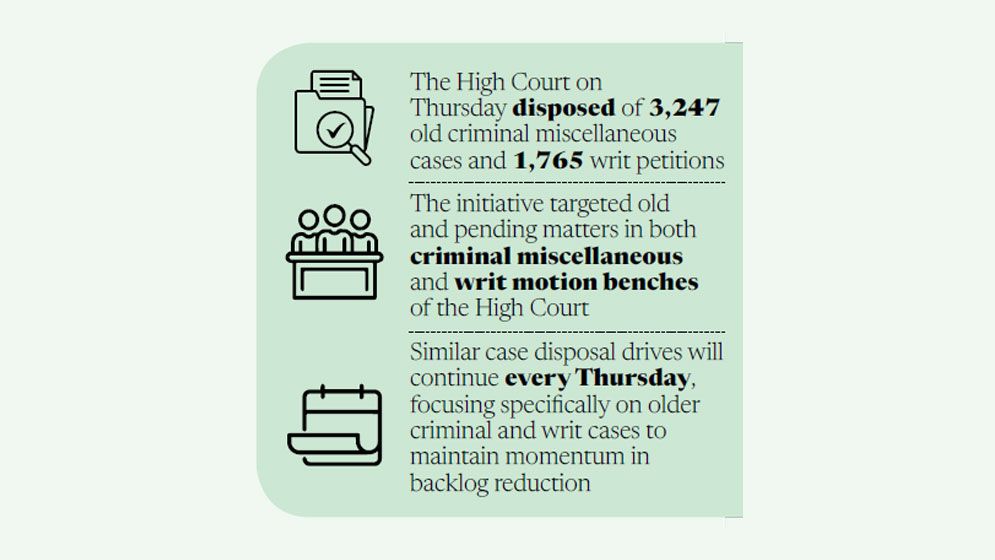
The chief justice has already taken a special move aimed at reducing the case backlog and speeding up justice delivery. As part of the move, over 5,000 old cases were disposed of in the High Court in a single day.
The initiative targeted old and pending matters in both criminal miscellaneous and writ motion benches of the High Court.
Md Shafiqul Islam, public relations officer of the Appellate Division of the Supreme Court, said that the effort is designed to ensure timely justice, reduce procedural delays, and improve overall efficiency in the judicial system.
Similar disposal drives will continue every Thursday, focusing specifically on older criminal and writ cases to maintain momentum in backlog reduction.
Judicial authorities described the development as part of a broader effort to modernise case management and improve access to justice for litigants affected by prolonged delays.
The judiciary is currently grappling with about 47 lakh pending cases against only 2,339 judges. On average, each judge is responsible for 1,977 cases.
As of 31 December 2025, a total of 40,41,924 cases were pending in lower courts across the country against 2,233 judges.
Many of the cases have been languishing for decades.
On the other hand, the number of cases pending in the High Court Division of the Supreme Court is more than 5,43,847. However, there are currently 101 judges in the High Court. Meanwhile, the Appellate Division of the Supreme Court is also bearing the brunt of the crisis, where the number of unresolved cases is now 39,417 against only five judges.
Many people remain in jail for years before verdicts are delivered. Legal experts said that the delay undermines the constitutional right to speedy justice.
The government has already established 871 new courts, created 232 new judicial posts, while the process is underway to create 304 additional posts and recruit 150 civil judges to reduce the case backlog. Steps for separation of civil and criminal courts at district level have also been taken.
The government has also initiated the “e-Judiciary” project to digitalise case management. However, the implementation of the “e-Judiciary” project still remains in the development phase.
Law Minister Asaduzzaman Khan recently said in Parliament that the government is taking various measures to reduce the case backlog and ensure faster and more accessible justice for all citizens.