


 For all latest news, follow the Daily Sun's Google News channel.


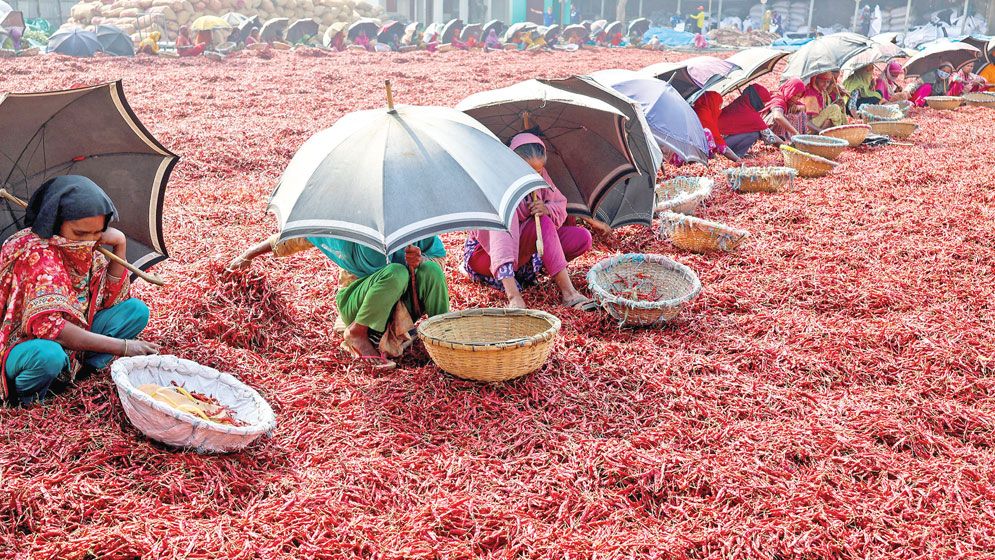
Female workers sort vast spreads of bright red chillies under a harsh sun, shaded only by worn umbrellas in Sariakandi, Bogura, on Thursday. These women endure a gruelling dawn-to-dusk shift in scorching heat, labouring for a meagre daily wage of just Tk250. - SM Mostafijur Rahman
 As the sun rises over the sprawling “char” lands of the Jamuna River, the horizon in Bogura turns a deceptive, brilliant crimson. Thousands of women descend upon the open courtyards known as chatals, their fingers moving with mechanical precision to collect the bad or damaged one from the better chilies. But while these “red peppers” are fuelling a multi-million-dollar export boom for Bangladesh, earning the crop the moniker “red gold”, the women behind the harvest are left with wages that barely cover a kilogram of rice and a litre of oil.
In the villages of Shariakandi, the daily wage for a female chili harvester has stagnated at a meager Tk250.
While Bogura’s chili industry has seen a massive transformation with exports reaching markets in the UAE, Saudi Arabia, and Europe the labor market remains stubbornly stratified.
Male labourers in the same region often command Tk400 to Tk500 for transport and heavy-lifting roles, while the meticulous work of harvesting and sun-drying, primarily performed by women, is undervalued.
“We start when the dew is still on the leaves and work until the sun goes down,” says Rahima Khatun, a 50-year-old worker in Fulbaria. “The heat from the sun is above us, and the heat from the chilies is in our hands. By evening, our fingers burn, but Tk250 is all we have to show for it.”
In 2026, the economic reality in Bangladesh makes Tk250 a difficult number to live on. With inflation impacting essentials like lentils, oil, and electricity, these women, many of whom are the primary breadwinners in households affected by river erosion, are forced to make impossible choices.
Working 8 to 10 hours daily in direct sunlight for a wage of only Tk250, these labourers endure a severe health toll that includes skin irritation, respiratory issues from chili dust, and chronic back pain.
Advocates for labour rights argue that as the chili sector graduates into a formal export industry, there must be a shift toward minimum wage enforcement and gender-neutral pay.
Bangladesh Nari Mukti Kendra president Seema Dutta said, “This is an example of the extent of labour discrimination women face in the rural economy. We are aware of the various ways tea garden workers are exploited, but sometimes conditions in the informal sector are even more dire. Because the informal sector lacks oversight, there is no mechanism to monitor what is happening.
“Owners are exploiting female workers in any way they can, often failing to treat them with basic human dignity. Furthermore, these women are also responsible for managing their households. We repeatedly call upon the government to take action to stop this exploitation and deprivation.”
Following the issue, Abdur Razzak, a manager of a well-known factory in Shariakandi said that over 200 female workers are employed here, and we pay them daily wages ranging from Tk200 to Tk250, consistent with the rates provided by nearby local crop-drying yards (chatals).
These workers are quite satisfied working with us because we provide a weekly incentive of Tk200 per person, along with an annual bonus of Tk5,000. Additionally, we serve special meals to the workers on our owner's birth and death anniversaries, and provide gifts and sweets during Pahela Baishakh.
Regarding the health and medical care of these impoverished workers, he said that over 80% of these women are above the age of 50; if any of them fall ill, they are taken to the local hospital and their initial medical expenses are covered.
Wishing anonymity, a female labourer in the factory said, “We only work here out of sheer necessity and because we have no other choice. A meager Tk250 is nowhere near enough for us, yet we are forced to work for this wage; if we ask for more, we are simply told not to come back. We have to work with pungent chilies under the scorching sun, which makes our eyes burn and breathing difficult, but there is really nothing we can do. We are essentially forced to come here and work for such low pay.”
Ultimately, as the harvest season nears its end, the red fields will eventually turn to brown. For the women of Bogura, the “red gold” remains a bittersweet crop, one that brings life to the district's economy but leaves their own pockets tragically empty.