


 For all latest news, follow the Daily Sun's Google News channel.


Justice within reach as legal aid becomes lifeline for vulnerable
National Legal Aid Day today

Ten years ago, Nargis (not her real name) was abandoned by her husband, who went on to remarry. In the aftermath, she entrusted Tk5 lakh in cash and her gold ornaments to her sister and elder brother for safekeeping.
On Monday, the woman, who has since been making ends meet as a domestic helper, presented herself at the Dhaka District Legal Aid Office to file a complaint against those very relatives, having failed over four years of repeated appeals to recover her assets from them.
In a separate case, Nobita (also a pseudonym) from Ashuganj in Brahmanbaria, also approached the Dhaka Legal Aid Office.
She alleged that on 26 April, around seven members of her husband’s family forced their way into her home, assaulted her and her father, and detained her two daughters. She further claimed to have endured sustained verbal abuse, threats of divorce, and domestic violence.
On Monday, she submitted an application seeking resolution of the family dispute through legal aid.
Like Nargis and Nobita, growing numbers of vulnerable women, children, and men are turning to legal aid offices across the country – some seeking redress for matrimonial disputes, others for the settlement of land conflicts.
The Directorate of Bangladesh Legal Aid (DBLA) ensures access to justice for all, with a particular focus on the poor and marginalised.
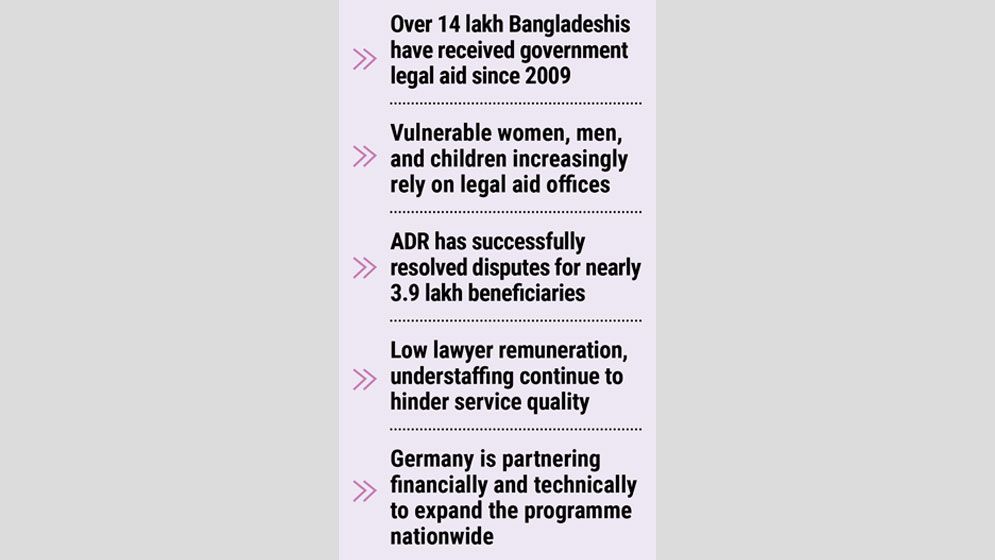
According to the DBLA, a total of 14,37,736 beneficiaries have received government legal assistance since its establishment in 2009 through to March this year.
Of these, 6.57 lakh are women, 7.04 lakh are men, and more than 75,000 are children.
The legal aid service also encompasses a hotline and alternative dispute resolution (ADR) provisions.
Data indicate that over two lakh people have availed themselves of the hotline service to date, whilst the number of beneficiaries in cases resolved through ADR stands at 3.9 lakh.
A further 30,000 individuals have received assistance from Legal Aid Cells in Dhaka and Chattogram.
Experts, however, have pointed to several areas requiring attention – among them lawyers’ remuneration, the appointment of additional officers, and the resolution of structural shortcomings – all of which, they say, would markedly improve the quality of the service.
Advocate Shamsuddoha Suman of the Dhaka District and Sessions Judges Court said the state’s obligation to provide legal services to all citizens was being largely fulfilled through legal aid.
“Poor, distressed, and helpless victims are receiving support at the district level,” he said, expressing hope that the services would expand further in the future.
Supreme Court lawyer Ishrat Hasan described legal aid as “a blessing for the justice system,” adding that if even 20 per cent of cases were resolved through it, the case backlog would be significantly reduced.
She cautioned, however, that many experienced lawyers were reluctant to participate owing to low remuneration, and noted that at the district level the service was being managed by a single officer – a provision she deemed wholly inadequate.
“Overcoming structural and manpower shortages, along with proper promotion of legal aid services, would make the system more effective and result-oriented,” she said.
The Law, Justice and Parliamentary Affairs Minister Md Asaduzzaman struck an optimistic note on Monday, saying the present government intended to bring legal aid services to people’s doorsteps.
He made the remarks whilst inaugurating a mobile legal aid camp at the Korail slum in the capital, held to mark National Legal Aid Day. Noting that legal aid activities in Bangladesh commenced in 1994 under the initiative of then prime minister Begum Khaleda Zia, the minister said the programme was being implemented with the German government as a development partner.
“It will be carried out across the country with their financial and technical support. I hope this joint initiative will play a significant role in ensuring justice for marginalised people across the country,” he said.
Describing the legal aid services as an important component of Prime Minister Tarique Rahman’s “Bangladesh First” initiative, the minister said coverage had been extended under the new programme to include not only the poor and destitute but also victims of political violence and torture, persons with disabilities, and citizens burdened with legal cases. He added that legal assistance would be ensured for families affected by the July mass uprising, with special emphasis placed on the protection of women and children.
The programme, he said, would provide crucial support to those unable to seek legal recourse owing to financial or social barriers, including victims of sexual violence and harassment.
Read More