



 For all latest news, follow the Daily Sun's Google News channel.


Bangladesh’s economic trajectory is no longer defined solely by infrastructure and industrial expansion. Technology-led innovation and an increasingly confident entrepreneurial culture are now assuming equal prominence.
Over the past decade, the country’s startup ecosystem has evolved from a nascent, idea-driven space into a more structured and investment-aware domain. It now stands at a critical inflection point where opportunity is substantial, but so too is the need for coherent policy, capital mobilisation and institutional coordination.
This shift is neither accidental nor spontaneous. It reflects a gradual but deliberate transition from fragmented entrepreneurial activity to ecosystem thinking. Increasingly, the conversation is no longer about “creating startups” but about “building scalable, investable ventures” within a supportive framework.
Government initiatives are playing a catalytic role in this transformation. The Digital Entrepreneurship and Innovation Ecosystem Development (DEIED) project, led by the Bangladesh Hi-Tech Park Authority under the ICT Division, signals a more strategic approach to nurturing innovation. Through its Startup and Scaleup Programme (SSP), the focus has expanded beyond training to include investment readiness, market linkage and sustainable business growth. In essence, the effort is to connect the dots—skills, capital, networks and opportunity—into a functioning ecosystem rather than isolated interventions.
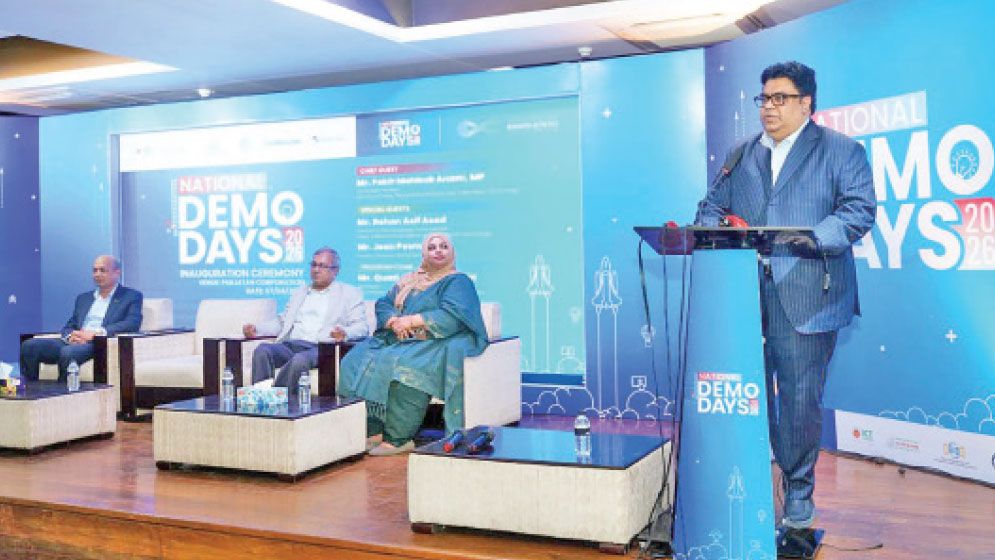
The recent “National Demo Day 2026” offered a timely snapshot of this evolution. More than a showcase, it functioned as a convergence point where startups, investors, policymakers and enablers engaged in real-time dialogue. The numbers are telling: over a thousand startups trained, with more than 300 advancing to the scale-up stage. These are not just statistics; they reflect a pipeline that is gradually maturing, producing ventures capable of attracting investment and generating measurable economic impact.
Yet, beneath the optimism lies a more nuanced reality. Bangladesh’s startup ecosystem is no longer struggling for visibility; it is now grappling with sustainability. The challenge has shifted from “starting up” to “scaling up”.
This was most evident in the panel discussion on “Startup Policy, Investment and Prospects”. The conversation moved beyond celebratory narratives to address structural bottlenecks—policy consistency, limited domestic investment participation, and gaps in market access. A key insight emerged: while international capital has shown interest, the ecosystem cannot revly solely on external funding. Local investors, institutions and corporate actors must step in with greater confidence and commitment.
Another critical takeaway is that funding alone does not define success. Startups require mentorship, regulatory clarity, cross-border exposure and integration into larger value chains. Without these, even well-funded ventures risk plateauing. In other words, capital can accelerate growth, but ecosystem depth sustains it.
There is also a broader strategic question at play: what kind of startup economy does Bangladesh want to build? One driven by quick valuations and exits, or one that prioritises long-term value creation, job generation and global competitiveness? The answer will shape policy choices in the coming years.
Encouragingly, there is a growing recognition that coordination is the missing link. Government agencies, financial institutions and private sector stakeholders are all active—but oftevvn in silos. Bridging these gaps could unlock exponential value. A more synchronised approach would not only reduce friction for entrepreneurs but also improve capital efficiency and market outcomes.
At its core, Bangladesh’s startup journey is entering a more demanding phase—one where ambition must be matched by execution. The ecosystem has proven that it can generate ideas and early-stage ventures. The next test is whether it can consistently produce companies that scale, compete and endure.
Platforms like Demo Day matter because they do more than showcase success; they force reflection. They bring stakeholders into the same room, surface hard questions and, crucially, push the conversation forward.
The direction is clear. Bangladesh is no longer an emerging startup market—it is an evolving one. The difference is subtle but significant. Emerging ecosystems chase possibility; evolving ecosystems build systems. The coming years will determine which path Bangladesh ultimately follows.
The writer is a tech freelancer.