



 For all latest news, follow the Daily Sun's Google News channel.


IT price shock puts govt projects at risk
As RAM prices jump up to 400%, contractors withdraw from bids, exposing vulnerabilities in public procurement processes

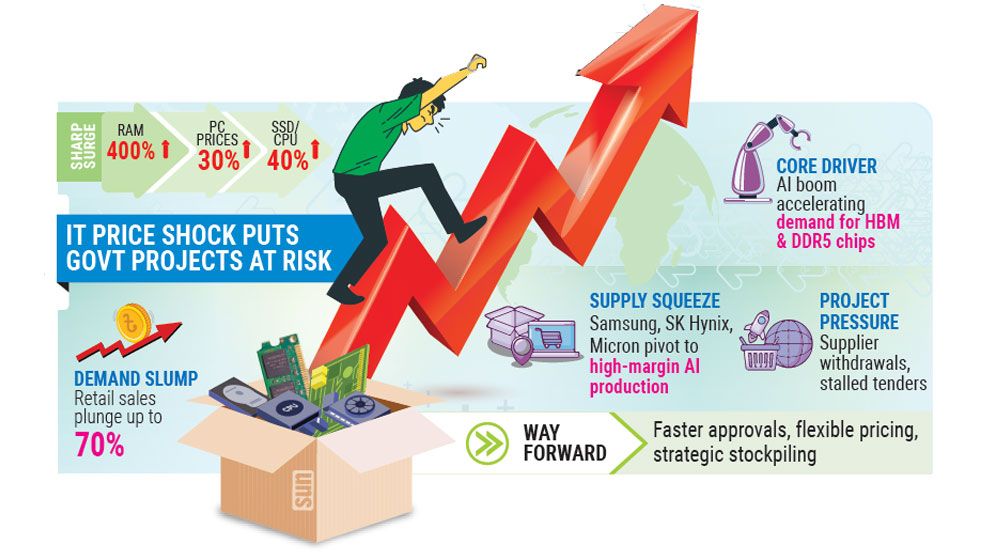
A global surge in IT equipment prices, driven by an unprecedented spike in memory costs, is threatening to derail the implementation timelines of several government projects in Bangladesh, as suppliers backtrack on previously quoted rates.
Market insiders say the disruption is being fueled by the explosive growth of artificial intelligence (AI), particularly generative AI, which has sharply increased demand for high-bandwidth memory (HBM) and DDR5 chips used in data centres.
According to IDC and TrendForce, the global storage market is in the midst of a prolonged two-year bull cycle.
To capitalise on AI-driven demand from North America and China, leading chipmakers such as Samsung, SK Hynix, and Micron have shifted production capacity toward high-margin AI components, tightening supply for conventional IT hardware.
The ripple effects have been stark. Memory chip prices have jumped by as much as 400% in recent months. A RAM module that cost Tk7,500 in October is now selling for up to Tk30,000.
Prices of SSDs and processors have risen by around 40%, pushing laptop and desktop prices up nearly 30%. At the same time, retail sales have slumped by up to 70%, reflecting a sharp contraction in demand.
Suppliers say the price volatility has made it commercially unviable to deliver products at earlier bid prices, placing multiple public procurement contracts in jeopardy. Many are now declining to proceed, raising the risk of re-tendering and further delays.
The Land Management Automation Project under the Ministry of Land highlights the growing strain. A tender floated on 18 December, 2025, for IT equipment supply resulted in a Notification of Award (NOA) on 19 February.
However, the selected supplier has since sought to withdraw, citing steep price hikes and supply chain disruptions.
In its communication, the supplier said executing the contract at the awarded price had become “commercially unfeasible,” despite efforts to renegotiate with manufacturers.
Project Director Md Parvez Hasan confirmed that the matter has been referred to the ministry, with work yet to begin following the supplier’s withdrawal request.
Procurement bottlenecks are amplifying the challenge. Lengthy approval processes for budget revisions or re-tendering are slowing project execution.
A case in point is the National Board of Revenue’s National Single Window (NSW) project. Despite issuing a tender in April 2025 for hardware, infrastructure, and software, no contract has been awarded even after a year, with bids yet to be opened.
Industry leaders warn of deeper market distortions ahead.
Smart Technologies (BD) Ltd, a major IT equipment supplier and distributor in Bangladesh, says rising costs are already disrupting the market.
Mujahid Al Beruni Sujan, director of channel sales at the firm, noted that the price of a 16GB RAM module has more than doubled in the global market – from around Tk7,000 to Tk15,000.
He added that motherboard prices have also increased due to higher memory and SSD costs.
Sujan also pointed to speculative stockpiling, saying some traders had accumulated inventory 7-8 months ago in anticipation of global price hikes. As a result, non-branded products have entered the market, often sold at inflated prices.
However, distributors were unable to build similar inventories due to regulatory and business constraints. He warned that unless import processes are eased, the market could stagnate in the future.
Sanjoy Sarkar of Global Brand PLC echoed similar concerns, noting that RAM prices have surged by up to 400% over the past year, making the market highly volatile.
“Global brands are revising prices within very short cycles. Dell offers price validity for just seven days, while HP extends it up to 21 days,” he said. “Retail sales have plunged, and we are unable to supply government projects at previously quoted rates.”
Experts caution that with a growing number of public projects reliant on IT procurement, escalating costs and bureaucratic inertia could significantly disrupt delivery timelines.
Analysts argue that policymakers must move beyond a “wait-and-see” stance by streamlining approvals, adopting framework agreements, and enabling strategic stockpiling. In the current climate, they warn, the cost of delay may far exceed the cost of early action.